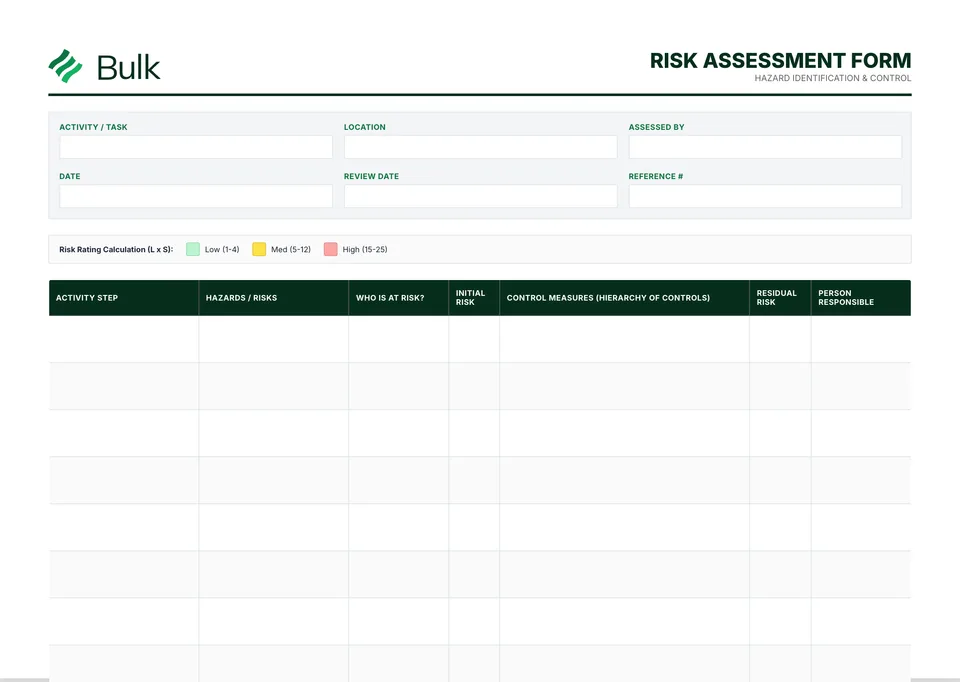
 Risk Assessment FormObserve the task with the people doing it, identify each hazard and who may be harmed, and use the site's agreed risk-rating definitions.
Hot Work Permit
Identify the job, location and proposed method, and consider whether the work can be moved or completed without hot work.
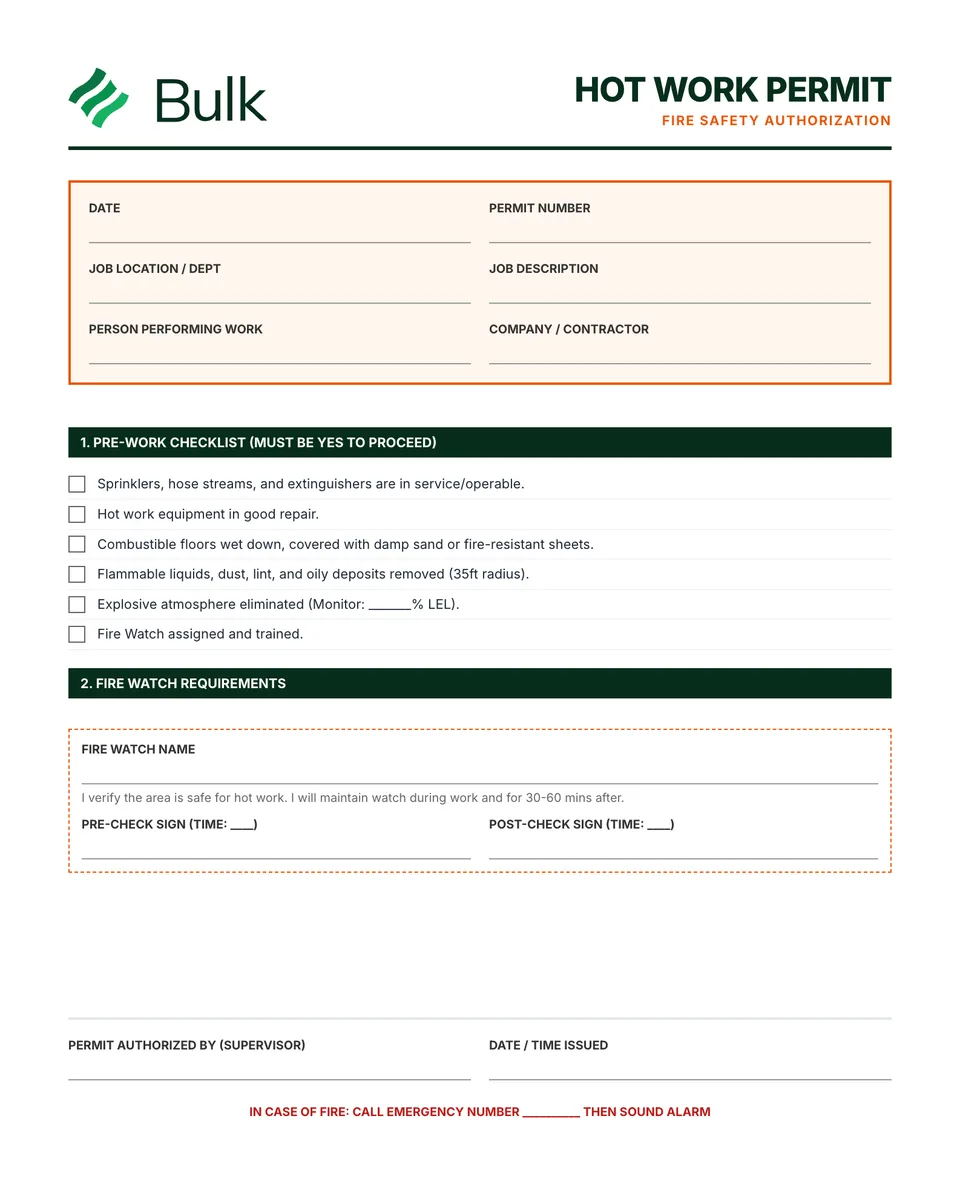
What it's for
This free hot work permit template records the precautions and site approval for one specified hot work job; an incomplete form is not permission. Use this hot work permit to keep the working record, its evidence and follow-up together. Identify the job, location and proposed method, and consider whether the work can be moved or completed without hot work. Use the site’s permit programme and applicable requirements.
What you can download
The PDF contains the original blank form, followed by a completed fictional example and a separate instructions page. Print only the blank pages for use at work; keep the example and guide as references. The download is free; enter your email to receive a secure link valid for seven days. Product-news consent is optional.
The blank permit is a single A4 page. It opens with the permit number, date, person performing the work, company or contractor, job location and description, and tick boxes for the type of hot work: welding, cutting, grinding, brazing or soldering, torch work or other. The pre-work checklist has Yes, N/A and reading or note columns in three groups. Equipment and fire watch covers sprinklers, hoses and extinguishers in service, hot work equipment in good repair, an extinguisher at the work area and a trained fire watch. Surrounding area covers removing flammable liquids, dust, lint and oily deposits, eliminating an explosive atmosphere (with a monitor reading in % LEL), wetting or covering combustible floors, shielding other combustibles and covering openings. Walls, ceilings and enclosed equipment covers the far side of walls and floors and cleaning and purging containers. The lower half names the fire watch and extinguisher, logs the post-work watch and monitoring checks, and holds the pre-check, post-check, issue and closure signatures.
What is hot work?
Hot work is any job that produces flame, sparks or enough heat to ignite something nearby: welding, flame or abrasive cutting, grinding, brazing, soldering and torch work are the usual examples. Sparks can travel a long way and smoulder unseen in dust, insulation or on the far side of a wall, which is why hot work outside a designated area is normally controlled by permit.
What a good hot work permit includes
- One job, one place, one time. A permit that covers “maintenance, all week” controls nothing.
- A check that hot work is needed at all. Cold cutting or moving the part to a designated welding bay may remove the risk.
- Verified precautions, each ticked by the person who checked it, with a reason recorded for every N/A.
- Readings where they matter, such as an atmosphere reading in % LEL where flammable vapour is possible.
- A named, trained fire watch with a suitable extinguisher and a way to raise the alarm.
- A post-work watch and closure. The permit stays open until the area has been checked and found clear.
How the hot work permit process works
- The requester describes the job, the location and the method, and the team confirms whether it can be done without hot work.
- An authorised reviewer inspects the area, including the far side of walls, floors and ceilings.
- Each precaution is verified and recorded, with the basis for any N/A, and a fire watch is assigned.
- The permit is issued for that job and location, and the work is carried out.
- When the work finishes, the finish time is logged and the post-work watch and monitoring checks are recorded.
- The supervisor closes the permit only once the watch is clear. If the request is declined, the form says so and no work takes place.
Hot work permit programme
The permit is one part of a wider hot work programme, sometimes called a hot work permit program. A typical programme sample sets out who may authorise permits, where hot work is allowed without a permit and where one is required, training for operators and fire watches, how long a permit stays valid, fire watch and monitoring arrangements, contractor controls and how records are kept. In the US, OSHA’s welding, cutting and brazing standard and NFPA 51B are common references; insurers often add their own conditions. This template gives the programme a consistent form to record against.
Completed manufacturing example
A proposed weld is not authorised because combustible residue remains and a fire watch has not been assigned. The form shows a clear hold rather than unchecked boxes being mistaken for permission.
Every unverified requirement remains unresolved. The example is a completed declined request, so there are no work-finished or post-work readings.
Permit HW-014 is a contractor’s request to weld a bracket in bay 4. The reviewer finds residue still in the area, the atmosphere assessment pending, most precautions not verified and no fire watch assigned, so the permit is marked “not authorised” at 09:00 and closed as held with no work performed.
Common hot work permit mistakes
- Ticking without checking. A box ticked from the office is not a verified precaution.
- Reading a blank as a yes. Anything not verified stays unresolved, as the example shows.
- Open-ended permits. A permit should cover a defined period set by the site programme, not stay live until someone remembers it.
- Forgetting the other side. Combustibles behind a wall or below a grating are a common cause of hot work fires.
- Closing too early. The permit is closed after the post-work watch, not when the welder packs up.
When to use this template
The form is not an independent fire-safety assessment. Fixed generic watch durations, distances or checkbox completion alone do not establish that a job is safe or authorised.
A template does not replace a competent fire risk assessment or the authorisation of the responsible person under your programme. For breaking a job into steps and hazards before the permit is requested, see the job hazard analysis template.
Reference guidance: OSHA: welding, cutting and brazing.
Continue with Risk Assessment Form, Confined Space Entry Permit, Safety Inspection Form.
For shared records, evidence and follow-up, explore Bulk safety. Start a free trial to run it live, no card needed.
How to use it
- Identify the job, location and proposed method, and consider whether the work can be moved or completed without hot work. Use the site's permit programme and applicable requirements.
- The authorised reviewer verifies each required precaution and records the basis for any N/A. Define the required watch and monitoring arrangements for the particular hazards and governing rules.
- Issue permission only when requirements are met. Record actual completion, watch/monitoring checks and closure; if the request is declined, clearly state that no work is authorised.
Key features
- Comprehensive fire hazard assessment checklist
- Combustible materials clearance verification
- Fire watch personnel assignment and requirements
- Fire extinguisher and emergency equipment checks
- Work area preparation and protection requirements
- Post-work fire watch and monitoring procedures
- Completed fictional example and instructions
Ideal for
- Safety managers controlling hot work operations
- Facility managers in areas with combustible materials
- Contractors performing temporary hot work in facilities
Common uses
- Reviewing a proposed welding or cutting task
- Recording site controls and fire-watch arrangements
- Documenting a task that cannot be authorised
Questions, answered.
01
What is a hot work permit?
A hot work permit is a written authorisation for one welding, cutting, grinding, brazing or other spark- or flame-producing job at a named place and time, issued only after the fire precautions have been checked.
02
Who can issue a hot work permit?
A person authorised under the site's hot work programme, after inspecting the work area and verifying the precautions. The form records who authorised the permit and who closed it.
03
How long should a fire watch last after hot work?
That depends on the rules that apply to your site, your insurer's requirements and the hazards in the area, so the template leaves the watch and monitoring periods for you to record. Close the permit only after the post-work watch is clear.
04
What is a hot work permit program sample?
A hot work programme is the site's written procedure covering who may authorise permits, designated and permit-required areas, training, fire watch duties and record keeping. This template is the permit form used inside that programme, not the programme itself.
05
Does a completed hot work permit make the job safe?
No. The permit records that precautions were checked; it does not replace a competent fire risk assessment or the judgement of the authorised person. Ticked boxes alone do not make a job safe.
Related templates.
Risk Assessment FormObserve the task with the people doing it, identify each hazard and who may be harmed, and use the site's agreed risk-rating definitions.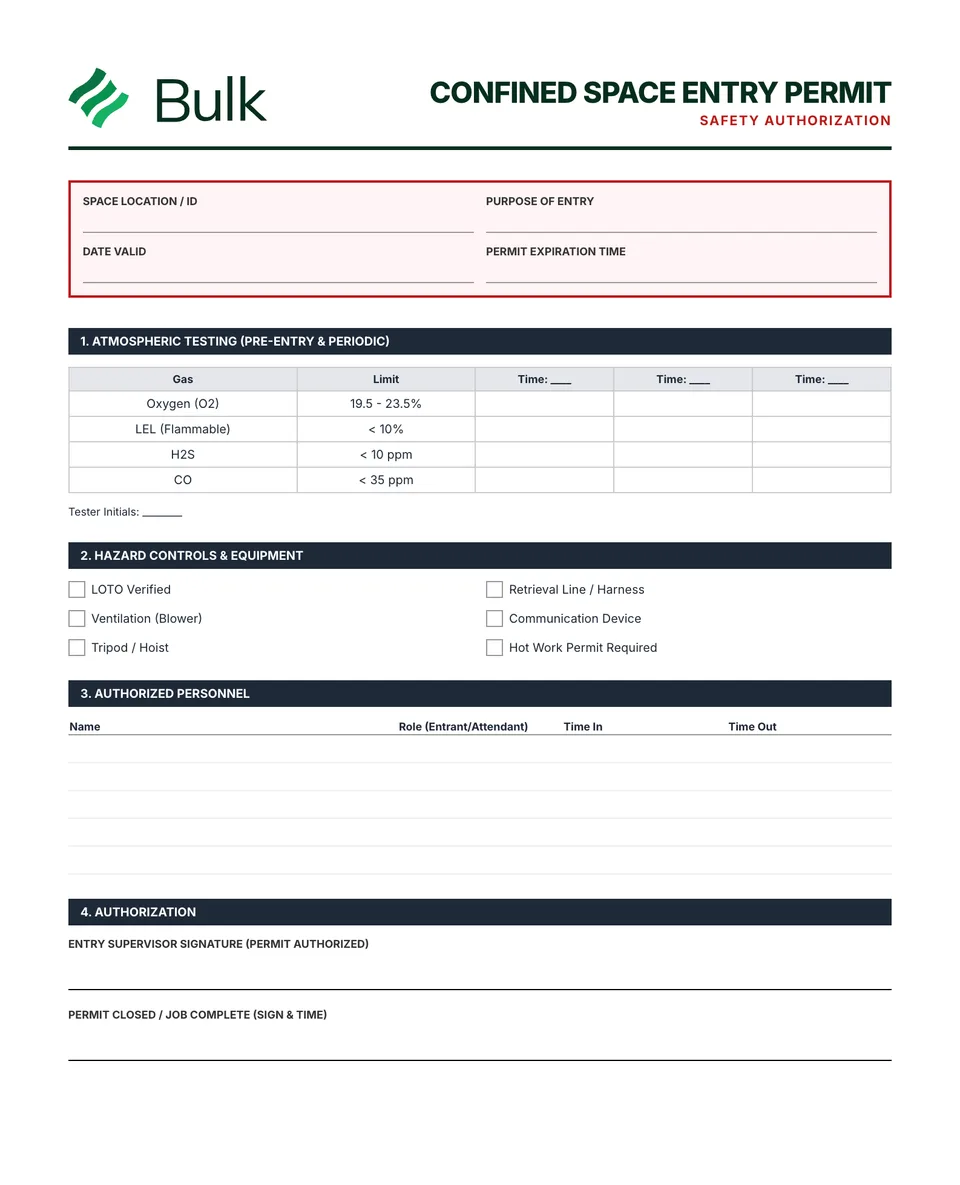 Confined Space Entry PermitDetermine whether entry can be avoided and classify the space under the applicable programme.
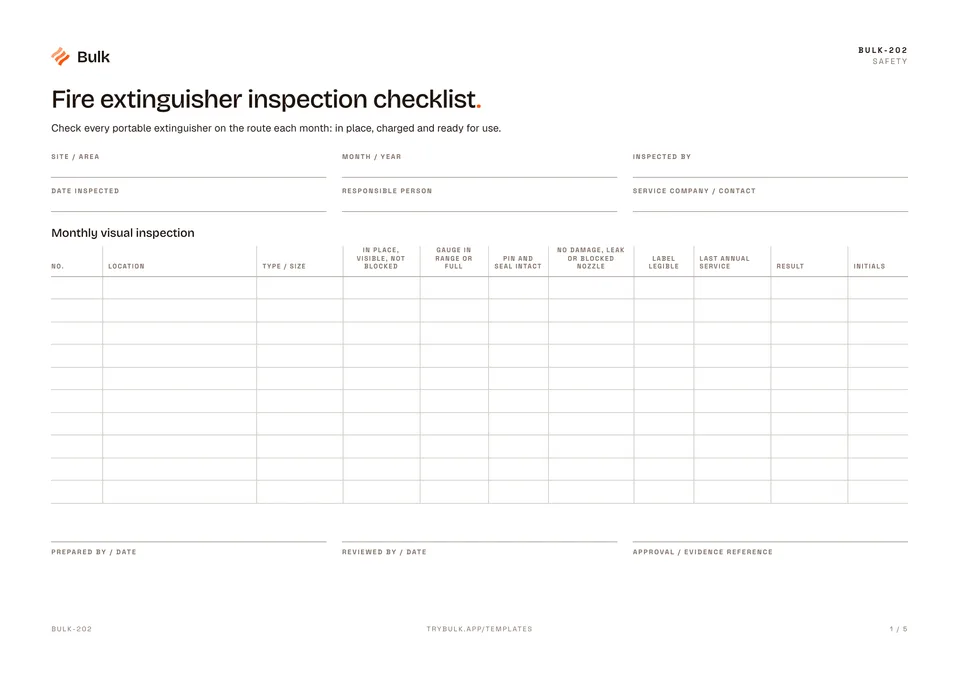 Fire extinguisher inspection checklistCheck every portable extinguisher on the route each month, record defects and keep the annual service dates in one place.
Turn the form into a live workflow.
Bulk connects the same checks, evidence, owners and approvals to the work happening on your floor.