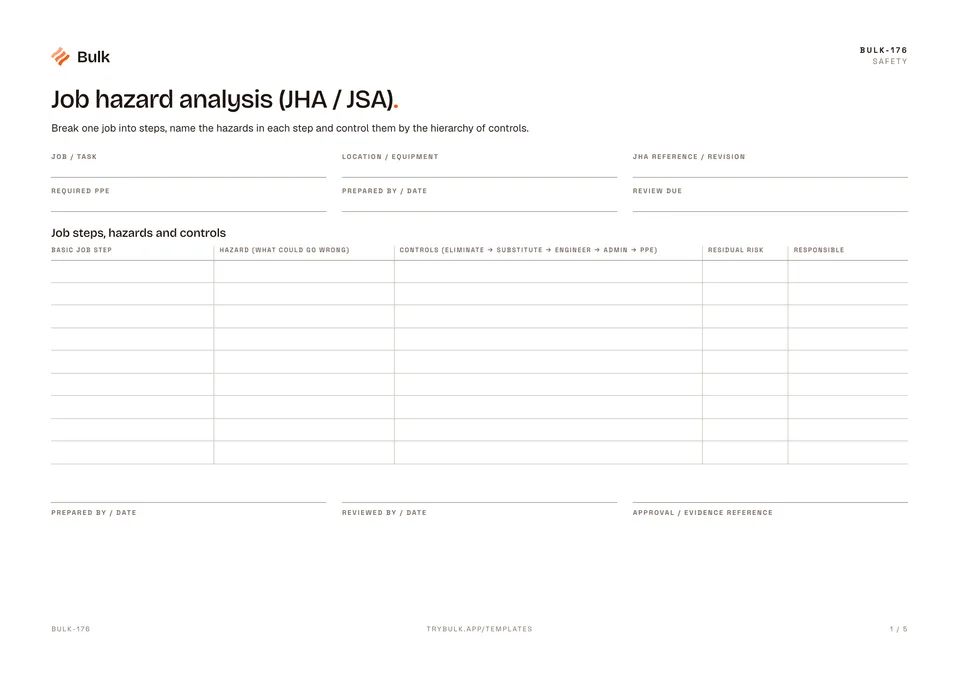
 Job hazard analysis (JHA / JSA)Break one job into steps, name the hazards in each step and control them by the hierarchy of controls.
Risk Assessment Form
Observe the task with the people doing it, identify each hazard and who may be harmed, and use the site's agreed risk-rating definitions.
What it's for
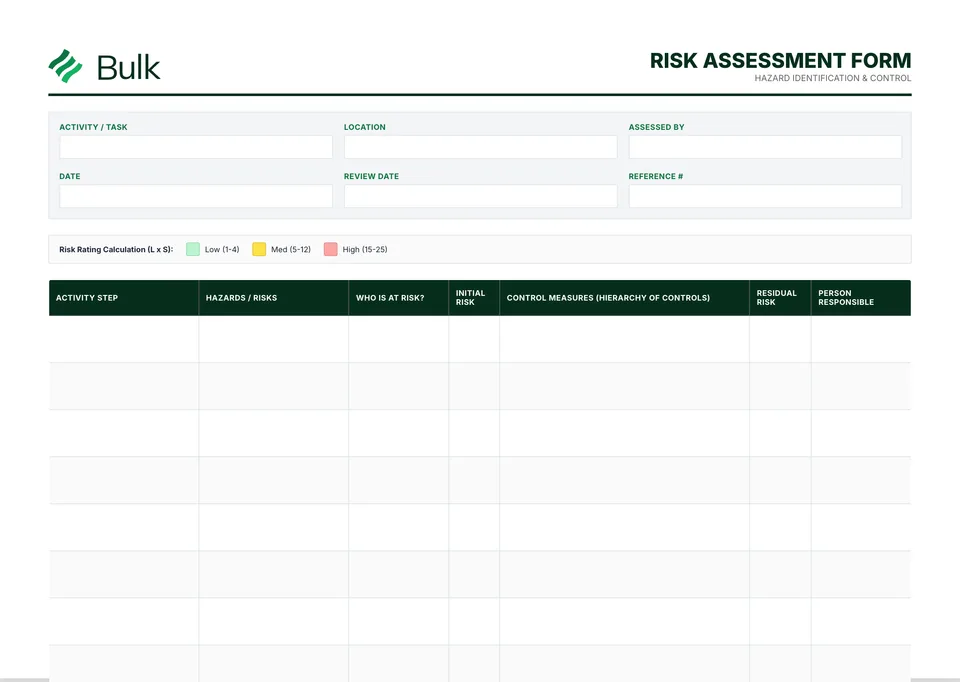
This free risk assessment template is a printable form for one task: break it into steps, rate the risk of each hazard, and record the controls, who owns them and when they are done. Observe the task with the people doing it, identify each hazard and who may be harmed, and use the site’s agreed risk-rating definitions.
What you can download
The PDF contains the original blank form pages, followed by a completed fictional example and a separate instructions page. Print only the blank pages for use at work; keep the example and guide as references. The download is free; enter your email to receive a secure link valid for seven days. Product-news consent is optional.
The blank risk assessment form is two landscape pages. Page one carries the activity or task, location, reference number, assessor, date and review date, a 5x5 risk matrix (risk = likelihood × severity; low 1–4, medium 5–12, high 15–25) and the hierarchy of controls numbered from 1 eliminate to 5 PPE. The hazard table follows, one row per hazard in job-step order: activity step, hazards, who is at risk, initial likelihood, severity and risk, control measures, control level, residual likelihood, severity and risk, person responsible, target date and done date. Page two continues the table to 15 rows and closes with the assessor signature and EHS manager approval.
What a good risk assessment includes
- A defined task and location. One activity per form, so the hazards and controls stay specific.
- Steps in the order they happen. Hazards are easier to spot, and harder to miss, when the job is broken down.
- Who could be harmed. Operators, pedestrians, maintenance staff, contractors and visitors are affected differently.
- An initial score using agreed definitions. Everyone on site should mean the same thing by “likely” or “major”.
- Controls from the top of the hierarchy. Eliminate or substitute where possible; engineering controls before procedures, signs and PPE.
- An owner and a date for each control. Without them, the assessment is a list of intentions.
- A residual score after verification. Rescore only when the control is in place and seen to work.
How to complete a risk assessment
- Choose the task and watch it being done with the people who do it. List each step in order.
- For every step, record what could cause harm and who could be harmed.
- Rate the initial risk with the site’s likelihood and severity definitions and note the score.
- Pick controls starting at elimination and write the control level (1 to 5) beside each one.
- Assign a responsible person and target date, and record the date the control was actually completed.
- Once the control is verified, rescore the residual risk. Severity usually stays the same unless the hazard itself has changed.
- Get the assessment approved, share it with the people doing the task, and set a review date.
Completed manufacturing example
A tray-transport assessment separates load movement from lifting. Controls target the task design and are checked again after implementation; severity is not reduced merely because a control was added.
The first example starts at likelihood 3 x severity 4 = 12. After a verified control, 1 x 4 = 4. The score supports discussion; it is not proof that a task is safe.
Assessment RA-014 covers tray transport in assembly aisle A2. Step one, moving a loaded tray, carries the risk of the load slipping into the aisle, affecting operators and pedestrians; a secured load and a separated route (an engineering control) bring it from 12 to 4. Step two, lifting the tray to the bench, starts at 3 × 3 = 9 for manual handling strain and falls to 3 after the lift aid and task design are reviewed. A final row schedules a review to confirm the controls still work after the change.
Risk assessment, JSA or JHA?
A risk assessment scores each hazard for likelihood and severity and shows how controls reduce the risk. A job hazard analysis (JHA), also called a job safety analysis (JSA), breaks one job into steps and records the hazards and the safe way to do each step, usually without a numerical score. Many plants keep a risk assessment for the task or area and use a JSA for a specific job on the day. If you need the step-by-step format, use the job hazard analysis template. Our guide on customising a risk assessment template covers adapting the rating definitions to your workplace.
Common risk assessment mistakes
- Rescoring before the control exists. A residual score for a control that is still planned gives false comfort.
- Lowering severity because PPE was added. PPE may reduce the chance of harm; it rarely changes how bad the harm could be.
- Copying a generic assessment. An assessment written for another site or task will miss the hazards that matter here.
- Relying on the bottom of the hierarchy. Training, signs and PPE are needed, but they depend on people getting it right every time.
- Never reviewing it. Tasks change; an assessment dated three years ago describes a different job.
When to use this template
The 5x5 matrix is illustrative. Risk acceptability, specialist assessments and legal duties cannot be determined by a generic score alone.
Reference guidance: HSE: managing risk.
Continue with Job hazard analysis, Incident Report Form, Safety Inspection Form.
For shared records, evidence and follow-up, explore Bulk safety. Start a free trial to run it live, no card needed.
How to use it
- Observe the task with the people doing it, identify each hazard and who may be harmed, and use the site's agreed risk-rating definitions.
- Consider elimination and higher-order controls before relying on instructions or PPE. Record the chosen controls, responsible people and completion dates.
- Reassess residual risk only after controls are verified. Review after changes, incidents or the agreed interval; escalate risks the site cannot accept.
Key features
- Job task breakdown into sequential steps
- Hazard identification for each job step
- Risk rating matrix (likelihood × severity)
- Control measures following hierarchy of controls
- Residual risk evaluation after controls applied
- Responsible persons and implementation timeline
- Completed fictional example and instructions
Ideal for
- Safety managers conducting workplace hazard assessments
- Operations managers planning safe work procedures
Common uses
- Reviewing a manufacturing task with its operators
- Assessing a change to equipment or work methods
- Verifying controls and reviewing residual risk
Questions, answered.
01
What is a 5x5 risk matrix?
It scores each hazard as likelihood (1 to 5) multiplied by severity (1 to 5), giving a risk from 1 to 25. This form bands the result as low 1–4, medium 5–12 and high 15–25; use your site's own definitions and bands where they differ.
02
What are the five steps of a risk assessment?
The widely used HSE approach is to identify the hazards, decide who might be harmed and how, evaluate the risks and decide on controls, record the significant findings, and review and update the assessment. The form has a place for each of those steps.
03
What is the difference between a risk assessment and a JSA or JHA?
A risk assessment rates each hazard for likelihood and severity and records how controls reduce the risk. A job safety analysis (JSA) or job hazard analysis (JHA) breaks one job into its steps and records the hazards and safe method for each, often without a score. For that format use the job hazard analysis template.
04
Does a completed risk assessment template make a task safe or compliant?
No. A template does not replace a competent assessment by people who know the work and the applicable legal duties. The score supports discussion; it does not prove that a task is safe.
05
How often should a risk assessment be reviewed?
Whenever the task, equipment, materials or people change, after an incident or near miss, and at the review date written on the form. Reassess residual risk once new controls are in place and verified.
Related templates.
Job hazard analysis (JHA / JSA)Break one job into steps, name the hazards in each step and control them by the hierarchy of controls.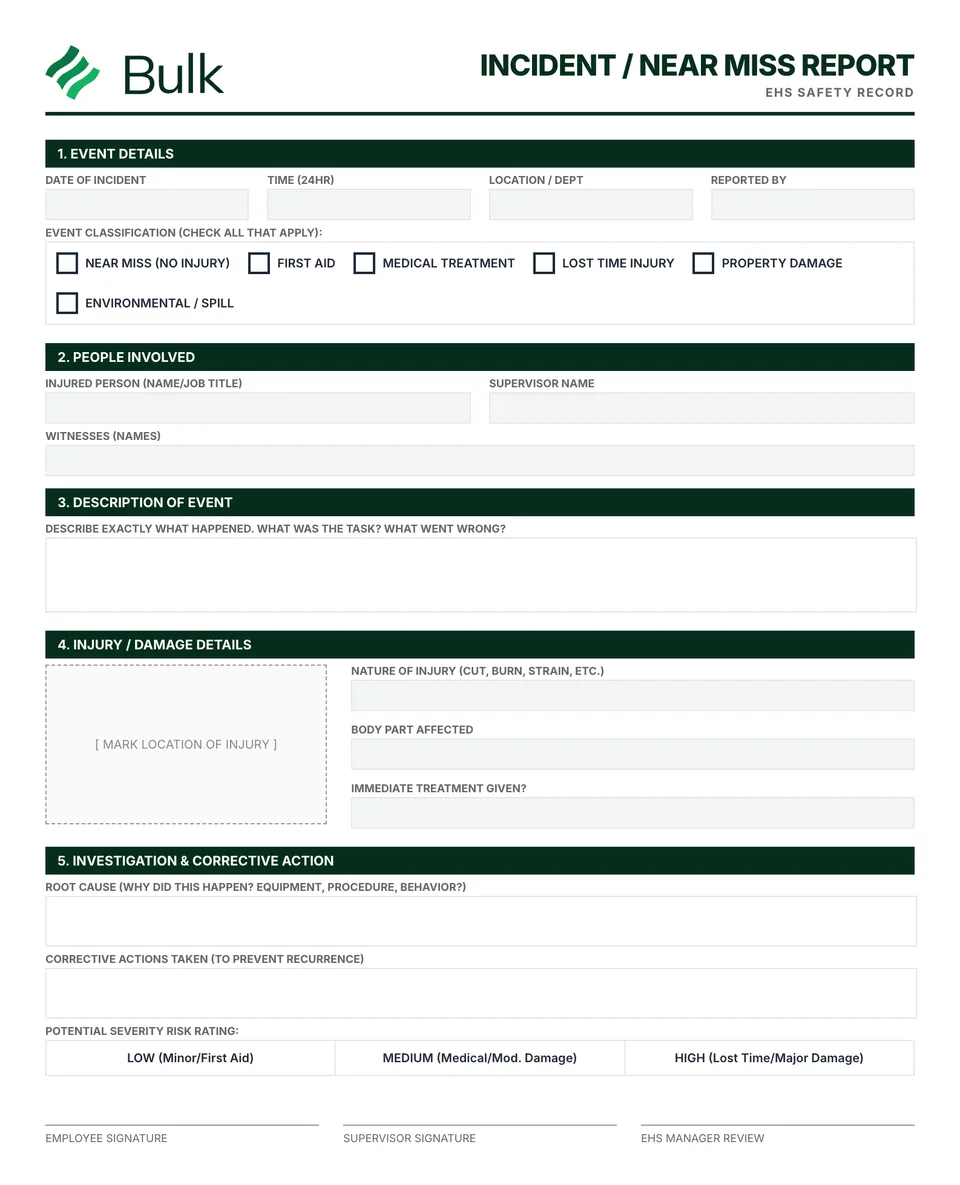 Incident Report FormFollow the emergency response process first.
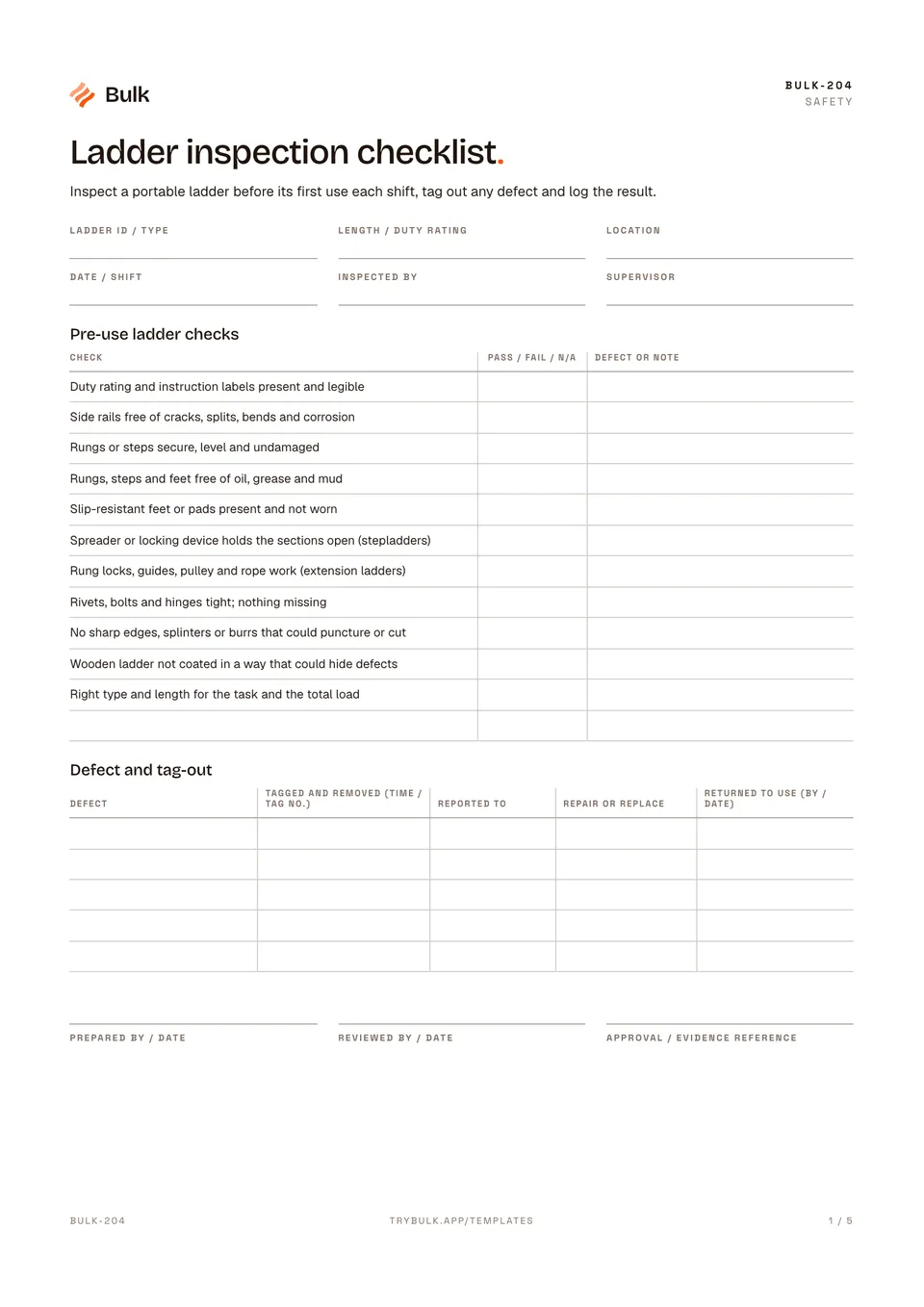 Ladder inspection checklistInspect a portable ladder before its first use each shift, tag out any defect and log the result.
Turn the form into a live workflow.
Bulk connects the same checks, evidence, owners and approvals to the work happening on your floor.