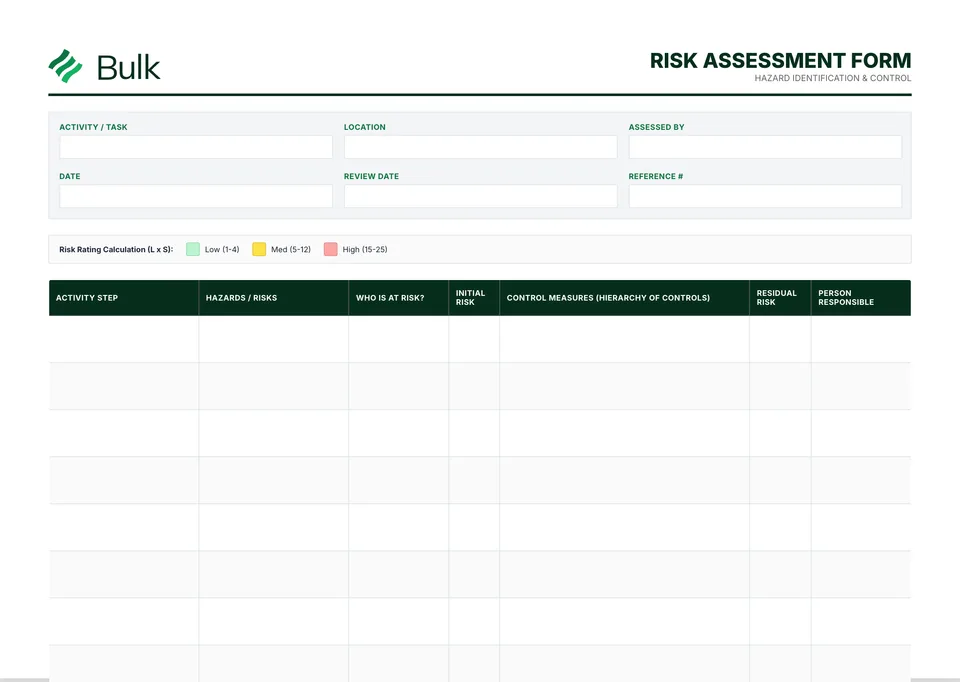
 Risk Assessment FormObserve the task with the people doing it, identify each hazard and who may be harmed, and use the site's agreed risk-rating definitions.
Incident Report Form
Follow the emergency response process first.
What it's for
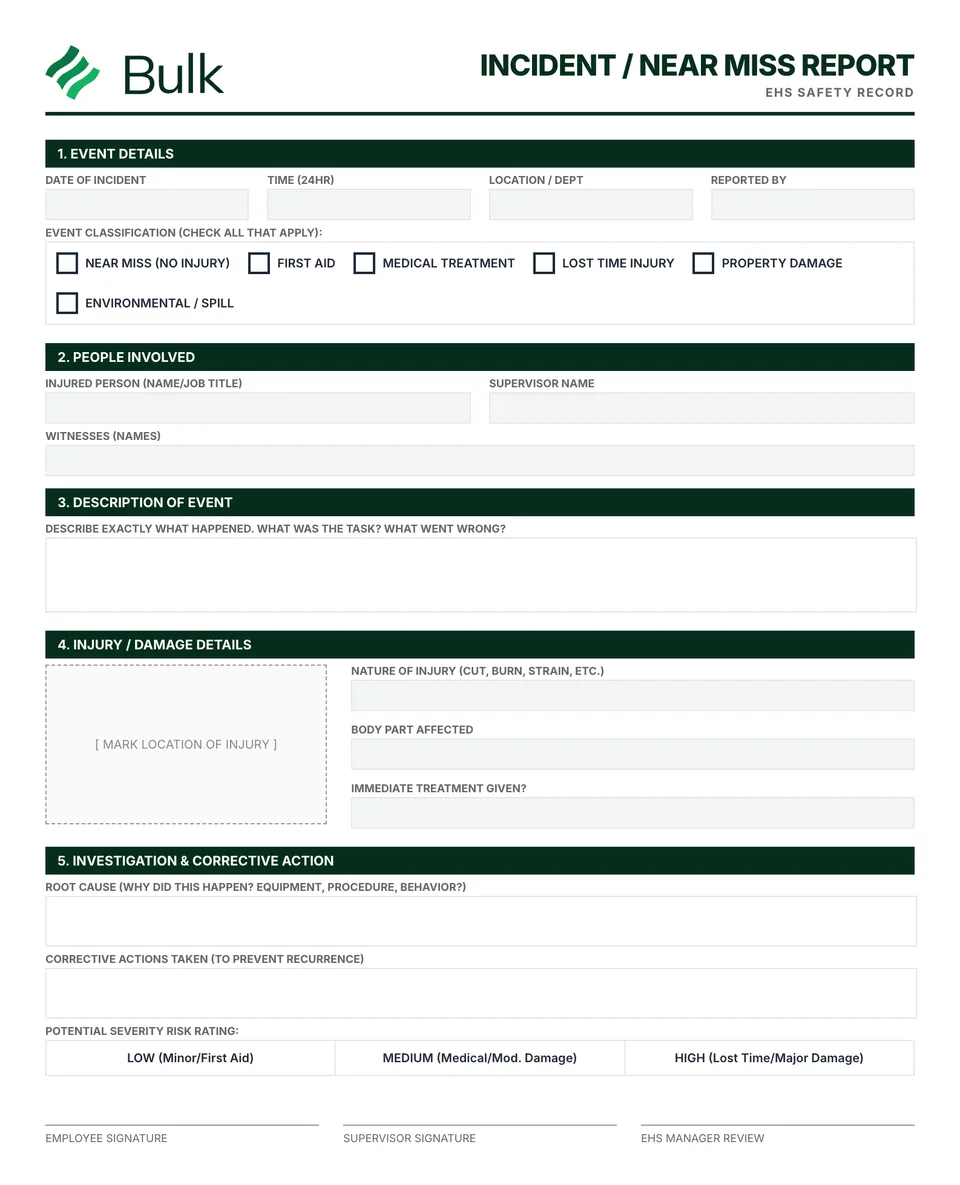
This free incident report form records any injury, near miss, property damage or spill as soon as it happens, then carries the report through to corrective action. Use this incident report form to keep the working record, its evidence and follow-up together. Follow the emergency response process first. Record who, what, where and when using factual observations, and protect sensitive personal information.
What you can download
The PDF contains the original blank form pages, followed by a completed fictional example and a separate instructions page. Print only the blank pages for use at work; keep the example and guide as references. The download is free; enter your email to receive a secure link valid for seven days. Product-news consent is optional.
The blank incident report template is two A4 pages. Page one records the report number, date and 24-hour time of the incident, location and department, who reported it and when, and an event classification with tick boxes for near miss, first aid, medical treatment, lost time injury, property damage and environmental or spill. A description box asks for facts in order, beside a response log timing when help was called, the area made safe, the supervisor notified and EHS notified. It continues with the people involved, a witness table, and injury and damage details with a front and back body outline, side of body, property damaged and any spill or release. Page two covers the conditions at the time (lighting, floors, housekeeping, weather or noise, equipment and guarding, PPE), immediate actions, the level of medical treatment, a preliminary root cause with contributing factor tick boxes, a corrective action table, potential severity, and employee, supervisor and EHS manager signatures.
What a good incident report includes
- Facts in time order. What the task was and what happened, with no speculation or blame.
- A response timeline. When help was called, the area made safe and people notified.
- Witness accounts taken while they are fresh, with contact details and whether a statement is attached.
- Conditions at the time. Lighting, floor, housekeeping, equipment and PPE, each marked OK or not.
- Immediate actions kept apart from causes. Isolating a machine is a control, not a finding.
- Corrective actions with owners and dates, and a potential severity rating so near misses are weighted properly.
How to complete an incident report
- Deal with the emergency first: first aid, making the area safe and calling for help.
- Start the report as soon as possible, with the date, time, location and classification.
- Describe the event in order using only what was seen, and log the response times.
- Take a statement from every witness and keep photographs and other evidence with the report.
- Record the conditions and the immediate actions taken.
- Note possible contributing factors, then investigate them properly, for example with a 5 Whys worksheet or a structured root cause analysis.
- Assign corrective actions with owners and dates, track them in a CAPA form, and check that they worked.
Completed manufacturing example
A tray enters a pedestrian aisle without causing injury. The example records the sequence, immediate controls and follow-up while keeping the cause open for investigation.
A near miss can have serious potential even when nobody is injured. No injury does not remove the need to investigate the tray-retention problem.
Report IR-014 records an empty tray sliding from trolley TR-02 into a marked aisle at 10:15; a pedestrian stops before contact. The area is made safe at 10:17, the supervisor told at 10:18 and EHS at 10:20, with a witness statement and photographs retained. The trolley is held for inspection. Two corrective actions follow, inspecting the trolley’s tray retention and reviewing the tray transport method, and the event is rated medium potential severity. The form notes that operator behaviour should not be assumed to be the root cause.
Near miss reports
A near miss is an unplanned event that could have caused injury, damage or a release but did not. The same form works as a near miss report form: tick Near miss, complete the description and conditions, and rate the potential severity rather than the actual outcome. Reporting near misses gives a plant the chance to fix a hazard before it hurts someone, which only works if people feel safe to report them.
Common incident report mistakes
- Writing opinions as facts. “Operator was careless” closes the investigation before it starts.
- Waiting. Witness recall and physical evidence degrade within hours.
- Closing on the immediate action. Removing the tray from the aisle is not the fix for why it slid.
- Storing medical detail too widely. Keep sensitive personal information to the people who need it.
- Assuming recordability from the form. Whether an event is legally reportable is a separate decision.
When to use this template
This internal report does not replace statutory reporting, medical records or jurisdiction-specific logs. Do not infer legal recordability from the example’s classification.
Reference guidance: OSHA: incident investigation.
Continue with Risk Assessment Form, CAPA Form (Corrective & Preventive Action), Safety Inspection Form.
For shared records, evidence and follow-up, explore Bulk safety. Start a free trial to run it live, no card needed.
How to use it
- Follow the emergency response process first. Record who, what, where and when using factual observations, and protect sensitive personal information.
- Retain witness accounts and evidence promptly. Separate immediate controls from suspected contributing factors and verified findings.
- Assign corrective actions, review their effectiveness and decide separately whether statutory reporting or recordkeeping duties apply. Track those duties through the responsible person.
Key features
- Complete incident details and timeline
- Injured person information and injury description
- Witness statements and contact information
- Environmental and equipment conditions
- Immediate actions taken and medical treatment
- Preliminary root cause and contributing factors
- Completed fictional example and instructions
Ideal for
- Supervisors and EHS teams recording incidents and near misses
- HR personnel managing workers
Common uses
- Recording a near miss or injury
- Retaining witness accounts and observations
- Tracking investigation and follow-up actions
Questions, answered.
01
What should be included in an incident report?
The date, time and location, who reported it, the type of event, a factual description in time order, the response times, the people and witnesses involved, any injury or damage, the conditions at the time, immediate actions, contributing factors, corrective actions with owners, and the review signatures.
02
Can I use this form as a near miss report form?
Yes. Tick Near miss in the event classification and complete the same sections. Record the potential severity, because a near miss with serious potential deserves the same investigation as an injury.
03
Who should fill in an incident report form?
Usually the person involved or the first person to see or report the event, together with their supervisor. The form has signature lines for the employee, the supervisor and an EHS manager review.
04
How soon should an incident report be completed?
As soon as people are cared for and the area is safe, ideally within the same shift while memories and evidence are fresh. Statutory reporting deadlines are separate and vary by jurisdiction.
05
Does this form replace OSHA or RIDDOR reporting?
No. This internal report does not replace statutory reporting or recordkeeping, such as OSHA injury and illness records in the US or RIDDOR reports in the UK. Decide separately, with the responsible person, which duties apply.
Related templates.
Risk Assessment FormObserve the task with the people doing it, identify each hazard and who may be harmed, and use the site's agreed risk-rating definitions.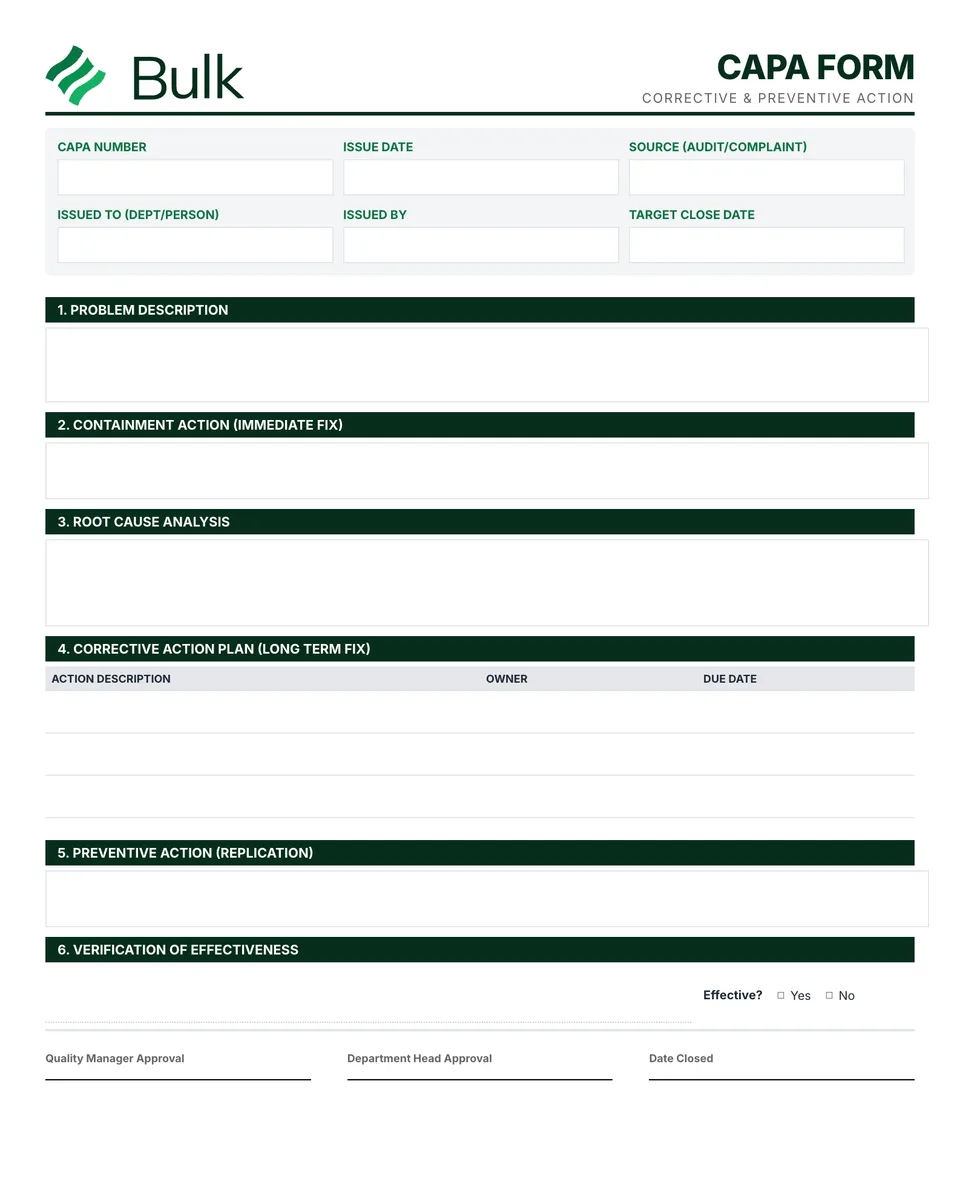 CAPA Form (Corrective & Preventive Action)Define the observed problem, scope and risk; link the NCR or complaint.
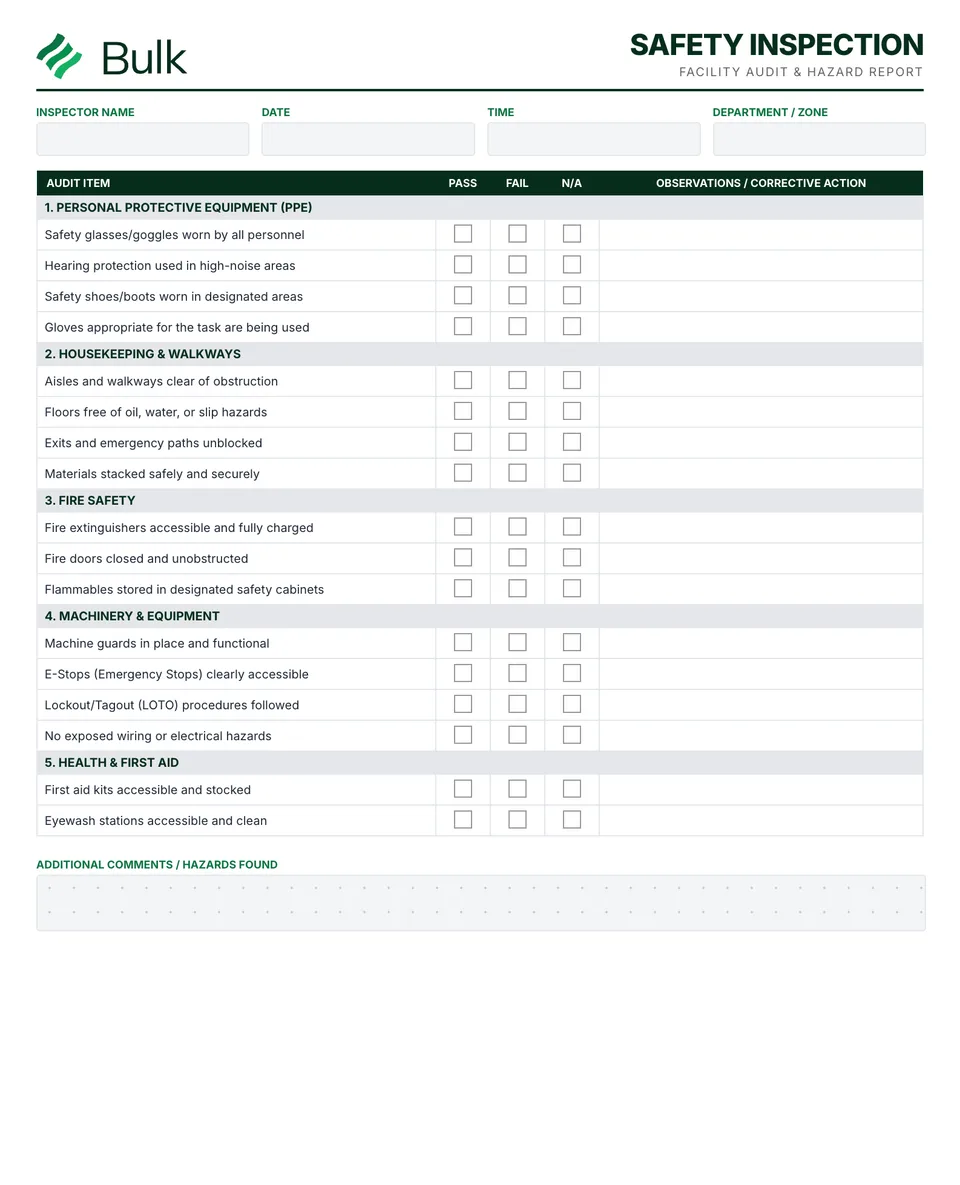 Safety Inspection FormDefine the area, scope and applicable checks with the responsible people.
Turn the form into a live workflow.
Bulk connects the same checks, evidence, owners and approvals to the work happening on your floor.