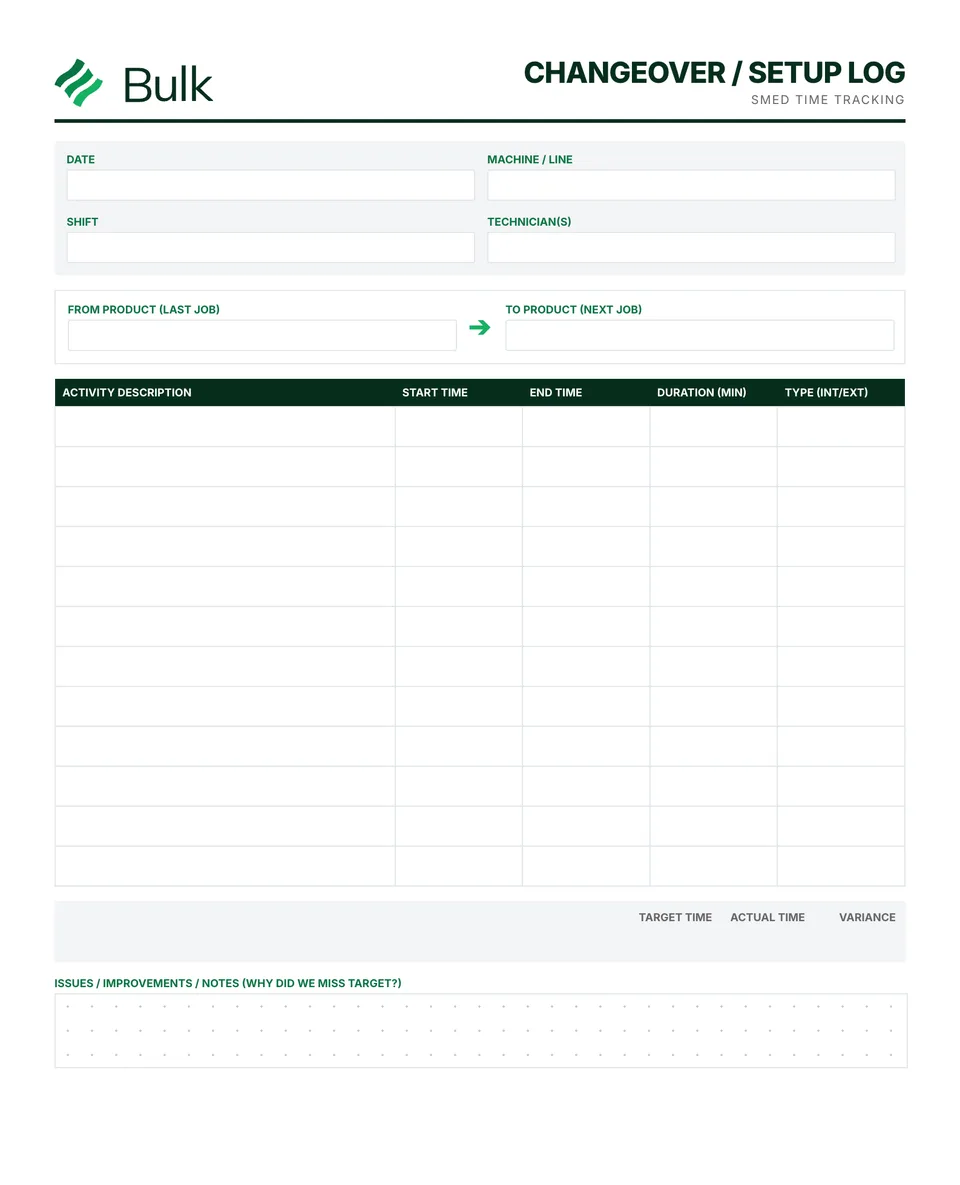
 Equipment Changeover LogAgree the start and end definition, products, team and target.
Kaizen Event Template
Agree the problem, scope, sponsor, team, baseline and measurable target before the event.
What it's for
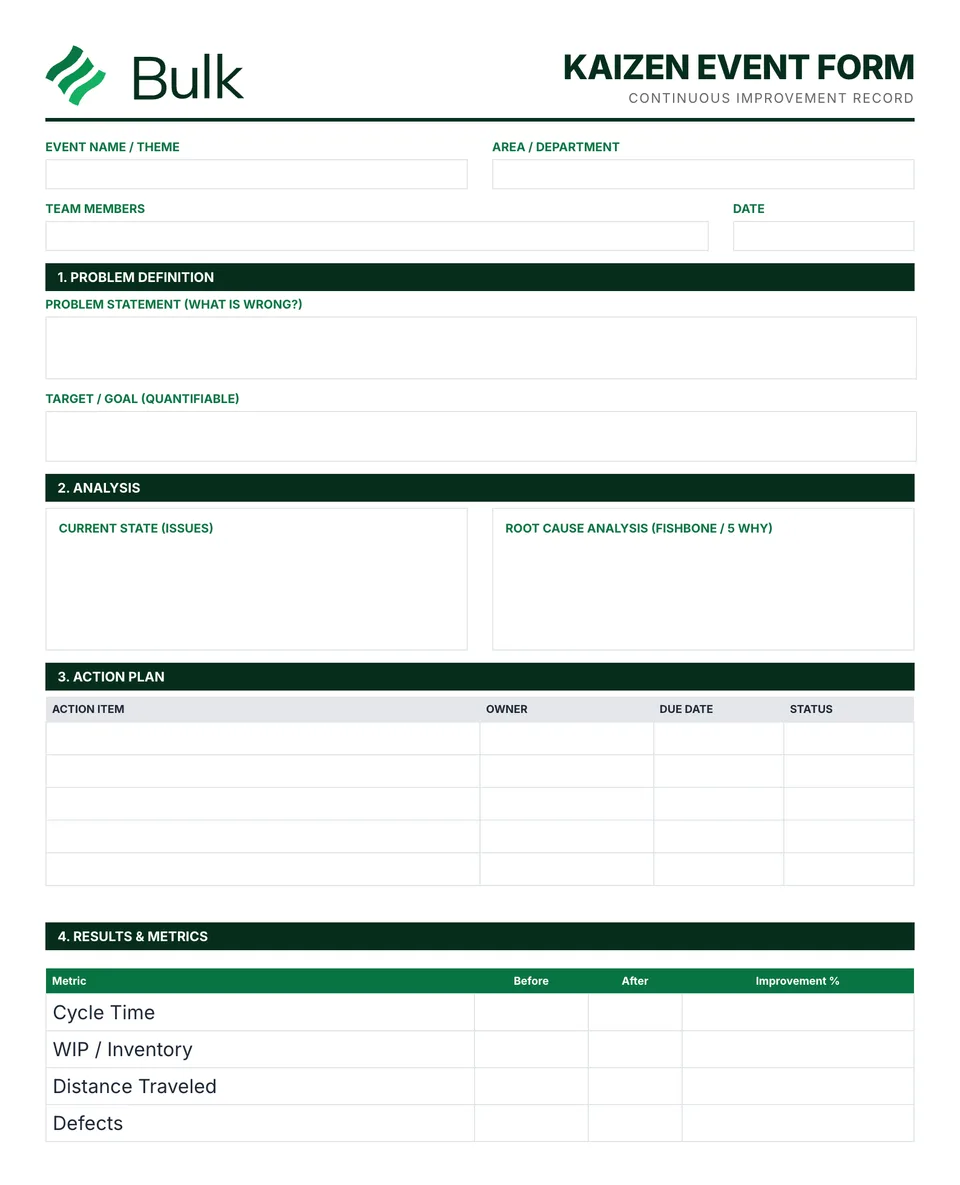
Use this kaizen event planning form to keep the working record, its evidence and follow-up together. Agree the problem, scope, sponsor, team, baseline and measurable target before the event. Include people who perform the work.
One kaizen template for planning and the report-out
The same form works before and after the event. Beforehand it is your kaizen event planning template: charter, scope, sponsor, team and baseline. Afterwards, the implementation, results and standardisation sections become the kaizen report you present at the report-out. For smaller improvements that do not need a full event, an A3 problem-solving sheet or a waste walk is often enough to start.
What you can download
The PDF contains the original blank form pages, followed by a completed fictional example and a separate instructions page. Print only the blank pages for use at work; keep the example and guide as references. The download is free; enter your email to receive a secure link valid for seven days. Product-news consent is optional.
Completed manufacturing example
A five-day event reduces observed changeover time from 40 to 30 minutes by preparing tooling before the stop. A later review confirms the revised process across three additional runs.
Time improvement is (40 - 30) / 40 = 25%. Distance improvement is (80 - 40) / 80 = 50%. Small sample counts are stated rather than presented as permanent performance.
When to use this template
An event plan does not prove a cause or guarantee a saving. Use a consistent measurement boundary before and after the change.
Continue with Equipment Changeover Log, A3 Problem Solving Template, Time-study worksheet.
For shared records, evidence and follow-up, explore Bulk production. Start a free trial to run it live, no card needed.
How to use it
- Agree the problem, scope, sponsor, team, baseline and measurable target before the event. Include people who perform the work.
- Observe the process, test causes and trial improvements with the required technical and safety review. Record decisions and assigned actions each day.
- Check results against the baseline, update the standard and train users. Hold a follow-up review after the event so apparent gains are tested in normal work.
Key features
- Event scope definition and goal setting
- Team member selection and role assignment
- Current state baseline metrics documentation
- Daily agenda and milestone planning
- Solution implementation tracking
- Results measurement and standardization plan
- Completed fictional example and instructions
Ideal for
- Lean facilitators leading improvement workshops
- Operations managers driving rapid process improvement
- Continuous improvement teams tackling specific problems
- Manufacturing leaders implementing lean transformation
Common uses
- Planning a focused improvement event
- Comparing observed before-and-after results
- Checking that a change is sustained
Questions, answered.
01
What is a kaizen event?
A focused improvement workshop, often three to five days long, in which a cross-functional team that includes the people who do the work studies one process, trials changes and standardises what works. It is also called a kaizen blitz or rapid improvement event.
02
What should a kaizen event template include?
The problem statement and scope, sponsor and team, baseline measures and target, a daily agenda, the changes trialled with owners, before-and-after results and a follow-up review date.
03
How do you measure kaizen results?
Measure the same thing in the same way before and after the change, then calculate the difference. In the worked example, changeover time falls from 40 to 30 minutes, a 25% reduction, and a later review checks three more runs.
Related templates.
Equipment Changeover LogAgree the start and end definition, products, team and target.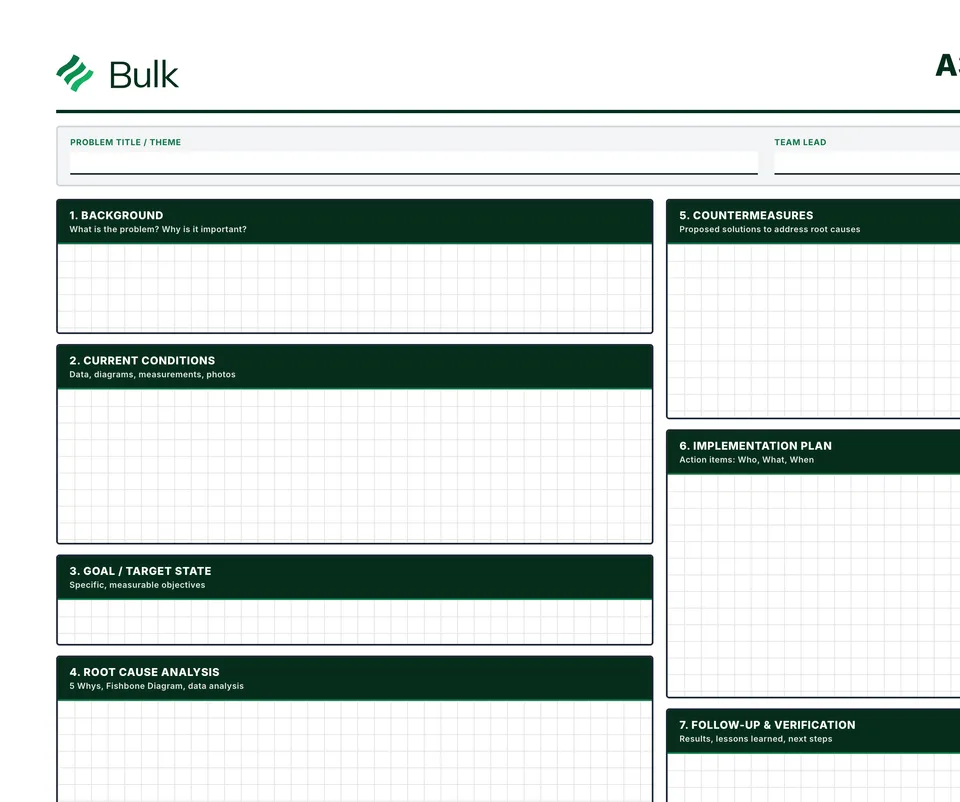 A3 Problem Solving TemplateDefine one problem, its boundary, the current condition and a measurable target.
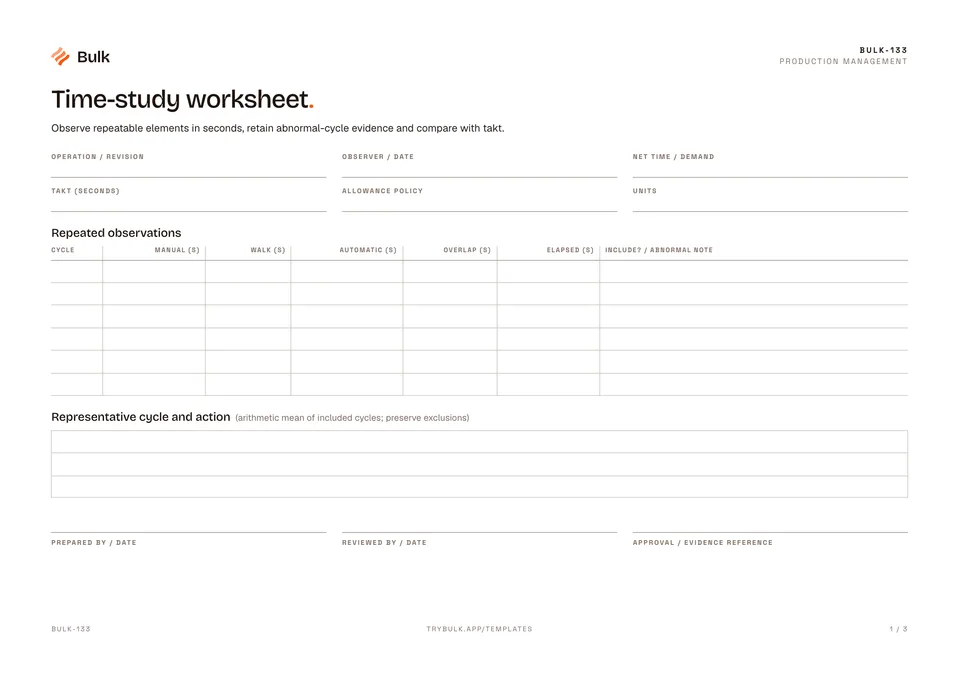 Time-study worksheetObserve repeatable elements in seconds, retain abnormal-cycle evidence and compare with takt.
Turn the form into a live workflow.
Bulk connects the same checks, evidence, owners and approvals to the work happening on your floor.