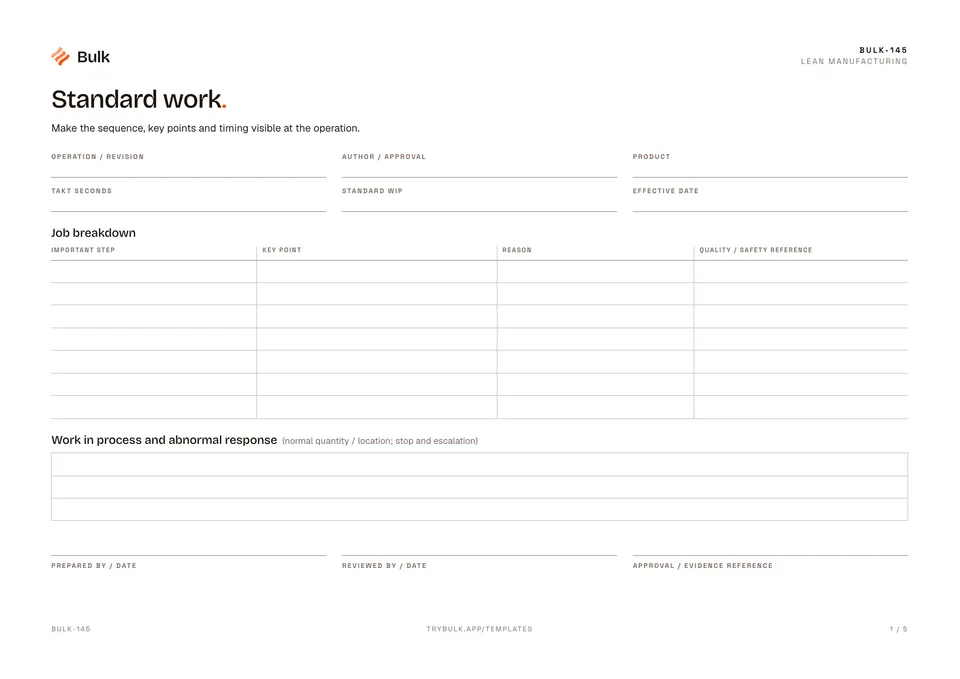
 Standard workMake the sequence, key points and timing visible at the operation.
Time-study worksheet
Observe repeatable elements in seconds, retain abnormal-cycle evidence and compare with takt.
What it's for
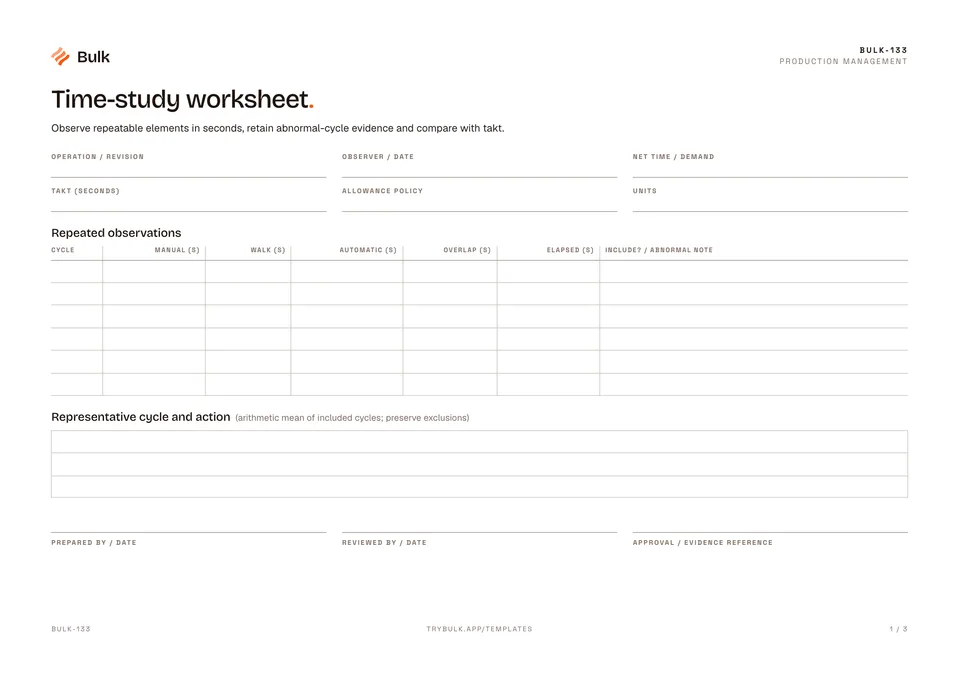
Observe repeatable elements in seconds, retain abnormal-cycle evidence and compare with takt. This is a manufacturing time study template (sometimes searched as a time and motion study template or time study sheet) for timing one operation on the shop floor, not a study planner.
What you can download
Available files: PDF, Excel. Each PDF includes the blank form first, a fictional completed example and instructions. The Excel workbook includes an unused template and a separate completed example, with labelled inputs, calculation cells and print settings. The download is free; enter your email to receive a secure link valid for seven days. Product-news consent is optional.
The blank worksheet is one A4 landscape page. The header records the operation and revision, observer and date, net available time and demand, takt in seconds, the allowance policy and the units used. The repeated observations table has one row per cycle with manual, walk, automatic and overlap time in seconds, the elapsed time, and whether the cycle is included or abnormal with a note. A representative cycle box holds the mean of included cycles and the action that follows, above a sign-off strip.
What is a time study?
A time study measures how long a trained person takes to complete a repeatable operation using the agreed method. The terms that matter:
- Observed time is what the stopwatch records for each cycle or element. Here each cycle is split into manual, walking and automatic (machine) time.
- Overlap is time when the operator works while the machine runs. It is subtracted once so it is not counted twice.
- Performance rating is the observer’s judgement of the pace against a defined normal pace of 100%. Normal time is observed time multiplied by the rating.
- Allowances add time for personal needs, fatigue and unavoidable delay, usually as a percentage. Standard time is normal time multiplied by one plus the allowance.
- Takt time is net available time divided by the good units required. It is the pace demand sets, not a measure of the work.
This worksheet records observed time and compares it with takt. It has an allowance policy field so the study states which policy applies, but it does not apply ratings or allowances itself.
From observed time to standard time: a worked calculation
Using the completed example:
- Elapsed time per cycle = manual + walk + automatic − overlap. Cycle 1 is 20 + 4 + 24 − 16 = 32 seconds.
- Included cycles of 32, 34 and 33 seconds give an observed mean of (32 + 34 + 33) ÷ 3 = 33 seconds. The 52-second cycle is kept on the sheet but excluded for a tool adjustment.
- Takt = 25,200 s ÷ 600 units = 42 seconds, so the observed mean leaves 9 seconds of margin.
- For illustration only, if a site’s method rated the pace at 100% and applied a 10% allowance, normal time would be 33 × 1.00 = 33 seconds and standard time 33 × 1.10 = 36.3 seconds. The worksheet itself stops at step 3.
How to do a time study
- Agree the purpose with the operator and supervisor, and choose a trained operator using the standard method.
- Define where each cycle starts and ends, and split it into manual, walking and automatic time.
- Time enough cycles to see normal variation, recording each measurement in seconds.
- Record overlap only when you actually observe it, and never more than the automatic time or the manual plus walking time.
- Mark any abnormal cycle with its reason and keep its measurements on the sheet.
- Calculate the mean of included cycles, compare it with takt and note the action.
Completed manufacturing example
Included elapsed cycles of 32, 34 and 33 seconds average 33 seconds. A 52-second cycle is retained but excluded with a tool-adjustment reason. Against a 42-second takt, the observed mean leaves nine seconds of margin.
Elapsed time equals manual plus walking plus automatic time minus observed overlap. The worksheet keeps the raw observations and exclusions visible; it does not apply performance ratings or allowances to create an engineered labour standard.
The study covers B42 drilling at revision C, observed by Lee on 14 September against 25,200 seconds of net time and demand for 600 units. Each cycle has 4 seconds of walking, 24 seconds of automatic time and 16 seconds of overlap, with manual time varying from 20 to 22 seconds in the normal cycles and 40 seconds in the abnormal one. The allowance policy field reads “No allowance added”.
Common time study mistakes
- Deleting slow cycles. Exclude abnormal cycles with a reason, but keep the measurements so the decision can be checked.
- Counting overlap twice. Adding operator and machine time together overstates the cycle.
- Timing without explanation. Operators who do not know why they are being timed rarely work at their normal pace.
- Too few cycles. One or two observations cannot show normal variation.
- Treating the mean as a labour standard. An observed mean is not an engineered standard until rating and allowances are applied by a defined method.
When to use this template
One repeatable operation only. No automatic performance rating, allowances or engineered labour standard.
Continue with Standard work, Spaghetti diagram, Manufacturing schedule.
For shared records, evidence and follow-up, explore Bulk production. Start a free trial to run it live, no card needed.
How to use it
- Define start/end points and measure manual, walking and automatic time separately in seconds.
- Overlap must be observed and cannot exceed either automatic time or manual plus walk time. Exclude an abnormal cycle only with a reason; retain its original measurements.
- Use the arithmetic mean of included elapsed cycles. Takt is net available seconds divided by required good units; this sheet does not establish staffing or safe pace by itself.
Key features
- Repeated observations
- Representative cycle and action
Ideal for
- Manufacturing engineers and operators studying cycle time together
Common uses
- Observing a repeatable operation before changing its sequence
Questions, answered.
01
What is a time study in manufacturing?
A time study is the direct observation and timing of a repeatable operation over several cycles to find how long it normally takes. It is used to compare the work with takt, balance a line, or prepare standard work.
02
How do you calculate standard time from a time study?
Normal time is the observed time multiplied by a performance rating, and standard time is normal time plus an allowance for personal needs, fatigue and delay. This worksheet stops at the observed mean; rating and allowances are applied separately under your site's method.
03
How is takt time calculated?
Takt time is net available working time divided by the number of good units required in that time. In the example, 25,200 seconds divided by 600 units gives a takt of 42 seconds per unit.
04
What is the difference between cycle time and takt time?
Cycle time is how long the operation actually takes, measured on the floor. Takt time is how often a unit must be finished to meet demand. A cycle time below takt leaves margin; above takt, the operation cannot keep up.
05
Is there an Excel version of the time study template?
Yes. The download includes an Excel workbook with an unused template and a separate completed example, labelled inputs, calculation cells and print settings, alongside the PDF.
Related templates.
Standard workMake the sequence, key points and timing visible at the operation.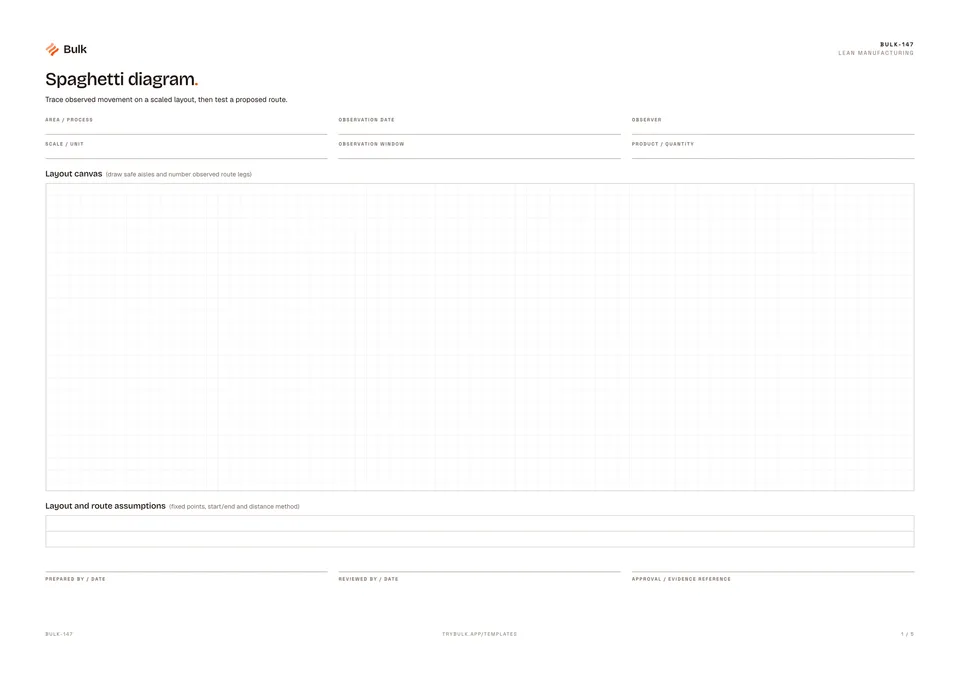 Spaghetti diagramTrace observed movement on a scaled layout, then test a proposed route.
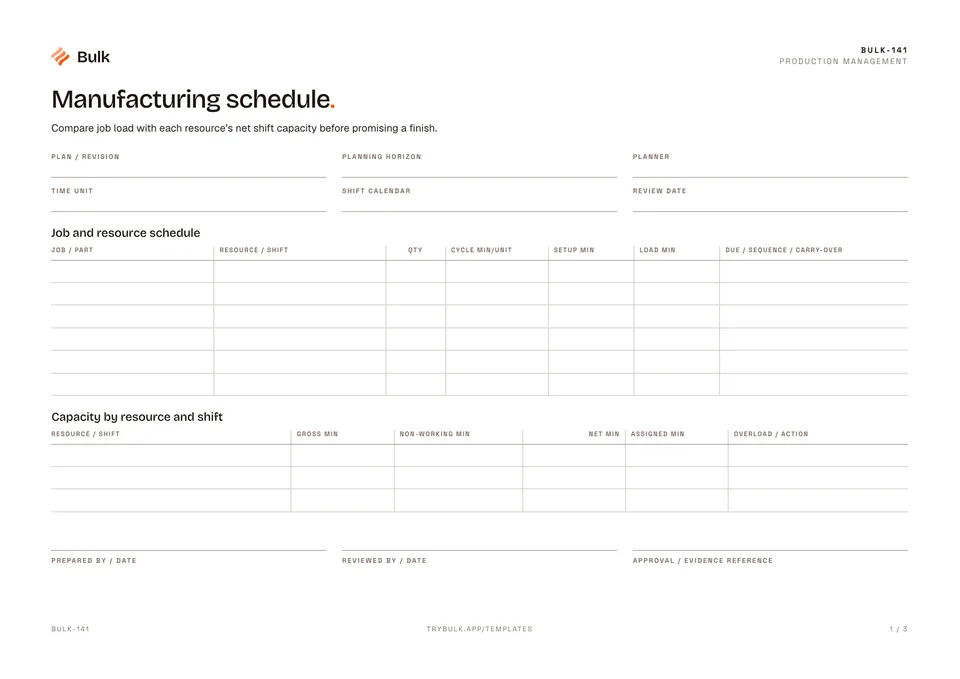 Manufacturing scheduleCompare job load with each resource’s net shift capacity before promising a finish.
Turn the form into a live workflow.
Bulk connects the same checks, evidence, owners and approvals to the work happening on your floor.