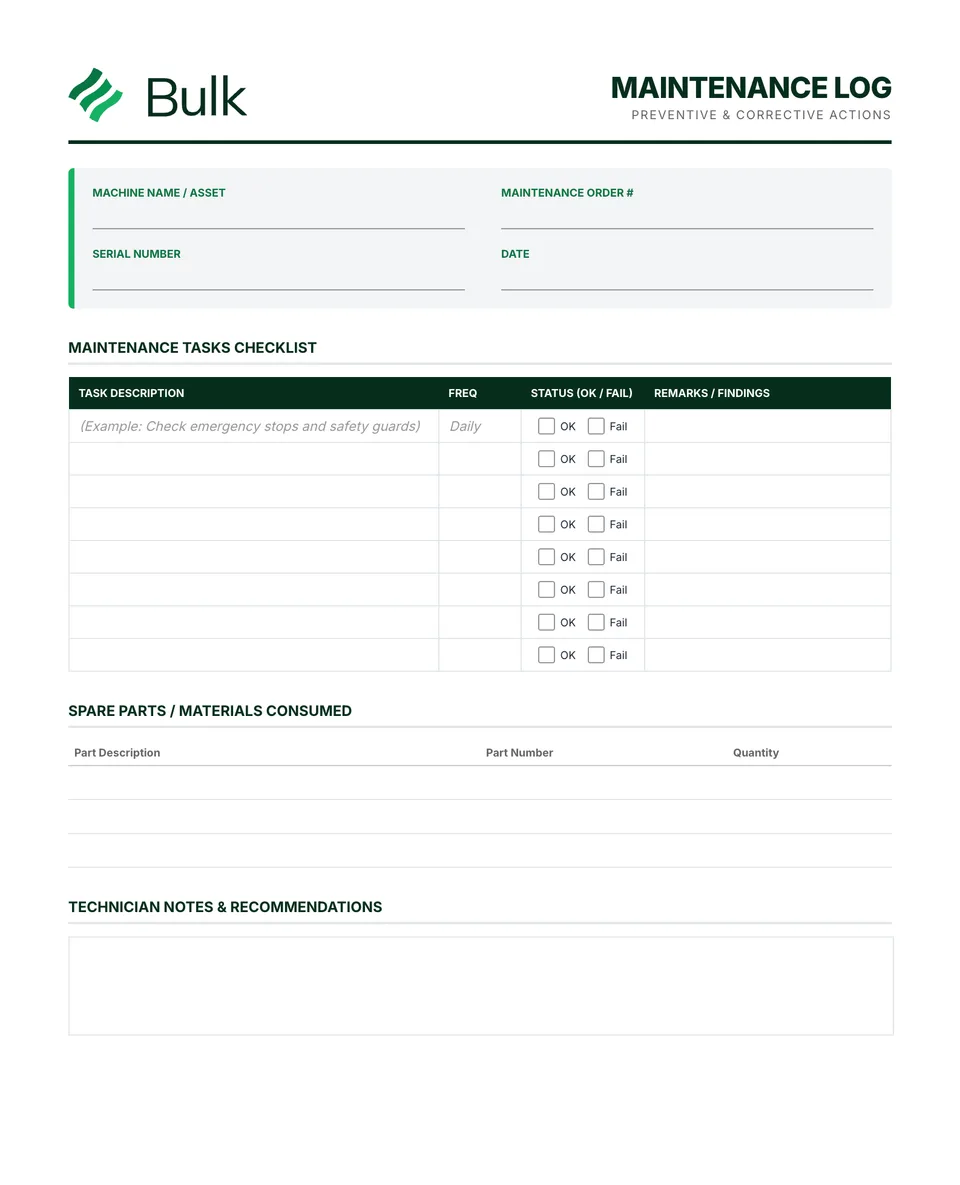
 Equipment Maintenance LogIdentify the asset and work order.
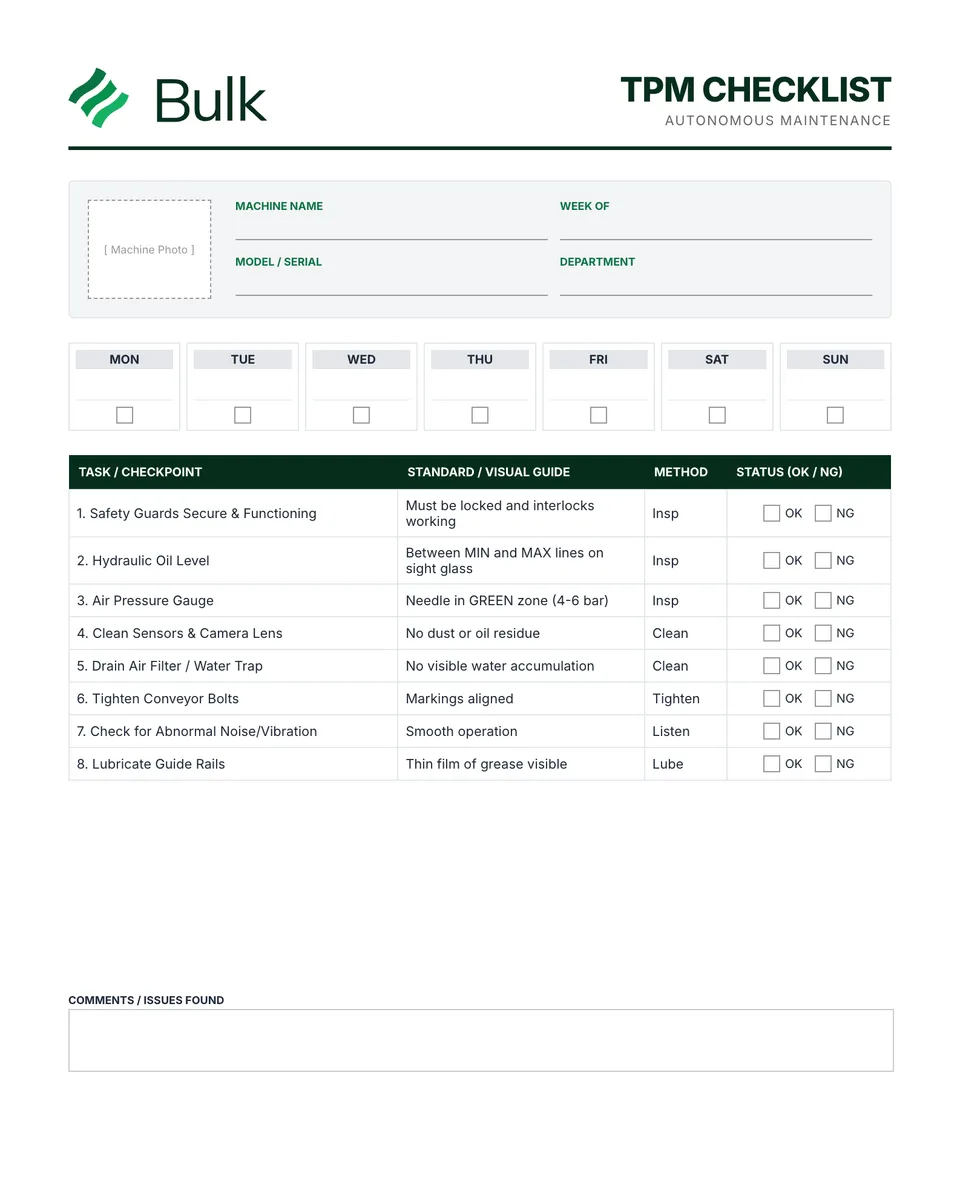
TPM Checklist (Total Productive Maintenance)
Match each task and standard to the actual asset and manufacturer's instructions.
What it's for
Use this TPM checklist (total productive maintenance) to keep the working record, its evidence and follow-up together. Match each task and standard to the actual asset and manufacturer’s instructions. Confirm which tasks operators are authorised to perform.
TPM checklist or autonomous maintenance checklist?
Autonomous maintenance (jishu hozen) is the TPM pillar in which operators take ownership of routine care for their own equipment: clean, inspect, lubricate, tighten and report abnormalities. An autonomous maintenance checklist is the daily record of that work, so in practice it is the same sheet most plants call a TPM checklist. Keep planned work on the preventive maintenance schedule and record repairs in the equipment maintenance log.
What you can download
The PDF contains the original blank form, followed by a completed fictional example and a separate instructions page. Print only the blank pages for use at work; keep the example and guide as references. The download is free; enter your email to receive a secure link valid for seven days. Product-news consent is optional.
Completed manufacturing example
A weekly operator-care record includes normal observations and a leak escalated to maintenance. The repair is closed only after a separate return-to-service check.
Green means the recorded check met its approved standard. Red records an abnormality requiring escalation; a later green does not replace the issue’s closure evidence.
When to use this template
Printed tasks, pressure ranges and intervals are examples for adaptation. This checklist does not authorise servicing, interlock testing or work beyond the person’s training.
Reference guidance: HSE: machinery maintenance.
Continue with Equipment Maintenance Log, Preventive-maintenance schedule, Lockout/Tagout Procedure (LOTO).
For shared records, evidence and follow-up, explore Bulk tasks and projects. Start a free trial to run it live, no card needed.
How to use it
- Match each task and standard to the actual asset and manufacturer's instructions. Confirm which tasks operators are authorised to perform.
- Record a result on each operating day. Use N/A for a non-operating day only when that is the agreed rule; do not mark an unchecked item green.
- Log every abnormality with its location, action and owner. Follow the site stop/escalation rule and obtain maintenance verification where required.
Key features
- Daily equipment cleaning and inspection checklist
- Lubrication points and frequency requirements
- Visual inspection criteria for wear and abnormalities
- Operator-maintainable items identification
- Problem reporting and escalation process
- Condition tracking with red/yellow/green status
- Completed fictional example and instructions
Ideal for
- Operators performing autonomous maintenance activities
- Maintenance managers implementing TPM programs
- Reliability engineers improving equipment availability
Common uses
- Recording authorised daily operator checks
- Reporting equipment abnormalities
- Linking a repair to return-to-service evidence
Questions, answered.
01
What is an autonomous maintenance checklist?
A daily list of the cleaning, inspection, lubrication and tightening tasks operators carry out on their own equipment, with the standard for each task and a place to report abnormalities. It is the working record of the autonomous maintenance pillar of TPM.
02
What are the pillars of TPM?
The commonly cited eight pillars are autonomous maintenance, planned maintenance, focused improvement, quality maintenance, early equipment management, training and education, safety, health and environment, and TPM in administration, usually built on a 5S foundation.
03
Which tasks can operators do under autonomous maintenance?
Only the tasks they are trained and authorised for, typically cleaning, visual inspection, lubrication at marked points and basic tightening. Servicing, interlock testing and repairs stay with maintenance unless the site has approved otherwise.
04
How often should a TPM checklist be completed?
Most operator checks are done at the start of each shift or operating day, with some weekly items. Set the frequency of each task from the manufacturer's instructions and your preventive maintenance schedule.
Related templates.
Equipment Maintenance LogIdentify the asset and work order.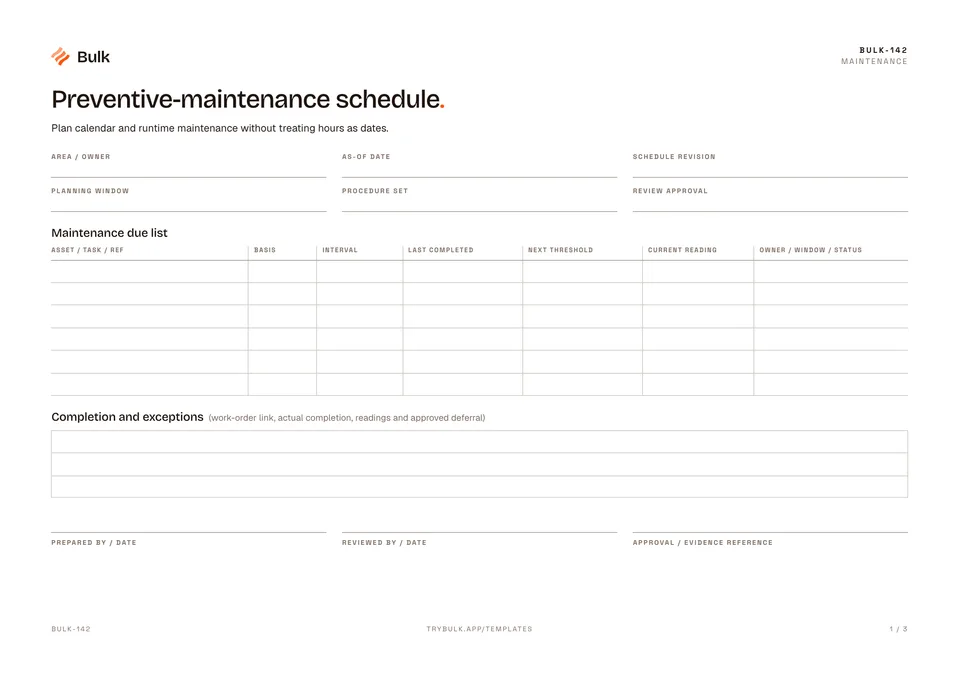 Preventive-maintenance schedulePlan calendar and runtime maintenance without treating hours as dates.
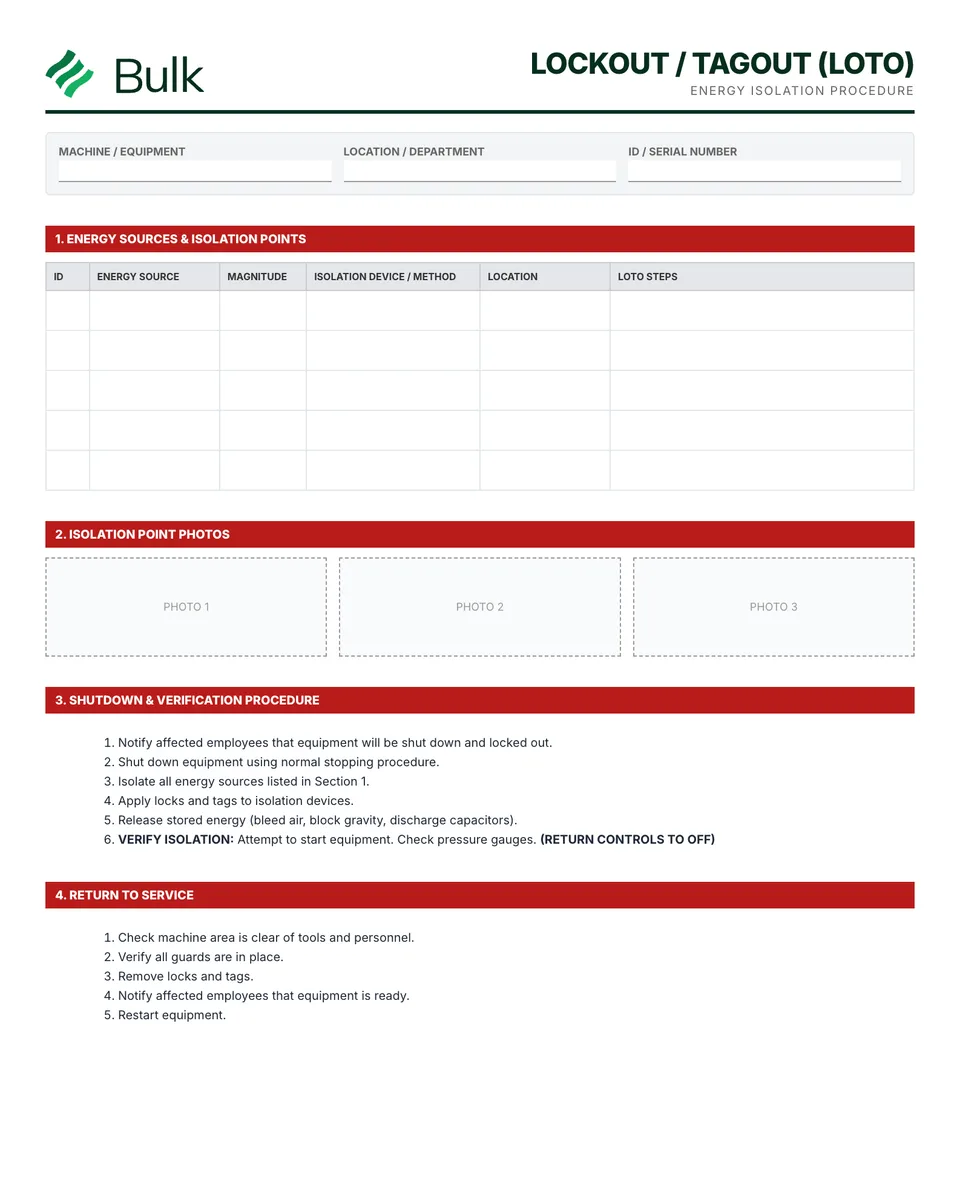 Lockout/Tagout Procedure (LOTO)Identify every hazardous energy source and the machine-specific procedure, including stored or residual energy.
Turn the form into a live workflow.
Bulk connects the same checks, evidence, owners and approvals to the work happening on your floor.