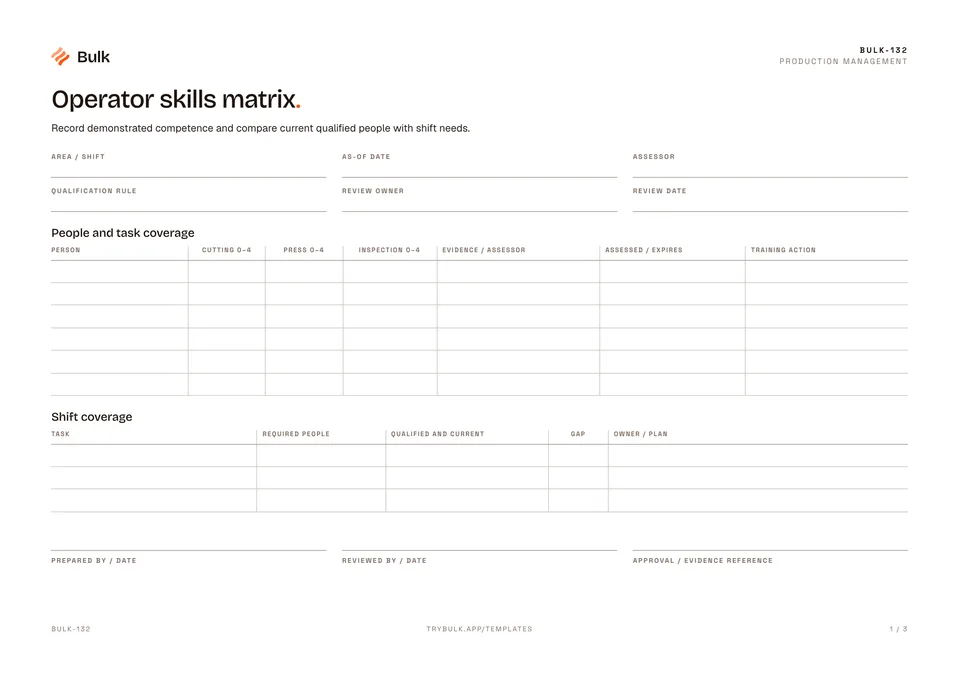
 Operator skills matrixRecord demonstrated competence and compare current qualified people with shift needs.
Employee training plan
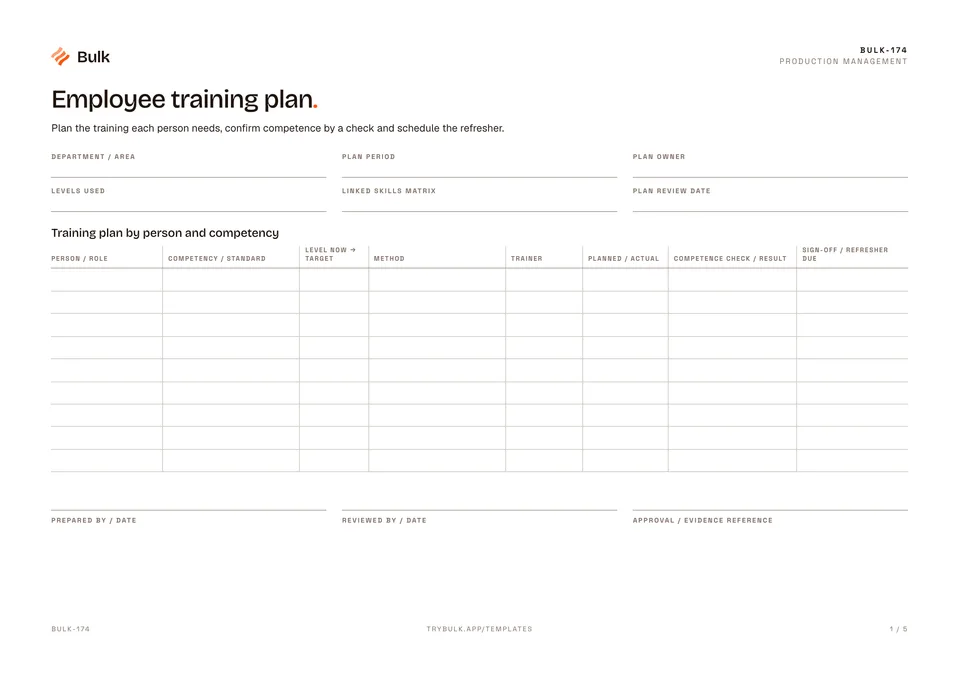
Plan the training each person needs, confirm competence by a check and schedule the refresher.
What it's for
Plan the training each person needs, confirm competence by a check and schedule the refresher.
What you can download
Available files: PDF. Each PDF includes the blank form first, a fictional completed example and instructions. The download is free; enter your email to receive a secure link valid for seven days. Product-news consent is optional.
Completed manufacturing example
A machining cell plans three months of training from its skills matrix. A setter moves from supervised to independent press-brake set-up through four supervised set-ups and an observed assessment. An operator learns the plug-gauge hole check from a one-point lesson and passes a ten-part gauge test. A new starter completes induction and lockout awareness in a classroom session with a quiz and walk-through.
One forklift refresher is still pending, so the plan records what happens if it is not completed in time. A second page shows the coverage gaps the plan closes: press-brake set-up goes from one qualified person per shift to two, and the gauge check from two to three.
When to use this template
Use it when a skills matrix shows gaps, when new starters join or when a process change needs people retrained. Attendance is not competence, so the plan records how each person was checked before sign-off. It is a planning record and does not replace statutory training, licences or site authorisation for safety-critical tasks.
Record who is qualified on the operator skills matrix, teach single steps with a one-point lesson and keep safety training evidence on the safety training record.
In Bulk, the Versatility Matrix shows each person’s level for every training program, expiry dates are set from each program’s validity, and alerts go out before training expires. Explore Bulk training and start a free trial to run it live, no card needed.
How to use it
- Start from the skills matrix: list the gaps against shift needs and the competencies each role requires.
- Choose the method that fits the task: on-the-job training for hands-on skills, a one-point lesson for one step or change, classroom for rules and awareness.
- Attendance is not competence. Record how competence was checked (observation, test, practical) and the result before signing off.
- Set a refresher date where the competency expires or the standard changes, and keep safety training evidence on the safety training record.
Key features
- Training plan by person and competency
- Coverage gaps the plan closes
- Plan review notes
Ideal for
- Team leaders and supervisors closing skills gaps on a line or cell
- Training coordinators scheduling on-the-job and classroom training
Common uses
- Planning the training that closes gaps found on the skills matrix
- Recording how competence was checked before sign-off
- Scheduling refresher dates for competencies that expire
Questions, answered.
01
What should an employee training plan include?
For each person: their role, the competency and standard required, the current and target level, the training method, the trainer, planned and actual dates, how competence was checked and the result, sign-off and when a refresher is due.
02
How do I make a training plan for employees?
Start from the gaps on your operator skills matrix, list the competencies each role needs, choose a method for each one, set dates and a trainer, and decide in advance how you will check competence before signing off.
03
What is the difference between a training plan and a skills matrix?
A skills matrix shows who is qualified for each task today. A training plan schedules the training that closes the gaps and records how each person was assessed.
04
How often should refresher training be scheduled?
Set it by the competency: when a certificate expires, when the standard or equipment changes, or at an interval your site sets for safety-critical tasks. Record safety training evidence on the safety training record.
Related templates.
Operator skills matrixRecord demonstrated competence and compare current qualified people with shift needs.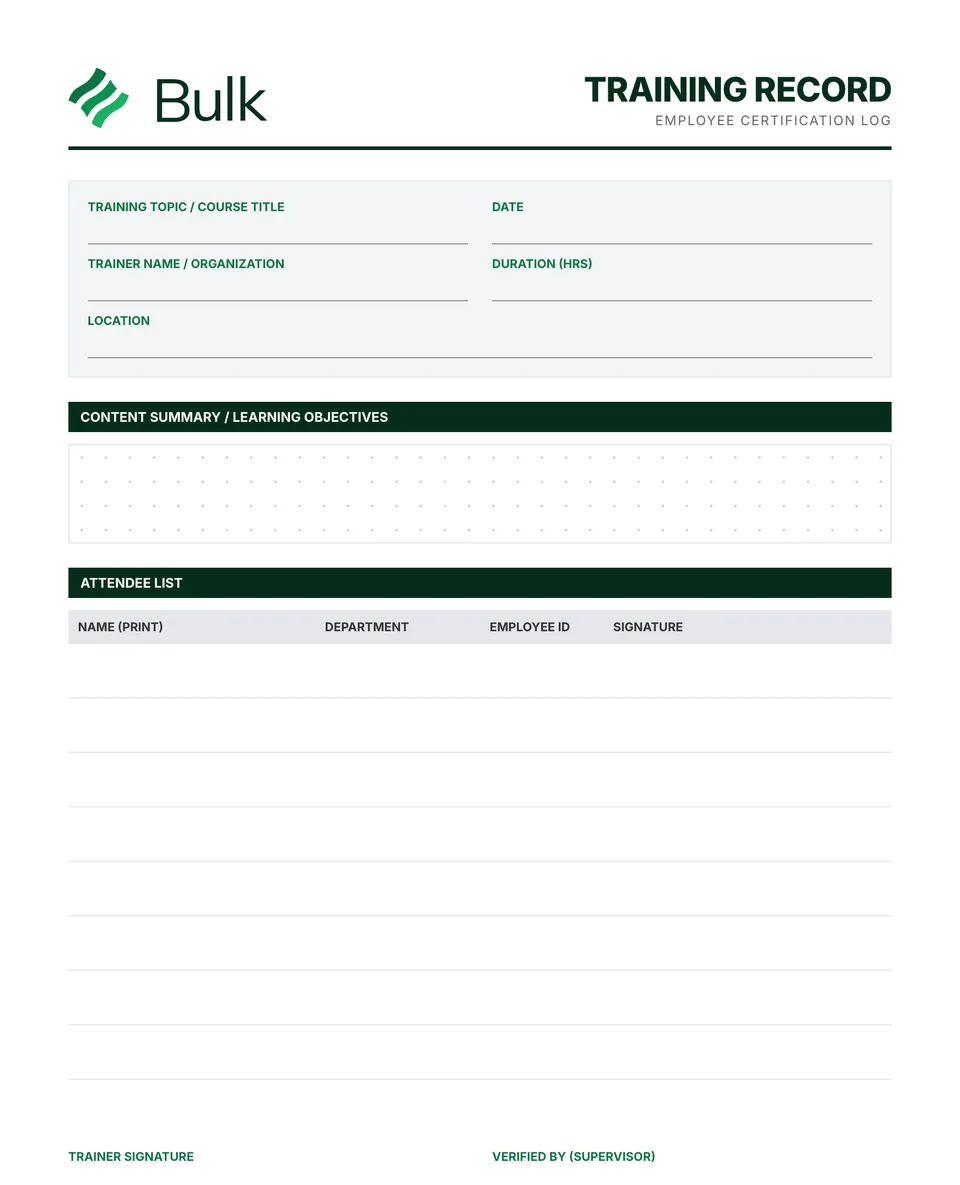 Safety Training Record & OSHA Training LogRecord the topic, procedure revision, objectives, trainer, date and duration.
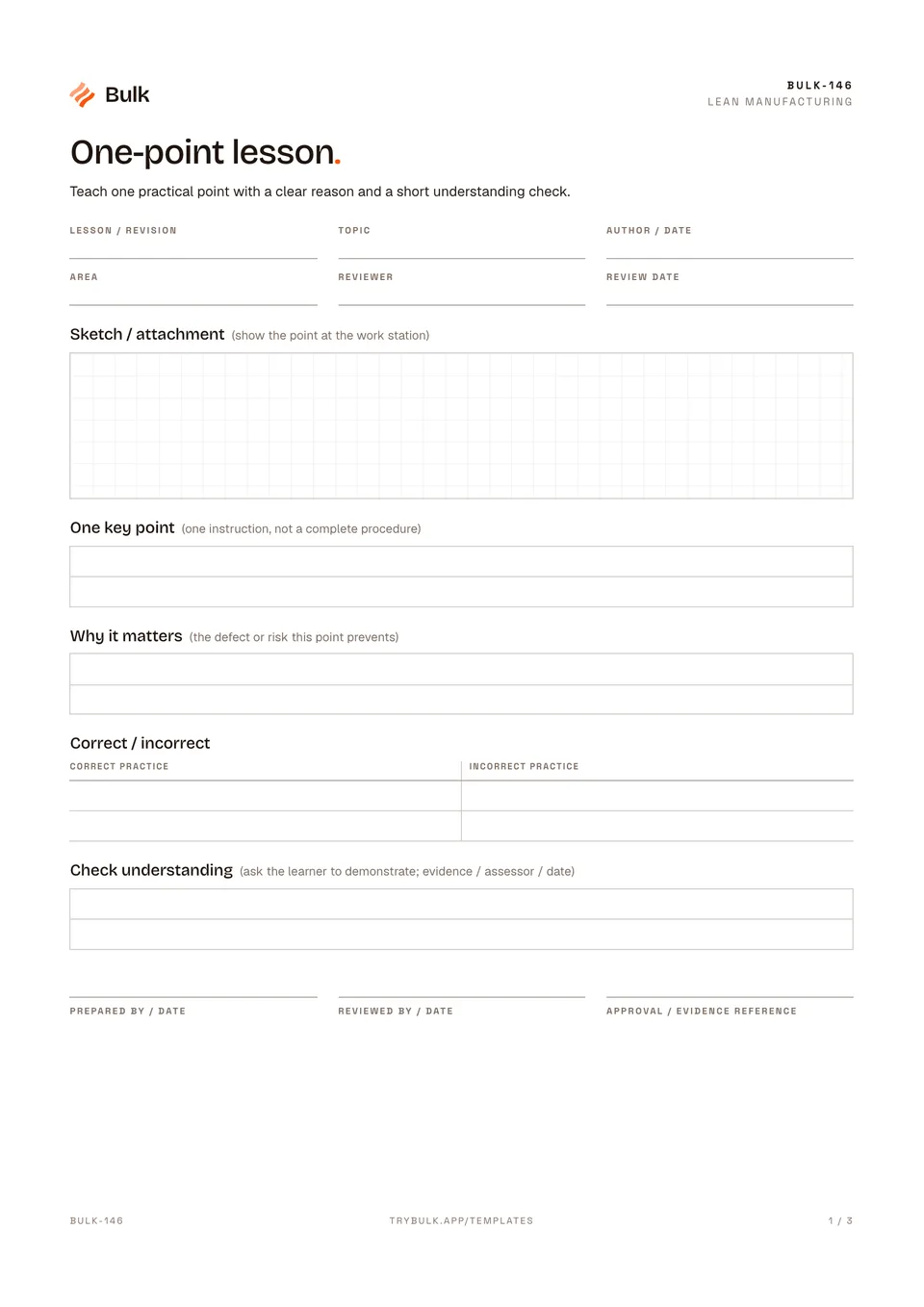 One-point lessonTeach one practical point with a clear reason and a short understanding check.
Turn the form into a live workflow.
Bulk connects the same checks, evidence, owners and approvals to the work happening on your floor.