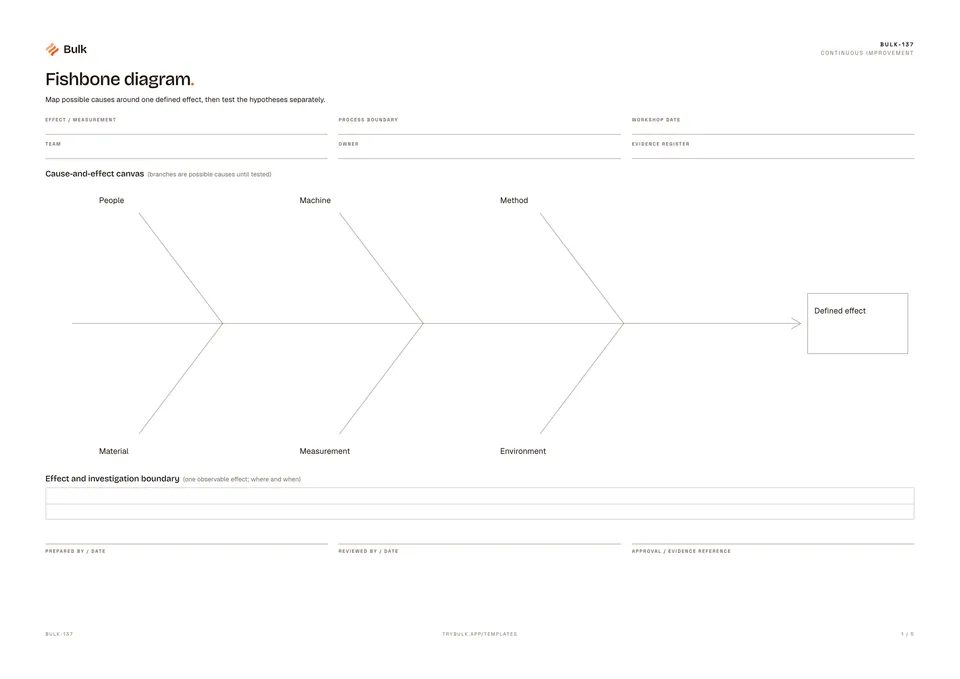
 Fishbone diagramMap possible causes around one defined effect, then test the hypotheses separately.
5 Whys worksheet
Build an evidence-led causal chain. Stop when the cause is verified, not when a box is full.
What it's for
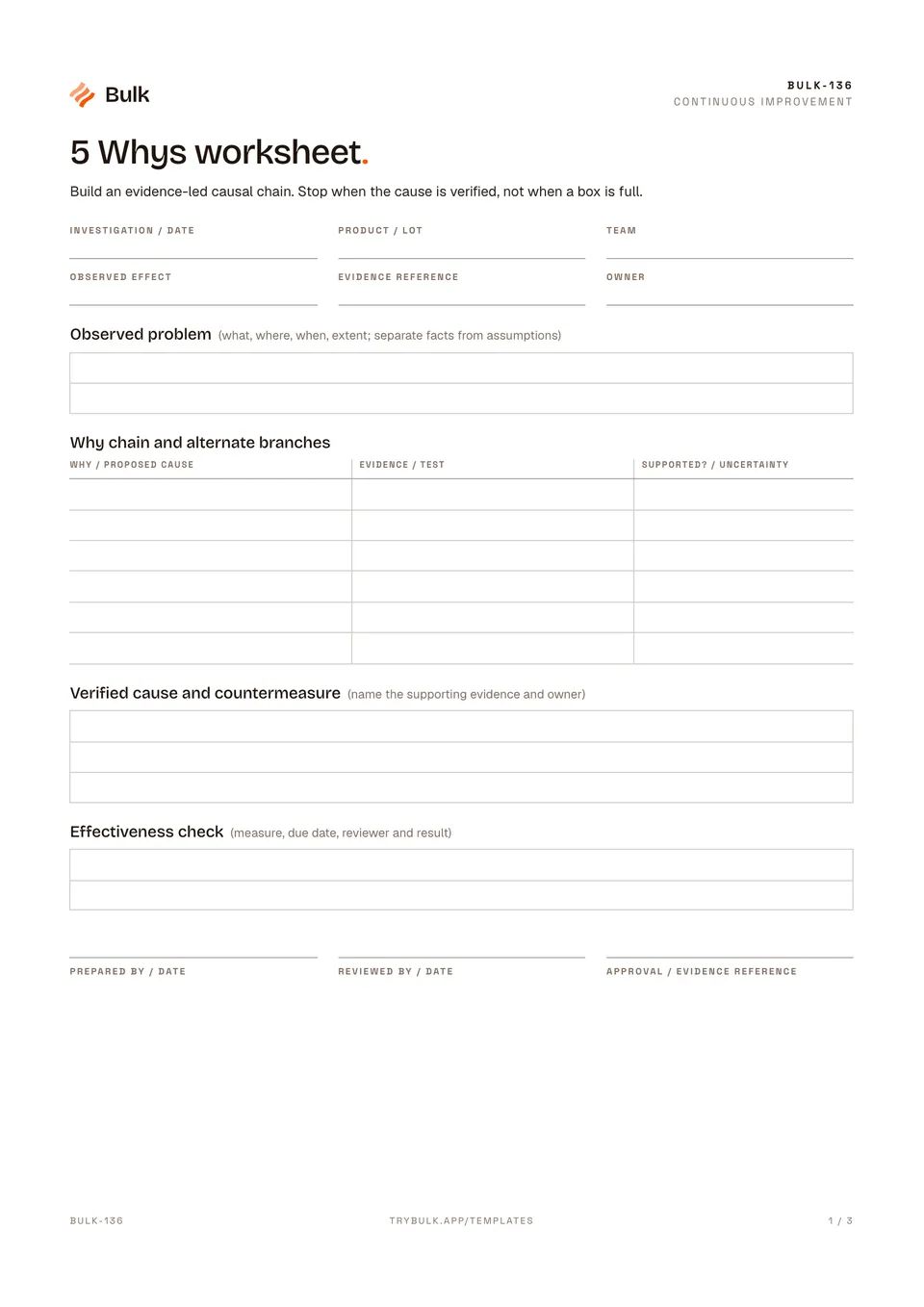
Build an evidence-led causal chain. Stop when the cause is verified, not when a box is full. This free 5 Whys template, also called a 5 why template or 5 Whys worksheet, keeps each answer tied to its evidence so the chain ends at a cause you have tested rather than one the team agreed on.
What you can download
Available files: PDF. Each PDF includes the blank form first, a fictional completed example and instructions. The download is free; enter your email to receive a secure link valid for seven days. Product-news consent is optional.
The blank worksheet is one A4 page. The header records the investigation reference and date, product and lot, team, observed effect, evidence reference and owner. Below it sit a box for the observed problem (what, where, when and extent, with facts kept apart from assumptions), the why chain table with columns for each why and proposed cause, the evidence or test, and whether it is supported along with any uncertainty, then boxes for the verified cause and countermeasure and the effectiveness check, and a sign-off strip.
What a good 5 Whys analysis includes
- An observable problem. “12 of 240 parts had undersize holes”, confirmed with a verified gauge, not “quality is poor”.
- Evidence on every line. Each why has a test, measurement or record beside it.
- Visible alternate branches. Causes that were considered and excluded stay on the sheet with their evidence.
- Honest uncertainty. A why that has not been proven is marked as uncertain, not written as fact.
- A countermeasure with an owner. The fix is tied to the verified cause, not to the last box filled.
- An effectiveness check. A measure, due date and reviewer to confirm the problem has gone.
How to run a 5 Whys
- Write the problem as an observation with its extent and evidence reference.
- Ask why it happened and write the proposed cause with the test that would confirm it.
- Test it. If it is supported, ask why that cause happened; if not, record it as excluded and try another branch.
- Keep going until you reach a cause the team can control and a countermeasure would stop recurring. That may be fewer or more than five levels.
- Record the verified cause, the countermeasure and its owner.
- Set an effectiveness check with a measure and date, and move the record into an 8D, CAPA or A3 if containment or approvals are needed.
Completed manufacturing example
The example traces an undersize hole to reamer wear, verifies that cause with a replacement-tool trial and excludes gauge error through a cross-check. A further question about why wear history was not reviewed remains uncertain.
Stop at the evidence, not at exactly five boxes. Keep an unverified branch open and use a fishbone when several cause families need exploring. An 8D or CAPA can carry containment, approvals and longer-term effectiveness checks.
Investigation RCA-18 starts from 12 of 240 B42 parts in lot L-260912 with holes below 10.00 mm. The chain reads:
- Why undersize? Reamer wear, supported by replacement-tool trial T-18.
- Why was the reamer not replaced earlier? There is no life limit, supported by reviewing tool instruction WI-20.
- Why is there no limit? Wear history was not reviewed, still uncertain and waiting on an interview with the owner.
- Alternate branch: gauge error, excluded by a reference-gauge cross-check.
The countermeasure is a validated replacement limit and a 30-part inspection interval. The effectiveness check reviews three lots by 12 October with a target of zero undersize readings, and the unverified system-cause branch stays open until there is evidence.
Common 5 Whys mistakes
- Stopping at “human error”. Ask why the process allowed the error; the answer is usually a method, tool or training gap.
- Following one chain only. Problems often have more than one contributing cause.
- Answers without evidence. A chain built from opinions can sound convincing and still be wrong.
- Forcing exactly five. Padding the chain to five boxes, or cutting it short, both lose the real cause.
- Skipping the effectiveness check. Without it, you cannot say the countermeasure worked.
5 Whys, fishbone or full root cause analysis?
The 5 Whys goes deep on one line of causes; a fishbone diagram goes wide across people, machine, method, material, measurement and environment first. When a problem reaches a customer or needs containment and formal approvals, carry the chain into a root cause analysis or an 8D report.
When to use this template
A discussion chain is not proof. Avoid blaming a person where the process conditions remain unexplained.
Continue with Fishbone diagram, Root cause analysis, 8D report.
For shared records, evidence and follow-up, explore Bulk quality. Start a free trial to run it live, no card needed.
How to use it
- Write an observable problem and link evidence.
- Ask why the preceding event happened. Keep alternate branches and uncertainty visible. Use fewer or more than five levels when the evidence calls for it.
- Test the proposed cause, assign a countermeasure and verify the outcome. Transfer the record into an 8D, CAPA or A3 when that workflow is needed.
Key features
- Observed problem
- Why chain and alternate branches
- Verified cause and countermeasure
- Effectiveness check
Ideal for
- Operators and quality teams testing causes before assigning corrective action
Common uses
- Investigating one observable manufacturing problem with a cause-and-evidence chain
Questions, answered.
01
What is the 5 Whys technique?
The 5 Whys is a root cause method in which a team asks why a problem happened, then why that cause happened, and so on until it reaches a cause it can act on. Each answer should be backed by evidence rather than opinion.
02
Do you always have to ask why five times?
No. Five is a rule of thumb. Stop when the cause is verified and a countermeasure would prevent recurrence, which may take three levels or seven. The worksheet has room for either.
03
What is a good 5 Whys example?
In the worked example, holes are undersize because the reamer is worn, the reamer was not replaced because the tool instruction has no life limit, and why there is no limit is still being checked. A gauge-error branch is tested and excluded along the way.
04
When should I use a fishbone diagram instead of the 5 Whys?
Use a fishbone diagram when several cause families are possible and you need to see them all. Use the 5 Whys to follow a supported cause down to something you can fix.
05
How do you know you have found the root cause?
The cause is supported by a test or measurement, removing it stops the problem, and an effectiveness check over the following lots confirms the problem has not returned.
Related templates.
Fishbone diagramMap possible causes around one defined effect, then test the hypotheses separately.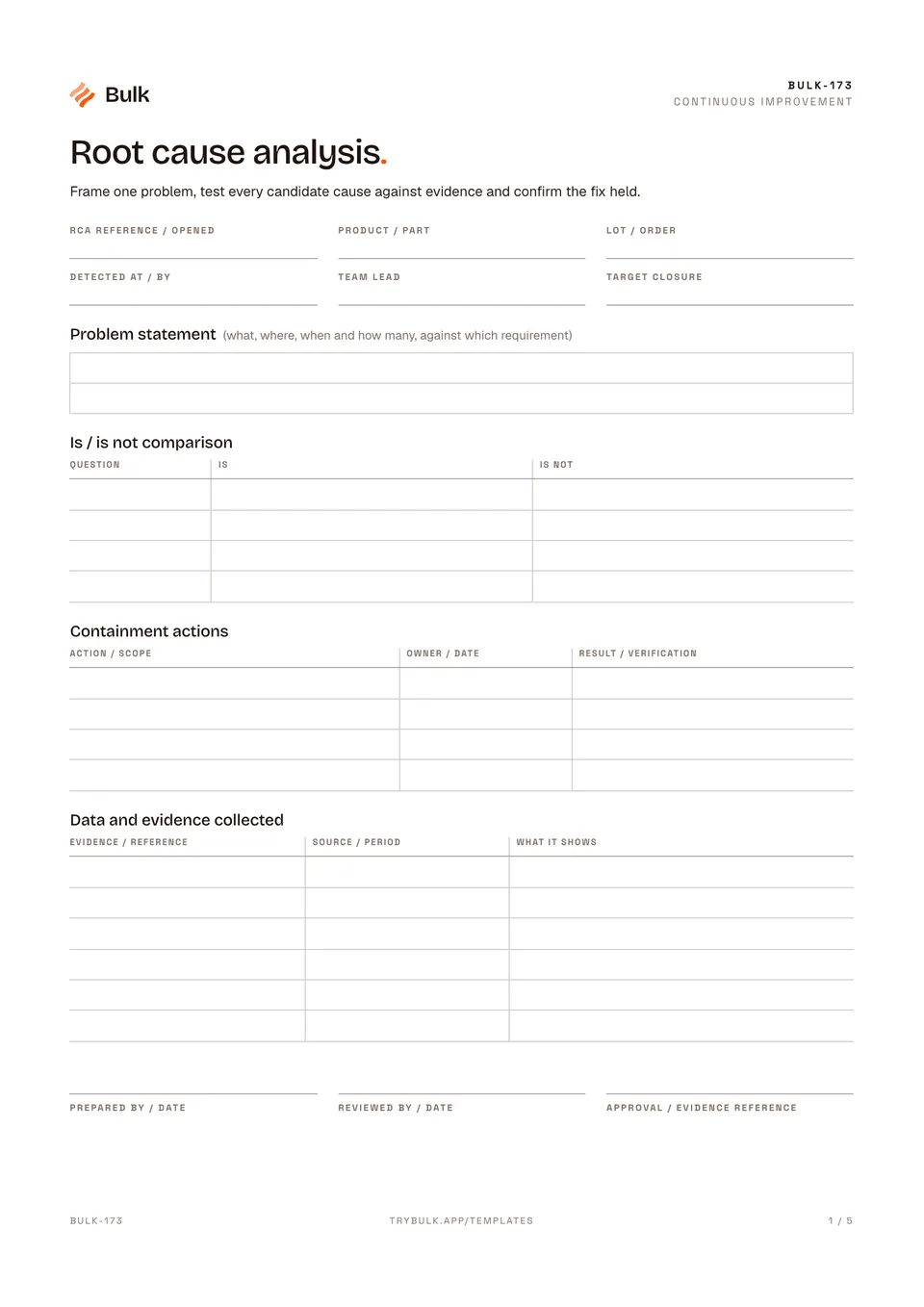 Root cause analysisFrame one problem, test every candidate cause against evidence and confirm the fix held.
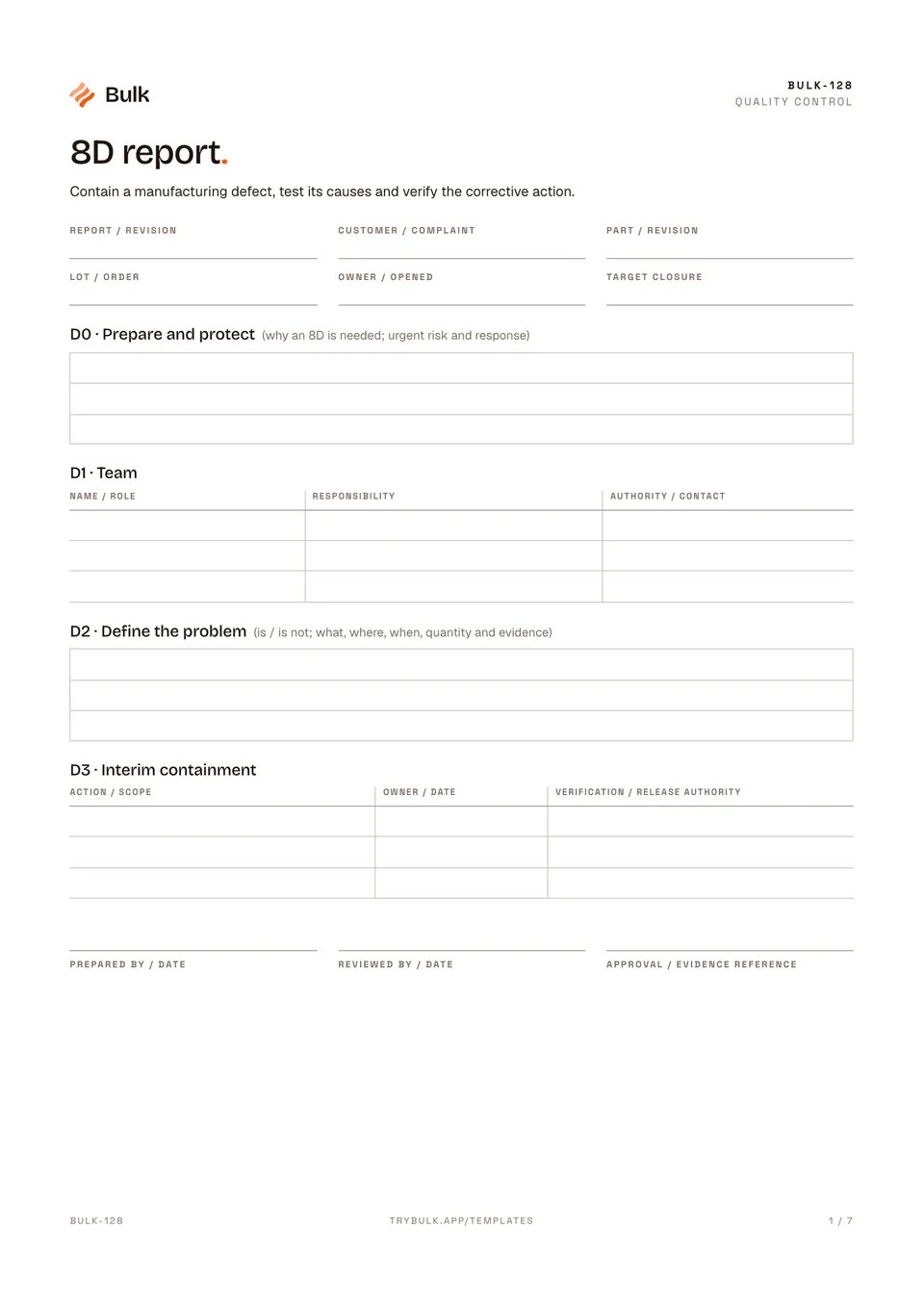 8D reportContain a manufacturing defect, test its causes and verify the corrective action.
Turn the form into a live workflow.
Bulk connects the same checks, evidence, owners and approvals to the work happening on your floor.