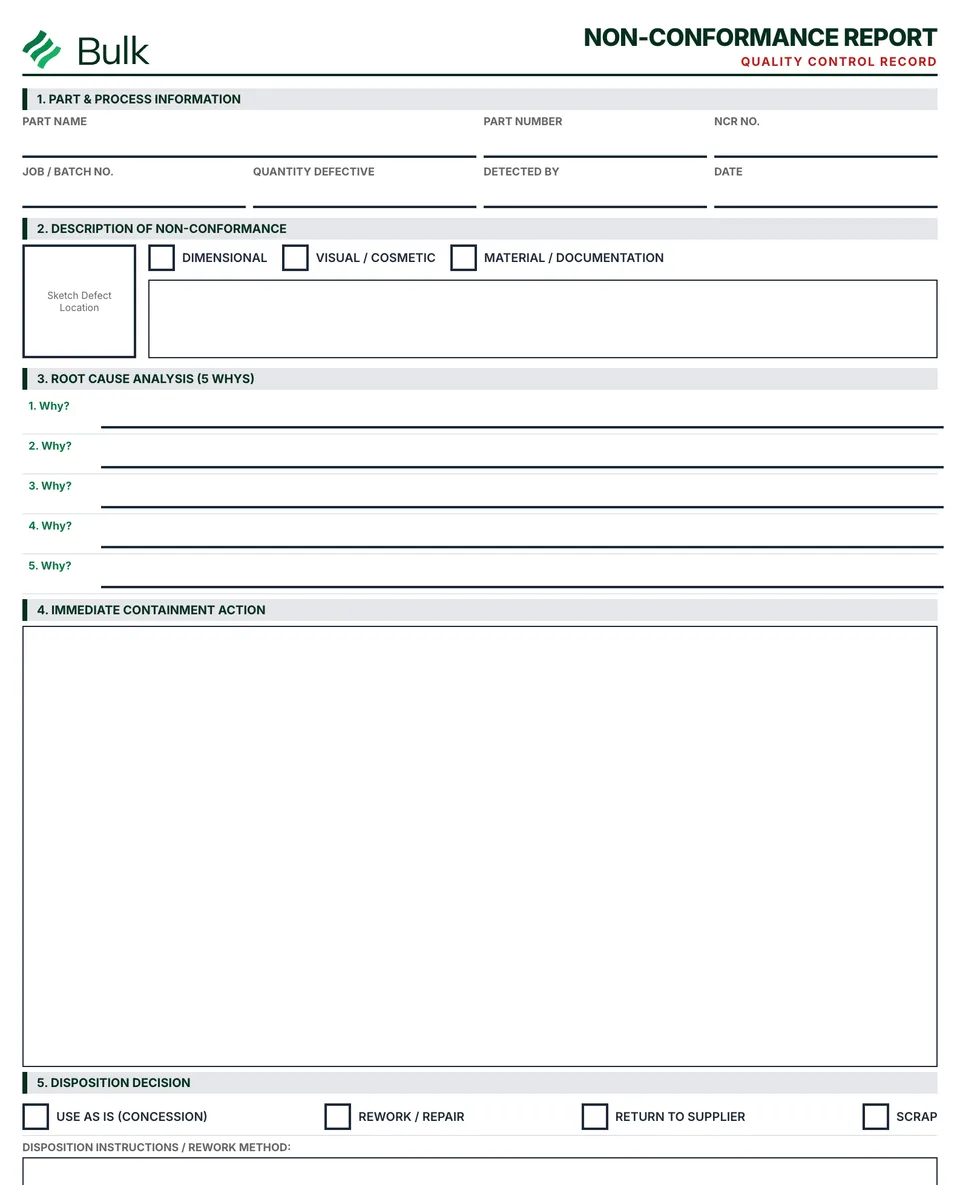
 Non-Conformance Report (NCR)Identify the requirement and observed departure, using the part revision, lot, quantities and objective evidence..
8D report
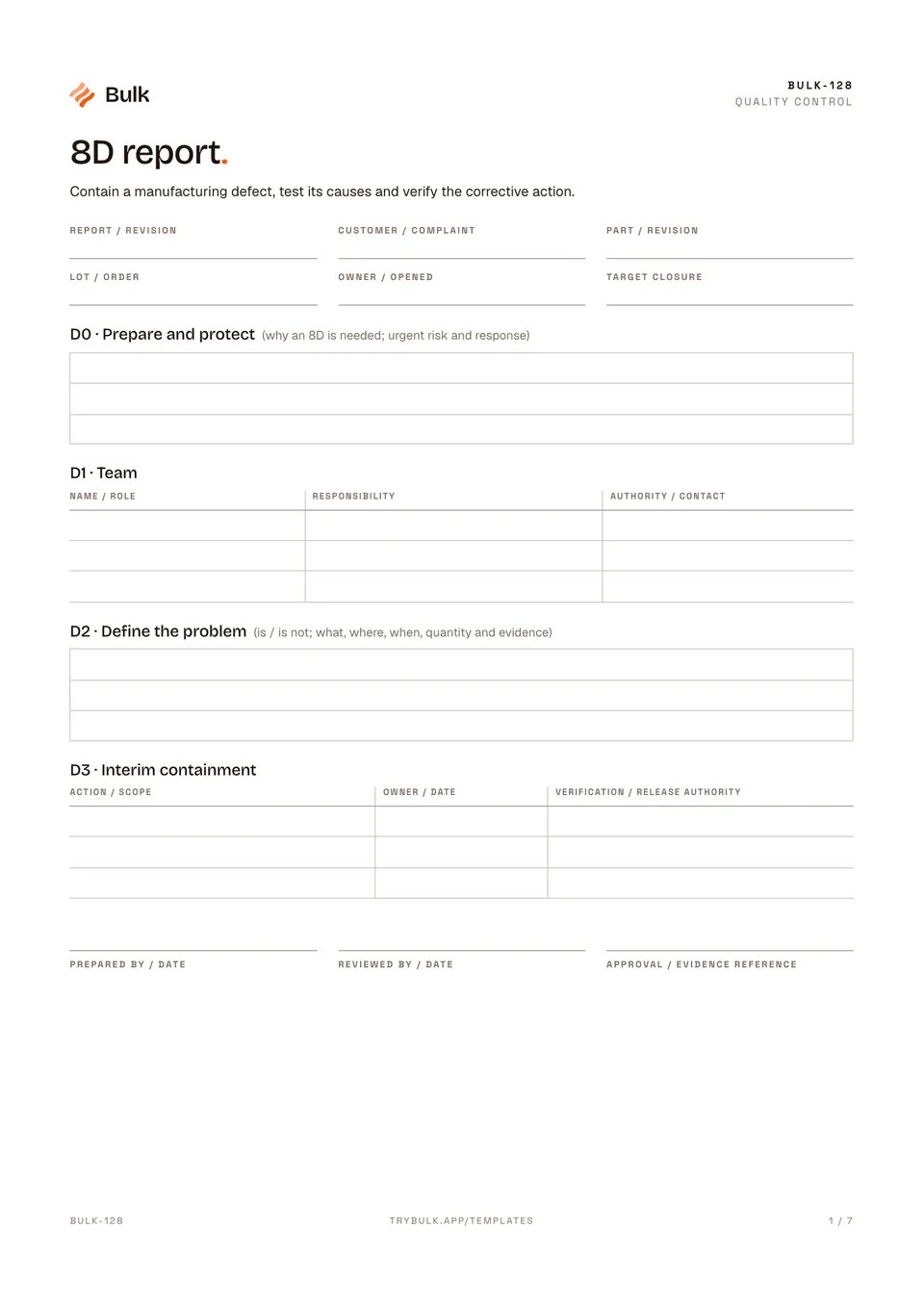
Contain a manufacturing defect, test its causes and verify the corrective action.
What it's for
Contain a manufacturing defect, test its causes and verify the corrective action.
What is an 8D report?
An 8D report is the record of the Eight Disciplines (8D) problem-solving method: a structured, team-based way to contain a problem, find its root cause, correct it and stop it coming back. Ford Motor Company popularised the method, and it is now common across automotive and other manufacturing supply chains, where customers often ask for an 8D in response to a complaint or a serious defect.
The disciplines run in order. D0 prepares and takes any emergency response action. D1 forms a cross-functional team, D2 describes the problem in measurable terms, and D3 puts interim containment in place to protect the customer. D4 finds and verifies the root cause, both why the defect occurred and why it escaped detection. D5 chooses and verifies the permanent corrective action, D6 implements it and confirms it works, and D7 prevents recurrence by updating standards, FMEAs and control plans and checking similar processes. D8 recognises the team and closes the report.
The report keeps containment, root cause and verified effectiveness as separate pieces of evidence, which is what customers review. Use it for problems that need a coordinated team response; a single, simple fix may only need a corrective action record.
What you can download
Available files: PDF. Each PDF includes the blank form first, a fictional completed example and instructions. The download is free; enter your email to receive a secure link valid for seven days. Product-news consent is optional.
Completed manufacturing example
A customer finds 12 undersize holes in a 240-piece shipment. The team holds suspect stock, checks 348 remaining parts and rejects 21. A controlled tooling trial separates the worn-reamer occurrence cause from the missing in-process inspection that allowed the defect to escape.
The report continues through D6 verification on three later lots, D7 review of similar processes and D8 closure. Containment, a completed action and verified effectiveness are separate decisions.
When to use this template
An original working form, not an official customer or standards submission. Agree customer-specific response times and evidence requirements.
Continue with Non-Conformance Report (NCR), 5 Whys worksheet, CAPA Form (Corrective & Preventive Action).
For shared records, evidence and follow-up, explore Bulk quality. Start a free trial to run it live, no card needed.
How to use it
- Assign a team with authority to hold product. Record the observed defect before choosing a cause.
- Keep occurrence and escape causes separate. A plausible explanation is not a verified cause: record the test and result.
- Validate a proposed action before release, then confirm effectiveness over an agreed period. Closure requires the named approver and customer agreement where applicable.
Key features
- D0 · Prepare and protect
- D1 · Team
- D2 · Define the problem
- D3 · Interim containment
- D4 · Occurrence cause
- D4 · Escape cause
- D5 · Select and validate action
- D6 · Implement and confirm
- D7 · Prevent recurrence / D8 · Close
- Continuation record
Ideal for
- Quality leaders coordinating production, inspection and dispatch
Common uses
- Customer complaints that need a coordinated D0–D8 response
Questions, answered.
01
What are the 8 disciplines in an 8D report?
D0 prepare and take any emergency action, D1 form the team, D2 describe the problem, D3 contain it, D4 find and verify the root cause (both why it occurred and why it escaped), D5 choose and verify the permanent corrective action, D6 implement it and confirm it works, D7 prevent recurrence in similar products and processes, and D8 recognise the team and close the report.
02
What is the difference between an 8D report and 5 Whys?
5 Whys is a cause-analysis technique; an 8D report is the whole response, from containment to closure. Teams often use 5 Whys or a fishbone diagram inside D4 to find the root cause, then carry on through corrective action, verification and prevention.
Related templates.
Non-Conformance Report (NCR)Identify the requirement and observed departure, using the part revision, lot, quantities and objective evidence..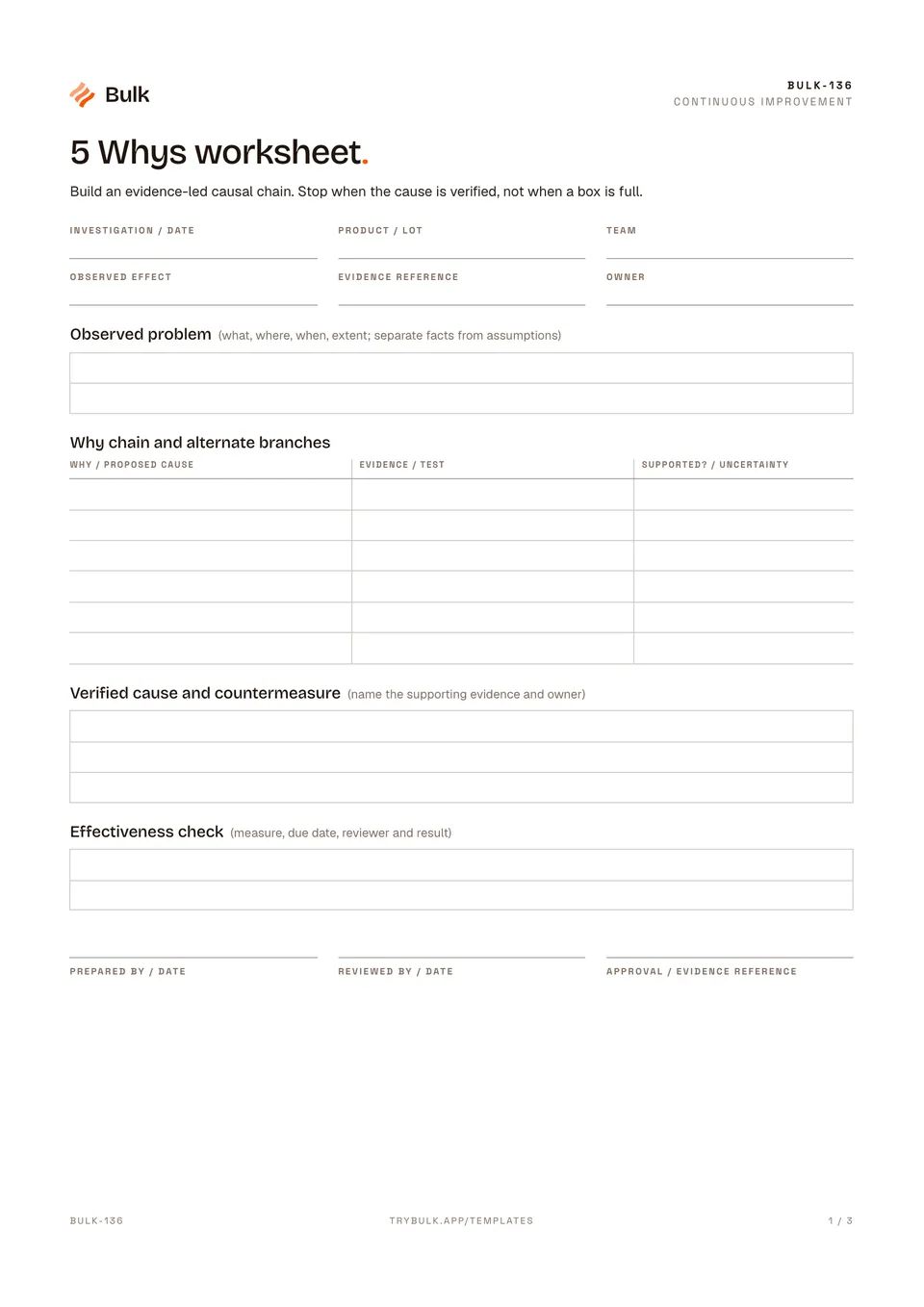 5 Whys worksheetBuild an evidence-led causal chain. Stop when the cause is verified, not when a box is full.
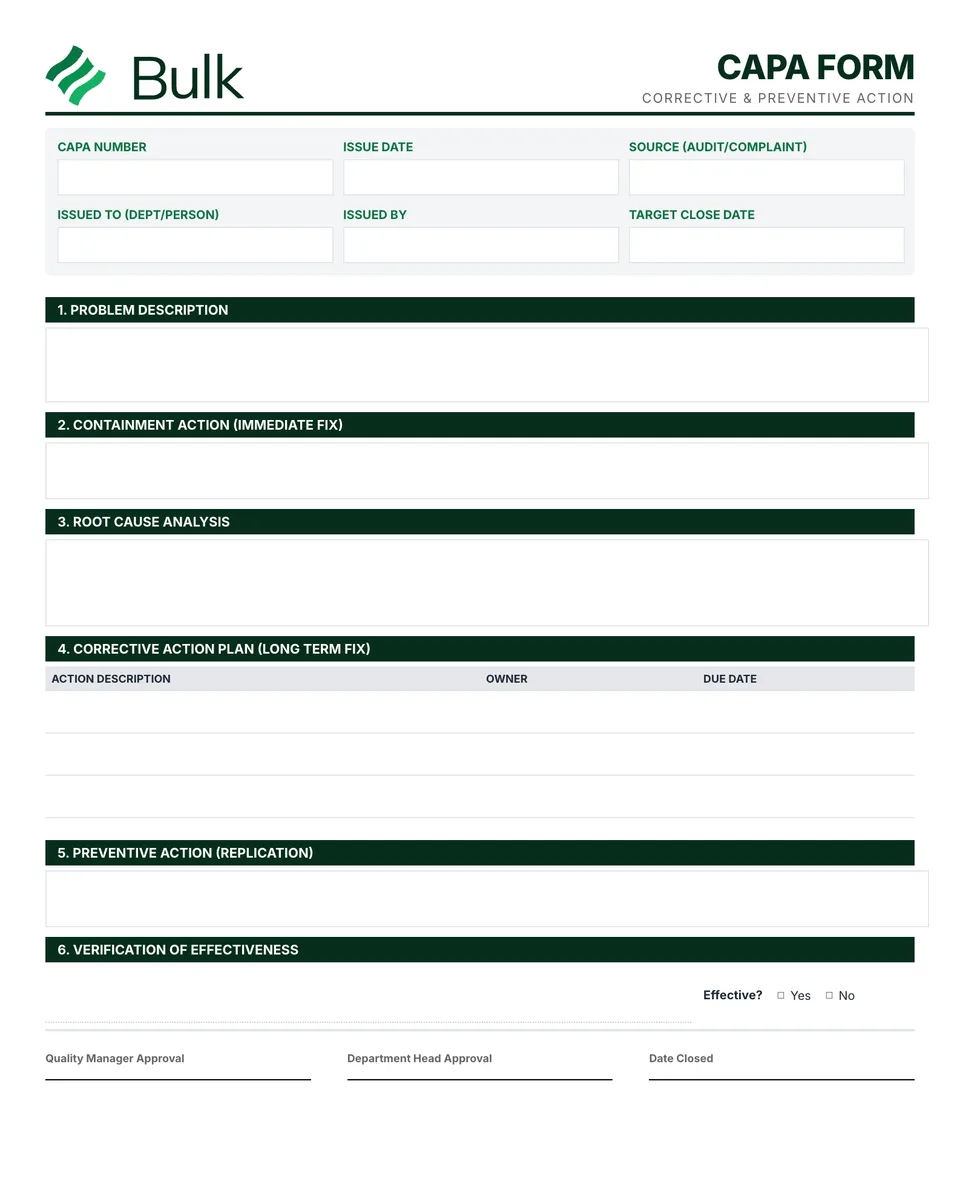 CAPA Form (Corrective & Preventive Action)Define the observed problem, scope and risk; link the NCR or complaint.
Turn the form into a live workflow.
Bulk connects the same checks, evidence, owners and approvals to the work happening on your floor.