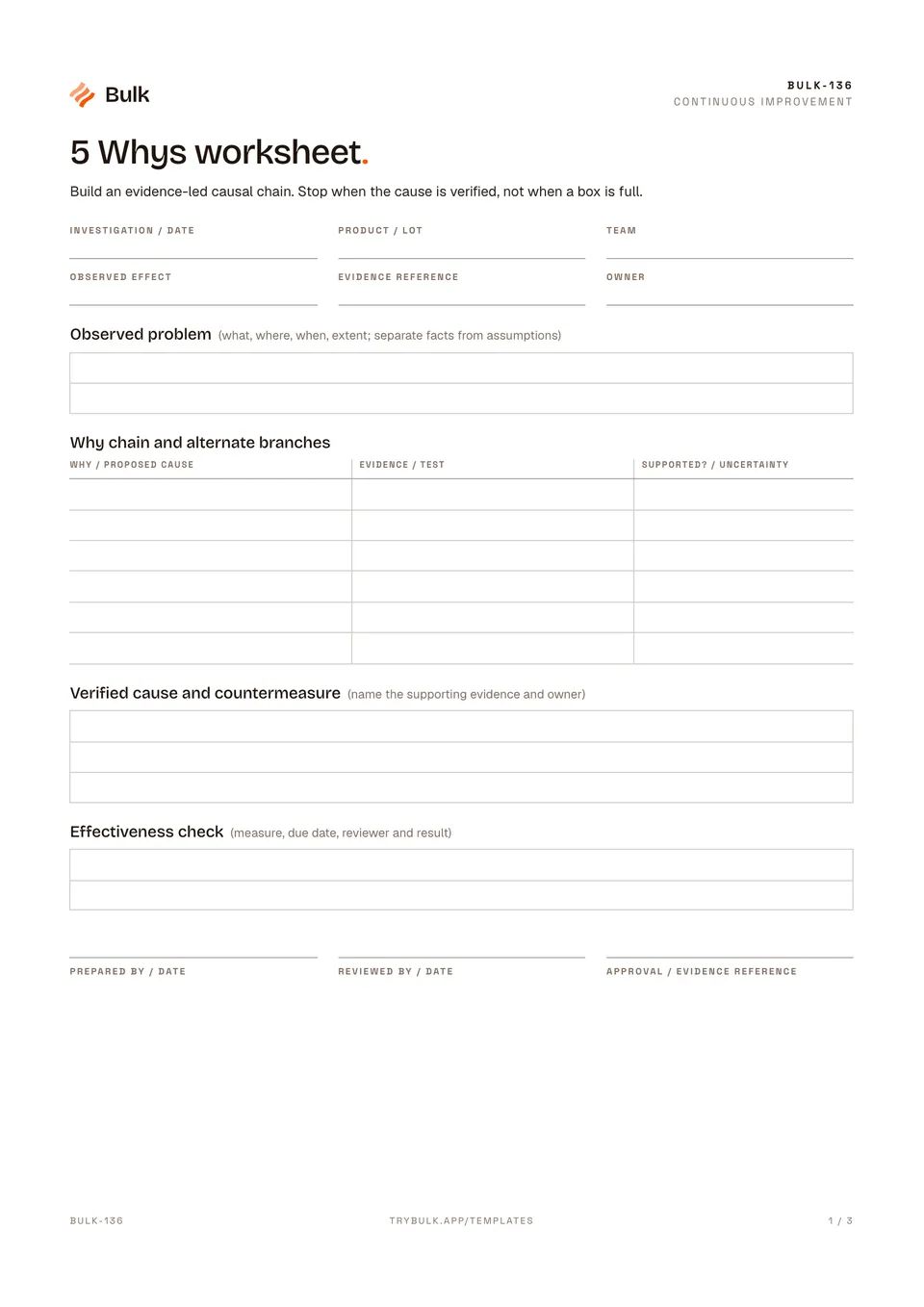
 5 Whys worksheetBuild an evidence-led causal chain. Stop when the cause is verified, not when a box is full.
Root cause analysis
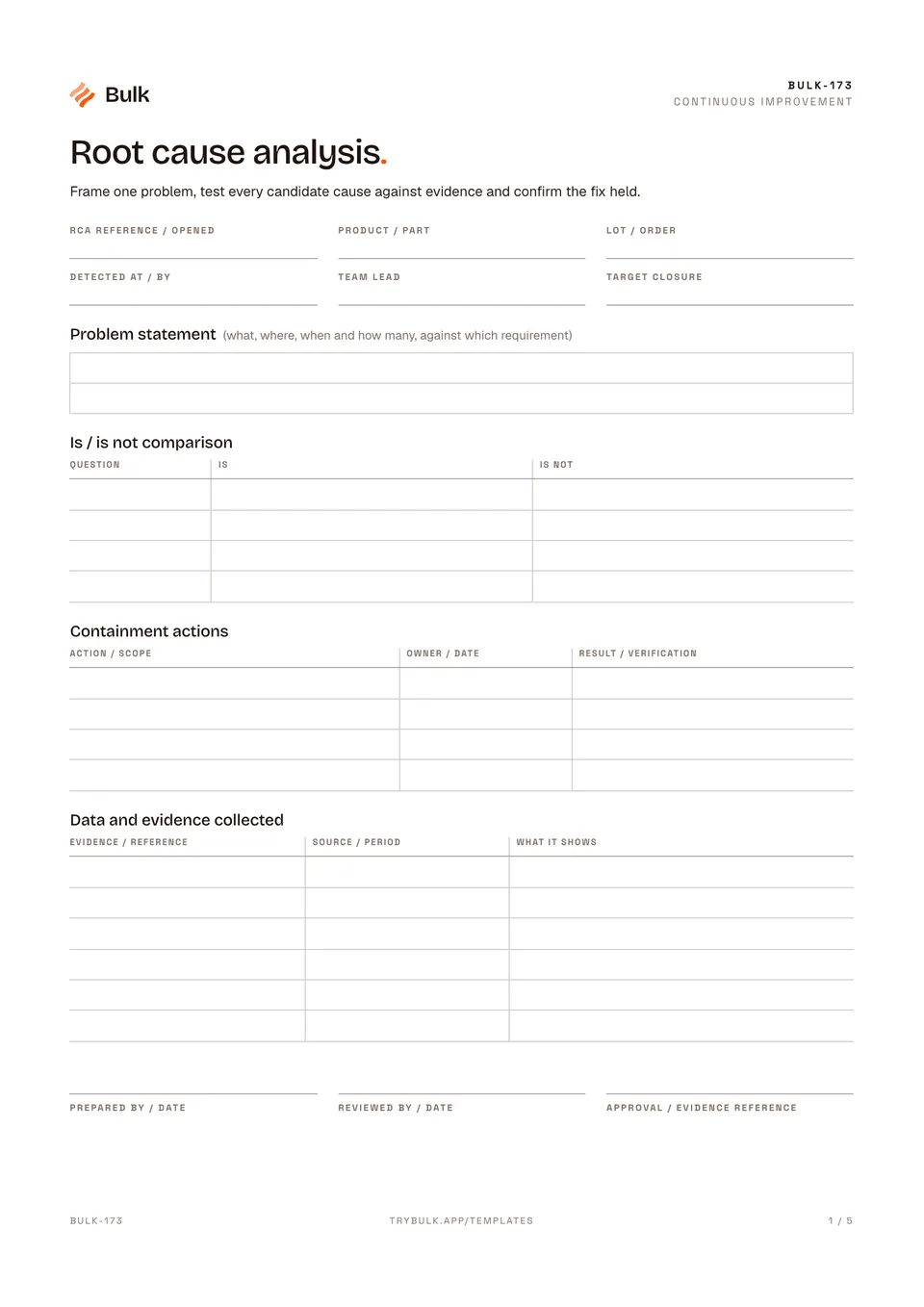
Frame one problem, test every candidate cause against evidence and confirm the fix held.
What it's for
Frame one problem, test every candidate cause against evidence and confirm the fix held.
What you can download
Available files: PDF. Each PDF includes the blank form first, a fictional completed example and instructions. The download is free; enter your email to receive a secure link valid for seven days. Product-news consent is optional.
Completed manufacturing example
Powder-coated brackets fail a cross-hatch adhesion test at final inspection: three of five samples reach grade 3 against a grade 0–1 requirement. The is / is not comparison narrows the problem to one coating line and two days of production, and 1,150 parts go on hold while the team investigates.
Five candidate causes are tested. The cure oven, powder batch, test method and a new operator are ruled out with evidence; low pretreatment concentration is confirmed by titration and test panels. The verified root cause is a failed dosing pump that a weekly titration did not catch. Corrective actions replace the pump, move titration to every shift and recoat the held parts, and the record closes only after ten clean lots.
When to use this template
Use it for one measurable problem that needs more than a quick fix: a defect, an escape to the customer or a problem that keeps coming back. It is an original working record and does not replace a customer-specific corrective-action format or the approval your quality system requires.
For deeper cause work, continue on the 5 Whys worksheet or the fishbone diagram. When a customer complaint or formal corrective action is involved, move the evidence into an 8D report or CAPA form. Once the cause is confirmed, list the actions, owners and checks on a corrective action plan.
In Bulk, an 8D report carries an Is / Is Not table, a fishbone, a 5 Why chain and a fault tree, and each quality issue links back to the job it came from. Explore Bulk quality and start a free trial to run it live, no card needed.
How to use it
- Write the problem as a measurable gap against a requirement. Use is / is not to narrow where and when it occurs before naming causes.
- Contain first: protect the customer while the investigation runs, and record how containment was verified.
- List candidate causes by category (people, method, machine, material, measurement, environment). Test each one and mark it confirmed or ruled out; keep the ruled-out causes as evidence.
- Use the 5 Whys worksheet to trace a confirmed cause back to its system cause, and a fishbone diagram when many causes need sorting. Move to an 8D report or CAPA form when a customer or formal corrective action is involved.
- Close only after the effectiveness check shows the problem has not returned over an agreed period.
Key features
- Problem statement
- Is / is not comparison
- Containment actions
- Data and evidence collected
- Candidate causes by category
- Verified root cause
- Corrective actions and owners
- Effectiveness check
Ideal for
- Quality and production teams investigating a defect, escape or repeat problem
- Engineers who need one record from problem statement to verified fix
Common uses
- Recording an internal defect investigation from containment to closure
- Showing which candidate causes were tested, confirmed and ruled out
- Preparing the evidence before an 8D report or CAPA is opened
Questions, answered.
01
What should a root cause analysis template include?
A measurable problem statement, where and when the problem does and does not occur, containment, the evidence collected, each candidate cause with the test that confirmed or ruled it out, the verified root cause, corrective actions with owners and due dates, and an effectiveness check.
02
What are the steps of a root cause analysis?
Define the problem, contain it, collect data, list candidate causes by category, test each one, confirm the root cause, act on it and check that the problem has not returned. This template follows those steps in order.
03
Is a root cause analysis the same as 5 Whys?
No. 5 Whys is one technique inside a root cause analysis. Use the 5 Whys worksheet to trace a confirmed cause back to its system cause, and a fishbone diagram when there are many possible causes to sort.
Related templates.
5 Whys worksheetBuild an evidence-led causal chain. Stop when the cause is verified, not when a box is full.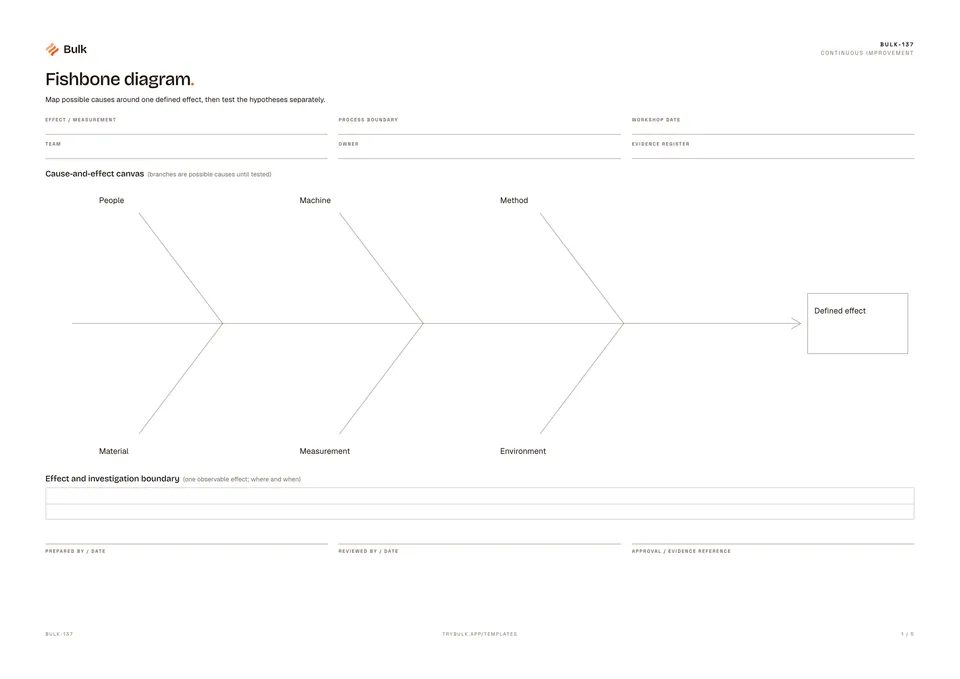 Fishbone diagramMap possible causes around one defined effect, then test the hypotheses separately.
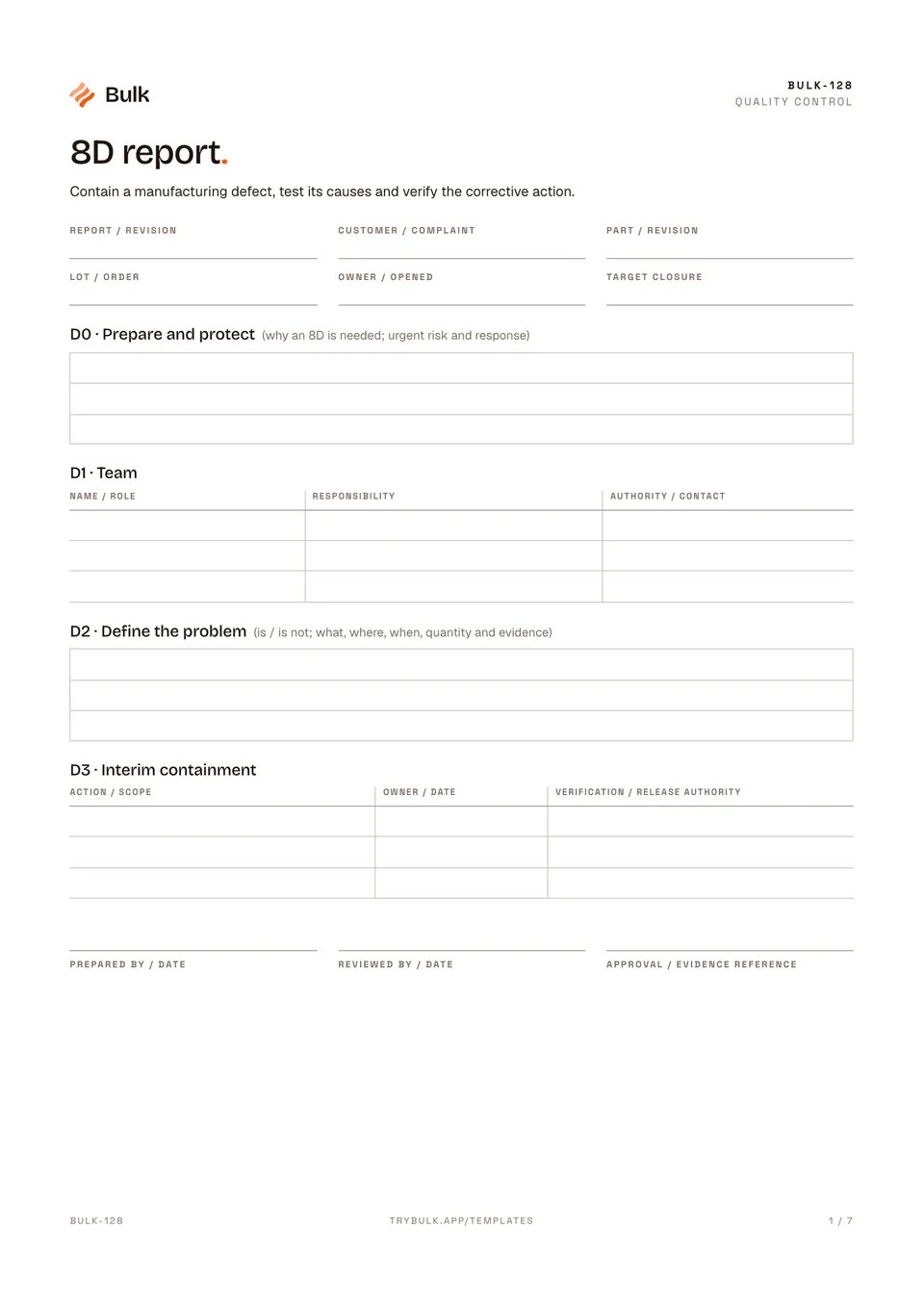 8D reportContain a manufacturing defect, test its causes and verify the corrective action.
Turn the form into a live workflow.
Bulk connects the same checks, evidence, owners and approvals to the work happening on your floor.