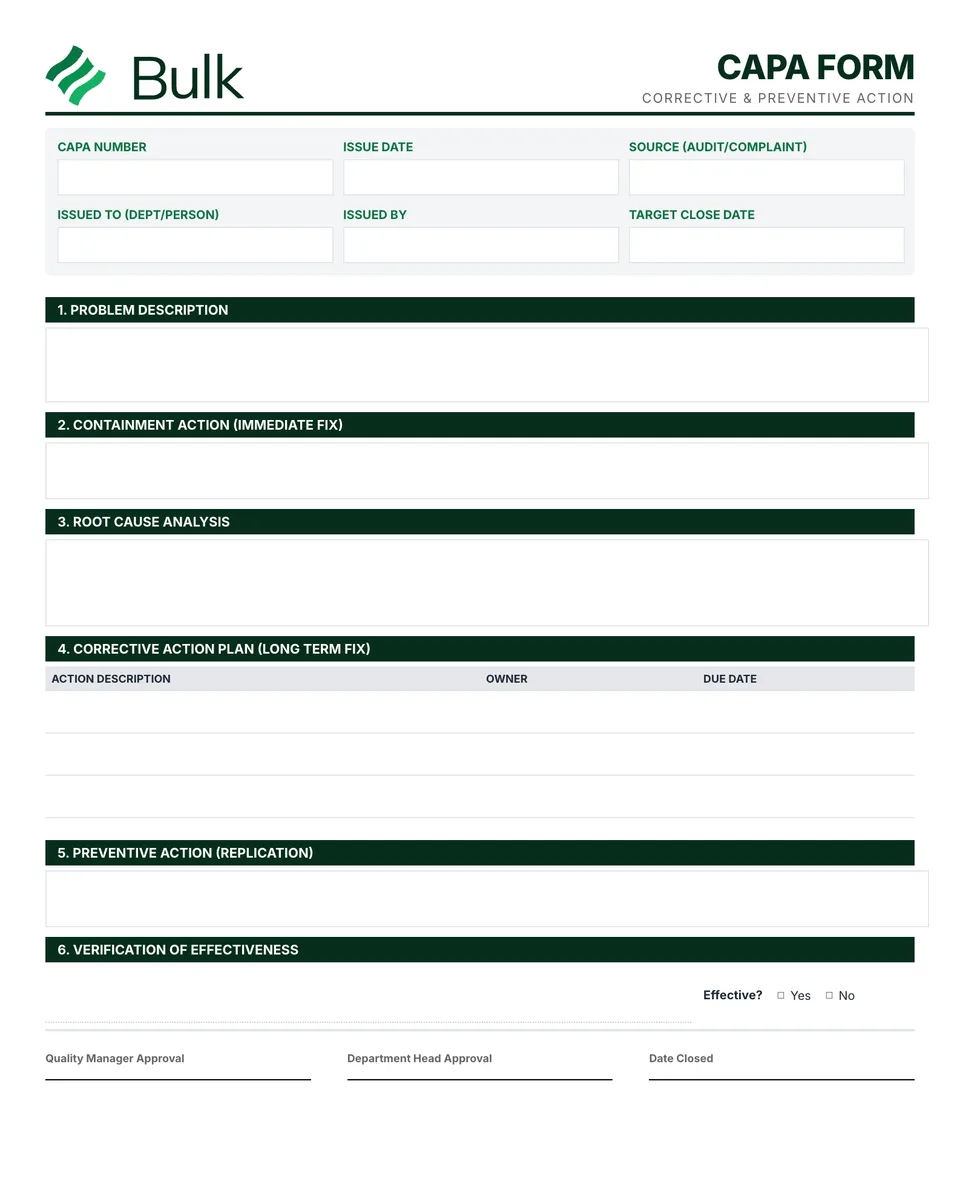
 CAPA Form (Corrective & Preventive Action)Define the observed problem, scope and risk; link the NCR or complaint.
Corrective Action Plan Template
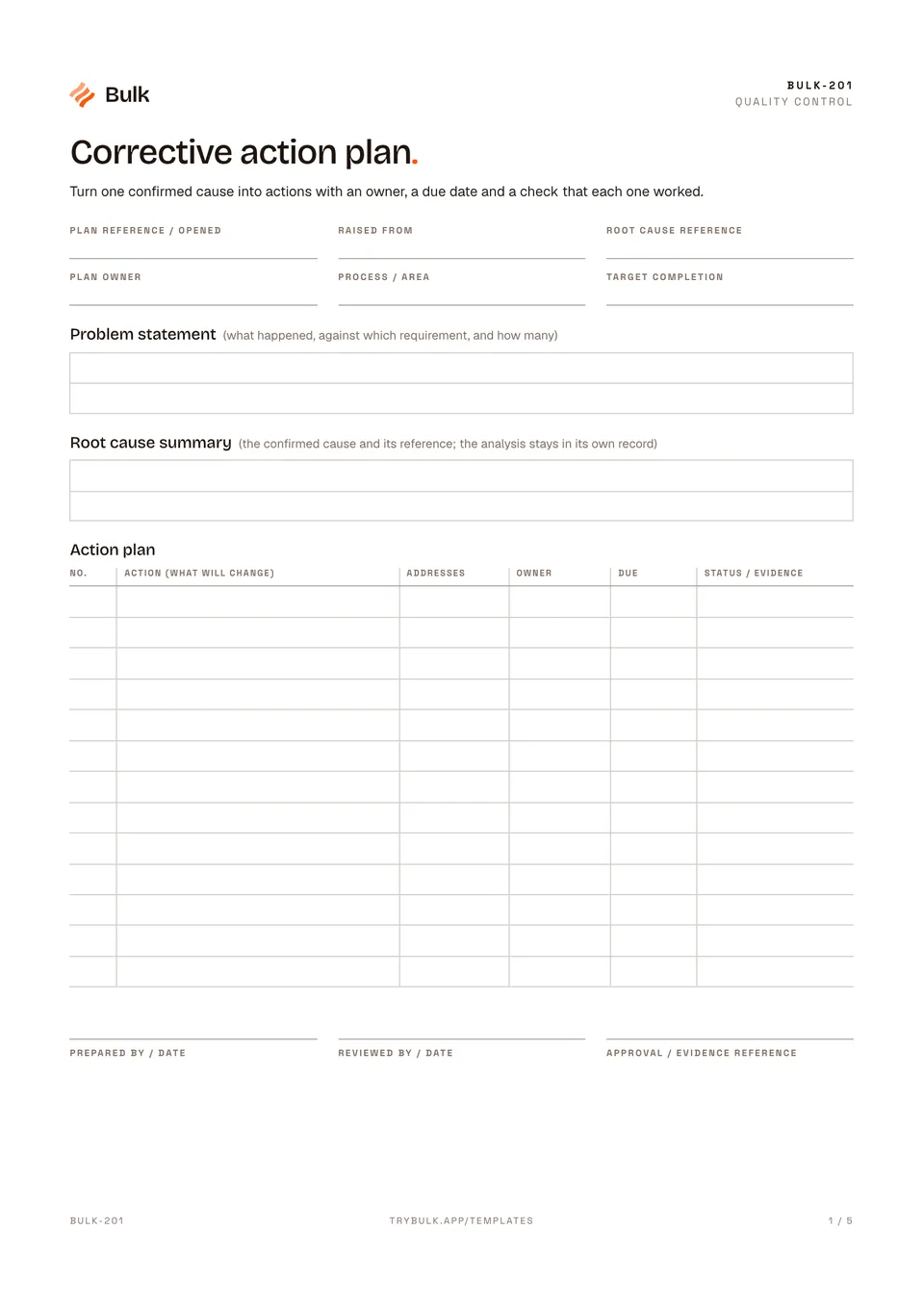
Turn one confirmed cause into actions with an owner, a due date and a check that each one worked.
What it's for
Turn one confirmed cause into actions with an owner, a due date and a check that each one worked. This free corrective action plan template is the action register that follows a root cause investigation: what will change, who does it, by when, and how you will know it worked.
What you can download
Available files: PDF. Each PDF includes the blank form first, a fictional completed example and instructions. The download is free; enter your email to receive a secure link valid for seven days. Product-news consent is optional.
The blank corrective action plan is two A4 pages. The header records the plan reference and date opened, where it was raised from (a complaint, audit finding or nonconformance), the root cause reference, the plan owner, the process or area and the target completion date. Page one holds the problem statement, a short root cause summary and the action plan: one row per action with what it addresses, the owner, the due date and its status or evidence. Page two holds the verification of effectiveness for each action, a dated log of changes to the plan, and the closure decision.
What a corrective action plan is for
A corrective action plan removes the cause of a problem that has already happened. It sits after the investigation: the root cause analysis, 5 Whys worksheet or 8D report finds and confirms the cause, and the plan turns that cause into work people own. Keeping the two apart keeps the plan short enough to run at a weekly meeting, and stops the analysis being rewritten every time a date moves.
It is also not a CAPA form. A CAPA is the formal record that many quality systems require, with preventive action for similar processes and an approval route. A corrective action plan can be attached to a CAPA, an 8D or a nonconformance report, or used on its own for an internal problem that does not need the formal record.
What a good corrective action plan includes
- A measurable problem. What happened, against which requirement, and how many, so the plan can be checked against it.
- A confirmed cause, by reference. One or two sentences and the reference to the analysis that confirmed it.
- Actions that change something. “Make deburring a required step in the routing” can be checked; “remind operators” cannot.
- What each action addresses. Containment, the root cause, the escape (why it was not caught), or the same risk elsewhere.
- One owner and one due date per action. Shared actions drift.
- A check for each action. A measure, a target and a check period, agreed before the work starts.
- A record of changes. A moved date with its reason and who agreed it, not a silent edit.
How to complete the plan
- Fill in the header and write the problem statement as a gap against a requirement.
- Summarise the confirmed root cause and give the reference to the analysis.
- List containment first, then the actions that remove the cause, then the actions that stop it escaping or recurring elsewhere.
- Give each action an owner and a due date, and agree them with the owner.
- On page two, write how each action will be verified: the measure, the target and the period.
- Review the plan at an agreed interval. Update the status column and record every change to an action, owner or date.
- When every action is done and its check has passed, write the closure decision and who closed the plan.
Completed manufacturing example
A customer returns 14 of 400 laser-cut cover panels with sharp burrs on the cut edges, against a drawing note that requires every edge to be deburred. The root cause analysis, referenced as RCA-034, found that a routing revision showed deburring as optional, so the night shift skipped it, and that pack-out had no edge check.
The plan has five actions. Stock and work in progress are checked and 22 panels reworked (containment). The routing is revised so deburring is required, and the night shift is briefed (root cause). An edge check is added to the pack-out checklist (escape). The eleven other routings changed in the same revision are reviewed for optional steps, and two are corrected (same risk elsewhere). That last action moved from 16 to 20 October because two routings were waiting for customer approval, and the change is logged with the reason and who agreed it.
Each action has its own check: no further returns, deburring signed on all 18 job travellers in the period, no burrs found on 1,640 panels at pack-out. The plan owner closes it on 7 November after 30 days of clean checks and sends it to the customer with the complaint reply.
Common corrective action plan mistakes
- Starting before the cause is confirmed. Actions aimed at a guessed cause use up time and leave the real one in place.
- Training as the only action. A briefing rarely holds on its own; change the routing, the check or the tool as well.
- No escape action. If the defect reached the customer, something should also change in how it is detected.
- Closing on “done”. The plan closes when the check shows the problem has gone, not when the last task is ticked.
- Silent date changes. A moved date without a reason hides a plan that is slipping.
When to use this template
Use it when a confirmed cause needs more than one action, or actions owned by more than one person: a customer complaint, an audit finding, a repeat defect or a nonconformance. It is an action register for one problem and does not replace the root cause investigation, a customer-specific corrective-action format or the approval your quality system requires.
Continue with the CAPA form for a formal corrective and preventive action record, the root cause analysis template to confirm the cause first, or the 8D report for a customer-facing team investigation.
In Bulk, a CAPA is a six-stage plan whose actions are tasks with owners and due dates, and it is closed from its Verifying stage, where the effectiveness result is recorded. Explore Bulk quality and start a free trial to run it live, no card needed.
How to use it
- Start from a confirmed cause. Write the problem as a measurable gap against a requirement and reference the analysis (root cause analysis, 5 Whys or 8D) instead of repeating it here.
- Write each action as a change someone can check: what changes, where, and which cause or risk it addresses. Keep containment separate from the actions that remove the cause.
- Give every action one owner and one due date. When a date moves, record the new date, the reason and who agreed it under Changes to the plan.
- Set the measure, target and check period for each action before the work starts. An action marked done is not the same as a problem that has gone.
- Close the plan only when every action is complete and verified. Use the CAPA form when your quality system needs a formal corrective and preventive action record.
Key features
- Problem statement
- Root cause summary with its reference
- Action plan with owners and due dates
- Verification of effectiveness
- Changes to the plan
- Closure decision
Ideal for
- Quality engineers and managers answering a complaint, audit finding or repeat defect
- Team leads who own actions and need one list to work from and report against
Common uses
- Turning a confirmed root cause into owned, dated actions
- Answering a customer complaint or audit finding with a plan and its evidence
- Checking that each action worked before the plan is closed
Questions, answered.
01
What is a corrective action plan?
A corrective action plan is the list of actions that remove the cause of a problem that has already happened. Each action has an owner, a due date and a way to check that it worked, and the plan stays open until every action is complete and verified.
02
What should a corrective action plan template include?
A measurable problem statement, the confirmed root cause and where its analysis is kept, each action with what it addresses, an owner, a due date and its status, how each action's effectiveness will be checked and the result, any changes to the plan, and the closure decision.
03
What is the difference between a corrective action plan and a CAPA?
04
How do you verify that a corrective action was effective?
Decide the measure, target and check period before the work starts, for example zero escapes over 30 days of pack-out checks. Record the result and who verified it. Completing the action is not enough; the problem must not come back over the agreed period.
05
Can I use this corrective action plan for an audit finding?
Yes. Write the finding as the problem statement, reference the clause or procedure it was raised against, and record the cause your investigation confirmed. The internal audit checklist records the finding itself.
Related templates.
CAPA Form (Corrective & Preventive Action)Define the observed problem, scope and risk; link the NCR or complaint.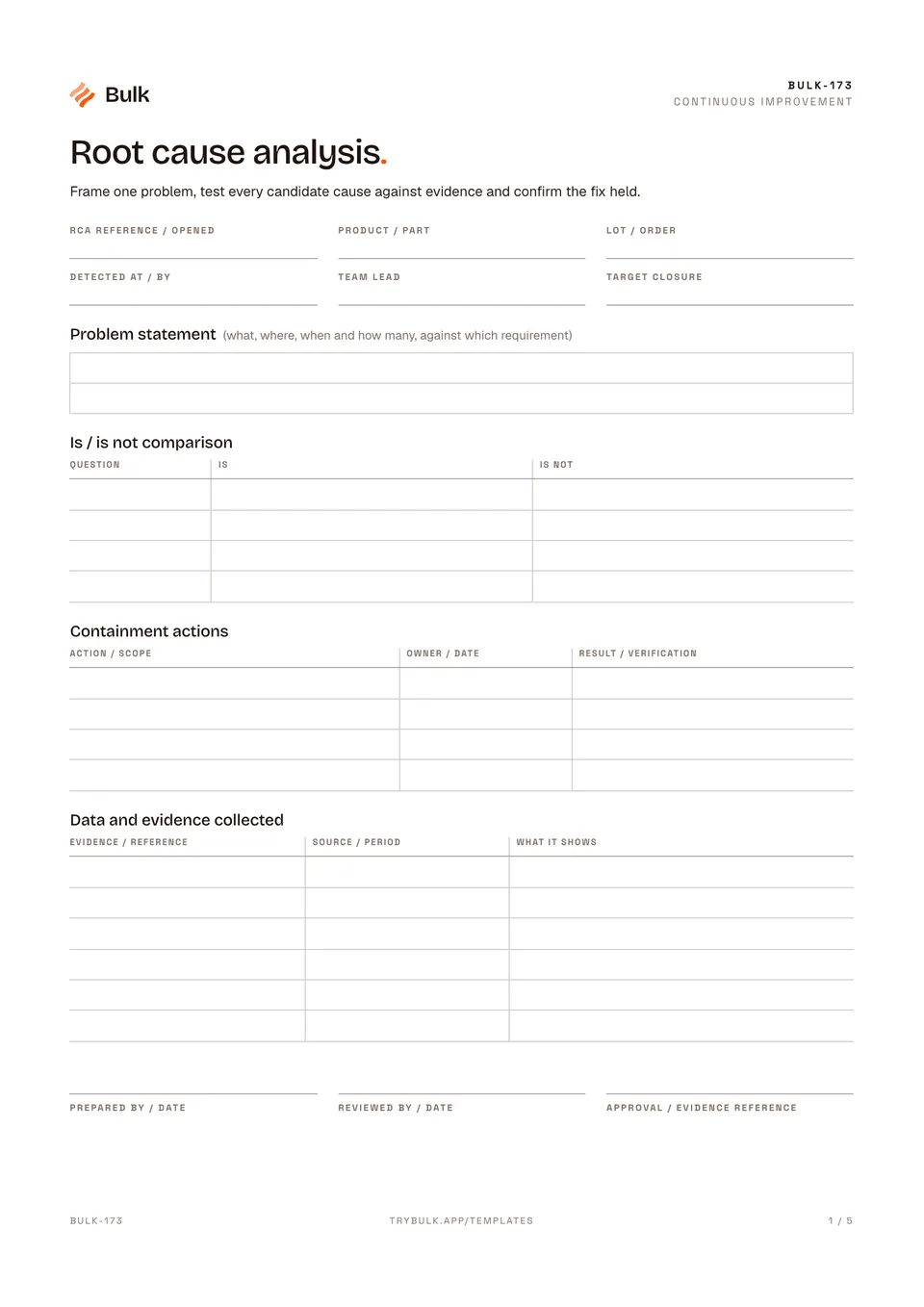 Root cause analysisFrame one problem, test every candidate cause against evidence and confirm the fix held.
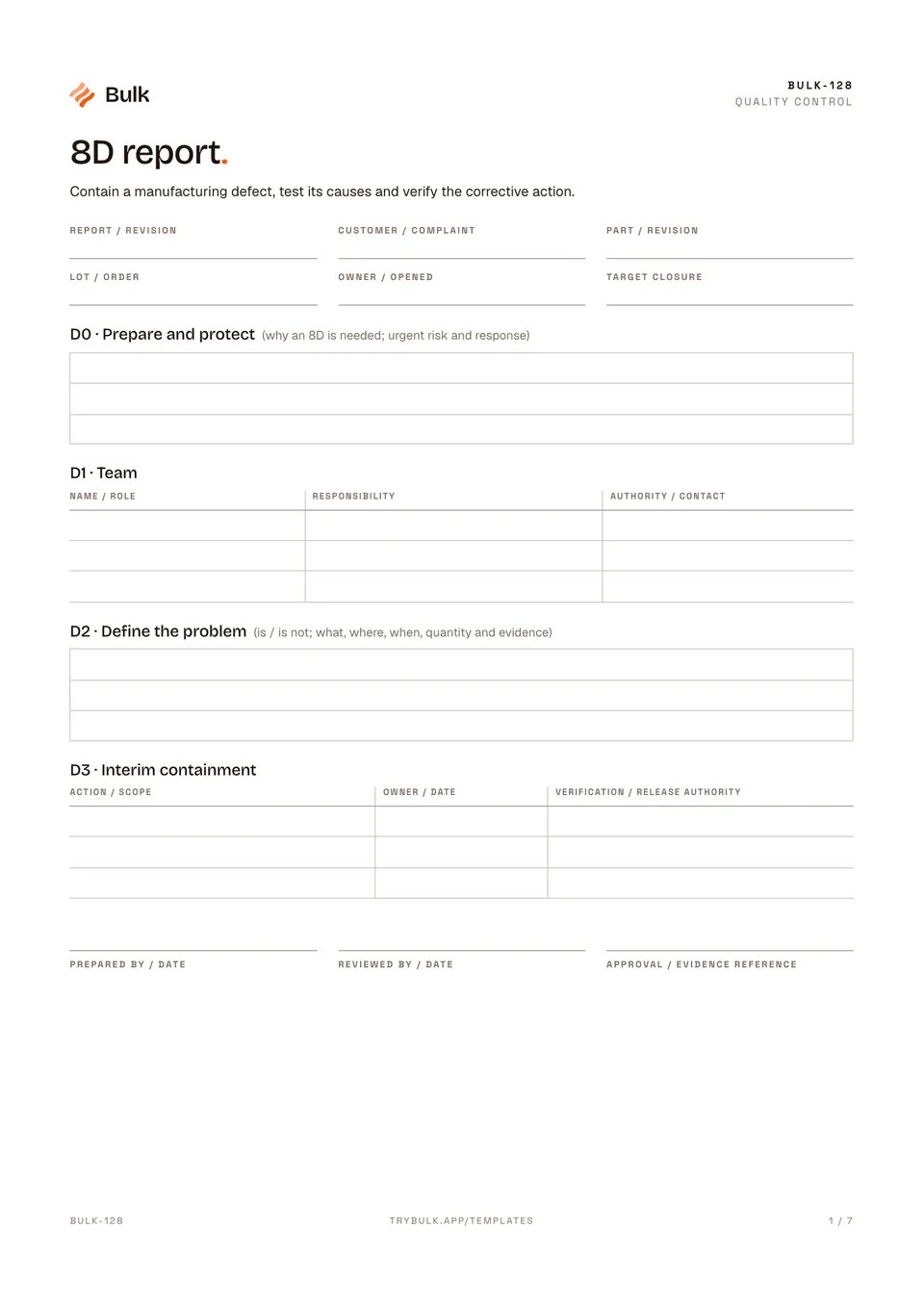 8D reportContain a manufacturing defect, test its causes and verify the corrective action.
Turn the form into a live workflow.
Bulk connects the same checks, evidence, owners and approvals to the work happening on your floor.