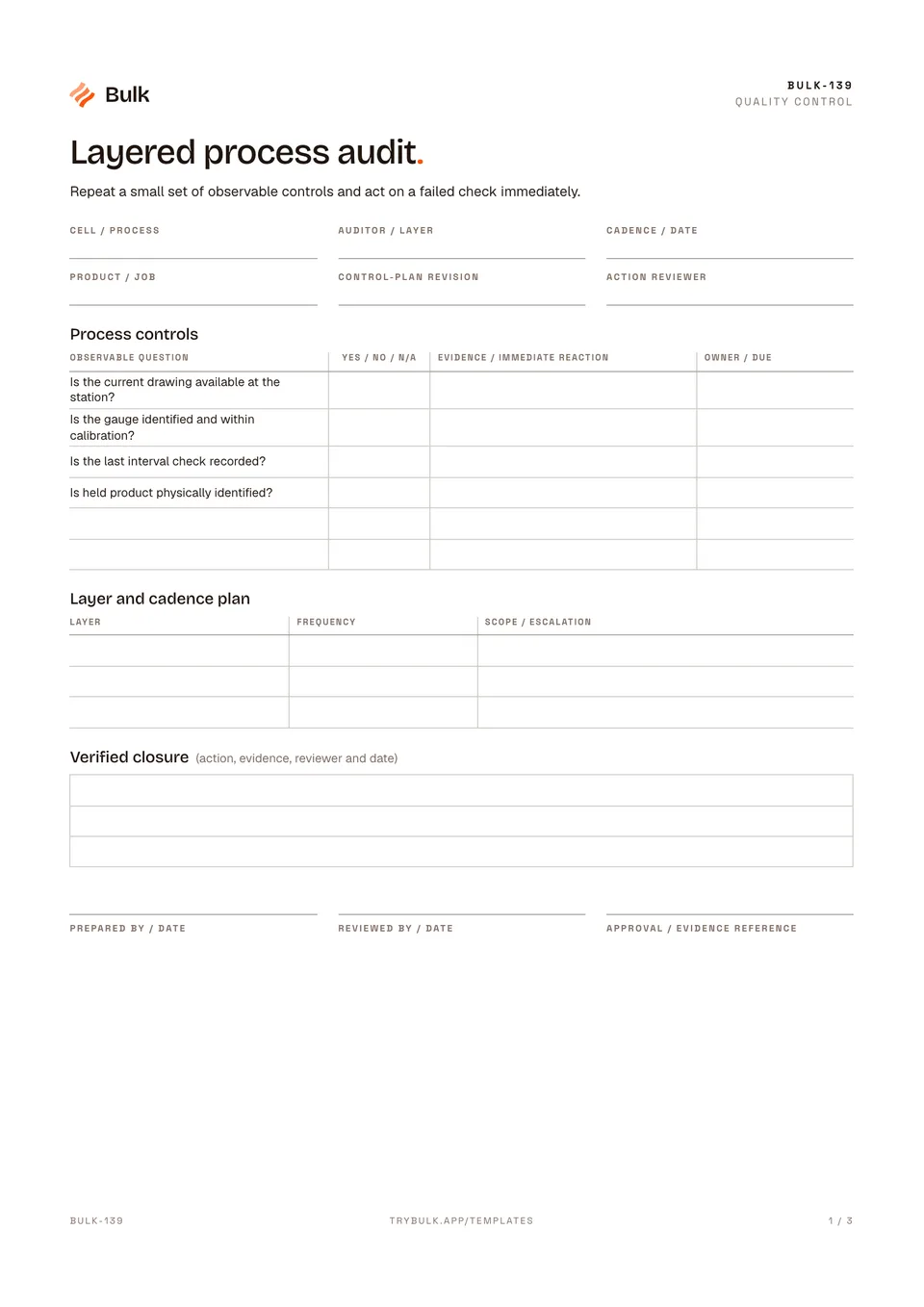
 Layered process auditRepeat a small set of observable controls and act on a failed check immediately.
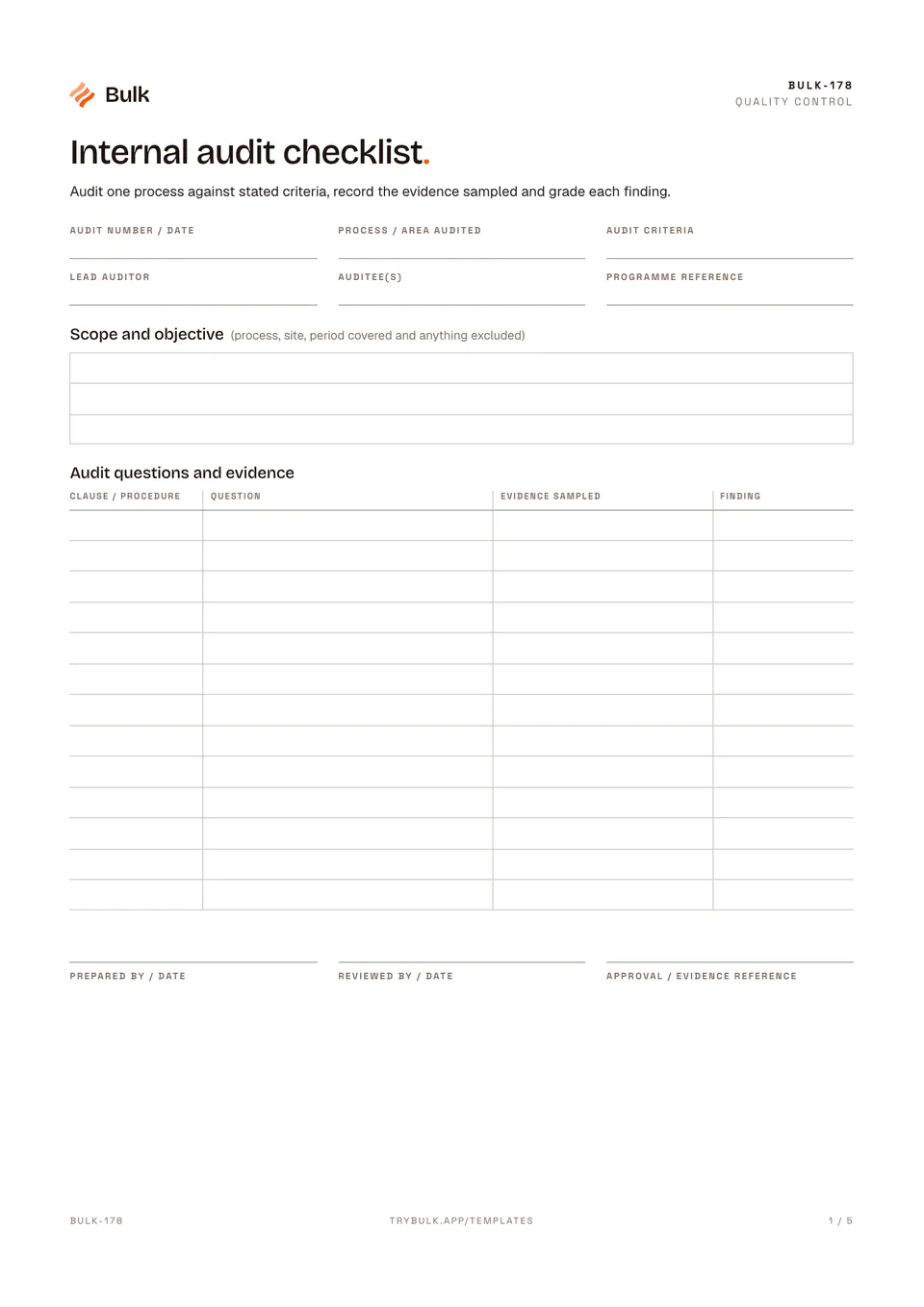
Internal audit checklist
Audit one process against stated criteria, record the evidence sampled and grade each finding.
What it's for
Audit one process against stated criteria, record the evidence sampled and grade each finding.
What you can download
Available files: PDF. Each PDF includes the blank form first, a fictional completed example and instructions. The download is free; enter your email to receive a secure link valid for seven days. Product-news consent is optional.
Completed manufacturing example
An internal auditor audits purchasing and goods-in against ISO 9001 clause 8.4 and the site’s purchasing procedure. Six questions each carry a clause reference and the evidence sampled: five of 42 supplier files, ten purchase orders, eight goods-in records, two calipers and two past supplier nonconformities.
Four questions conform. Two purchase orders omit the drawing revision the procedure requires, which is graded a minor nonconformity with a corrective-action reference, owner and due date, and a faded calibration label is recorded as an opportunity for improvement. The closing meeting summary records who attended, what was agreed and when the corrective-action plan is due.
When to use this template
Use it for planned internal audits under your audit programme, whether the criteria are ISO 9001 clauses, a customer requirement or your own procedures. The checklist supports an audit programme and does not certify conformity to ISO 9001 or any other standard; certification is decided by an accredited certification body.
For short, repeated checks of critical controls at the point of use, use the layered process audit. Carry nonconformities into a CAPA form, and record nonconforming product on a non-conformance report.
In Bulk, audits run from versioned templates on a schedule, capture photos and signatures as evidence, can create a task when an item fails and export as a PDF report. Explore Bulk audits and start a free trial to run it live, no card needed.
How to use it
- Plan from the audit programme: agree the scope, the criteria (a clause of ISO 9001 or another standard, or your own procedure) and the auditees before the day. Auditors do not audit their own work.
- Write questions from the criteria and note the clause or procedure section beside each. Record the evidence you actually sampled: document numbers, records, dates and people.
- Grade each question: conforms, minor nonconformity, major nonconformity, or opportunity for improvement. A finding states the requirement and the evidence that does not meet it.
- Present the findings at the closing meeting, agree corrective-action references and owners, and verify each action before it is closed.
Key features
- Scope and objective
- Audit questions and evidence
- Findings and corrective actions
- Closing meeting summary
- Audit conclusion
Ideal for
- Internal auditors working to an audit programme
- Quality managers preparing for certification or customer audits
Common uses
- Auditing one process against ISO 9001 clauses or your own procedures
- Recording the evidence sampled and grading each finding
- Linking findings to corrective actions and the closing meeting
Questions, answered.
01
What should an internal audit checklist include?
The audit scope, the criteria (a standard’s clauses or your own procedure), the auditor and auditees, questions with a clause reference, the evidence sampled, a graded finding for each question, corrective-action references and a summary of the closing meeting.
02
How do you use an ISO 9001 internal audit checklist?
Pick the process and the clauses that apply to it, write questions from those requirements, then sample real records and talk to the people who do the work. Record what you saw and grade each question. Use the edition of ISO 9001 your certificate references.
03
What is the difference between a minor and a major nonconformity?
A minor nonconformity is a single lapse that does not stop the process meeting its requirements. A major nonconformity is a missing or broken system, or a failure that affects product or customer. An opportunity for improvement is not a nonconformity.
04
Does a completed internal audit checklist prove ISO 9001 conformity?
No. It supports your audit programme and shows what was sampled. Certification is decided by an accredited certification body. Carry each nonconformity into a CAPA form and verify it before closing.
Related templates.
Layered process auditRepeat a small set of observable controls and act on a failed check immediately.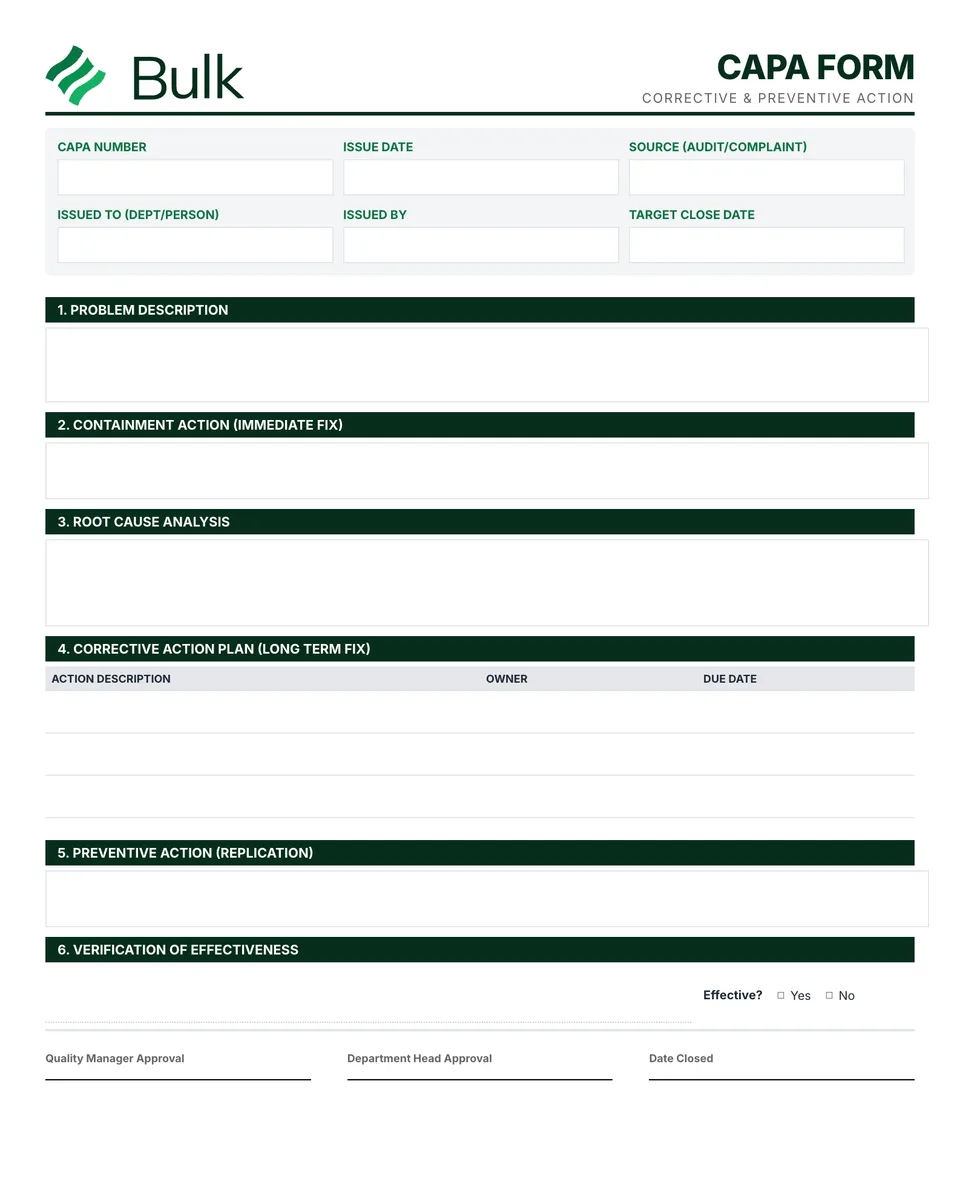 CAPA Form (Corrective & Preventive Action)Define the observed problem, scope and risk; link the NCR or complaint.
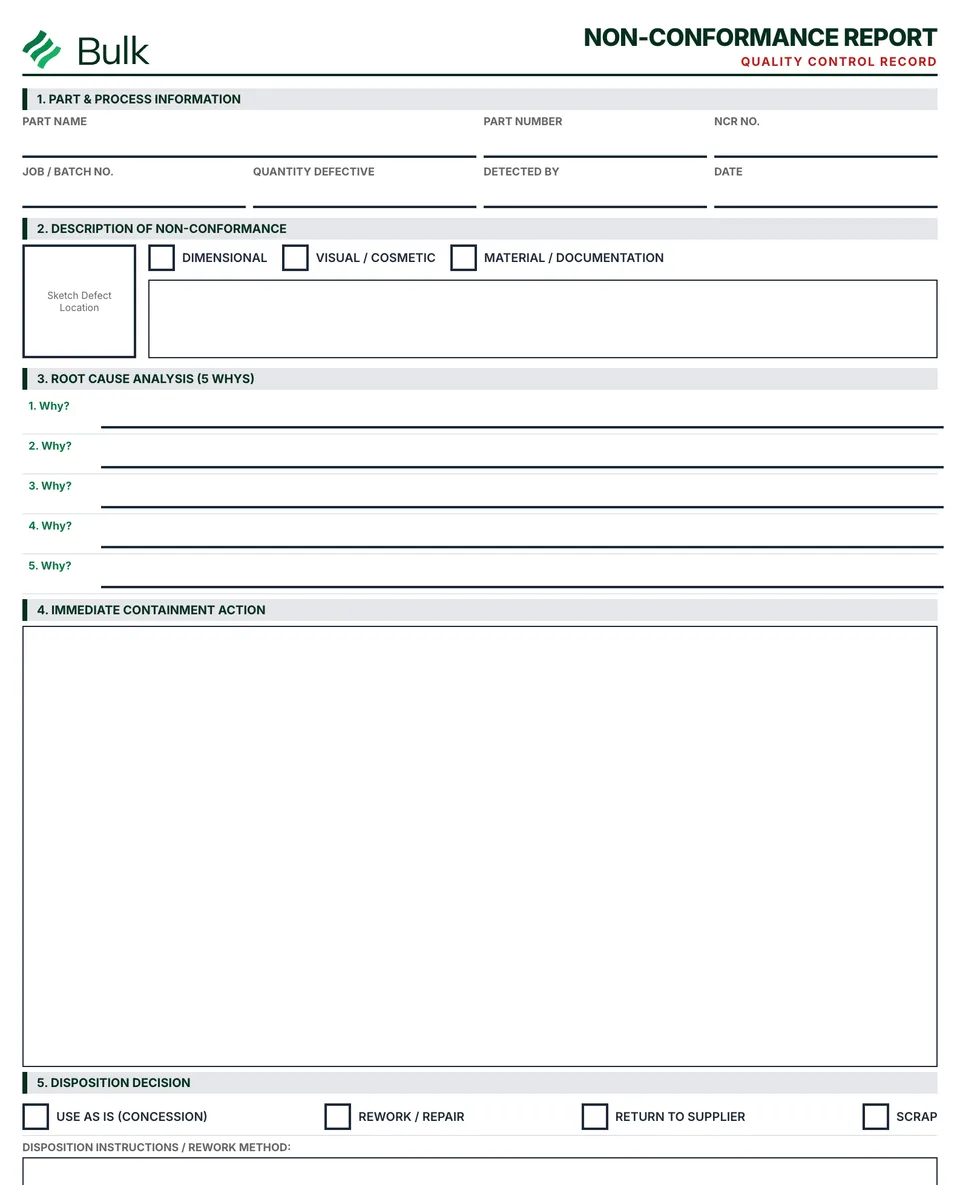 Non-Conformance Report (NCR)Identify the requirement and observed departure, using the part revision, lot, quantities and objective evidence..
Turn the form into a live workflow.
Bulk connects the same checks, evidence, owners and approvals to the work happening on your floor.