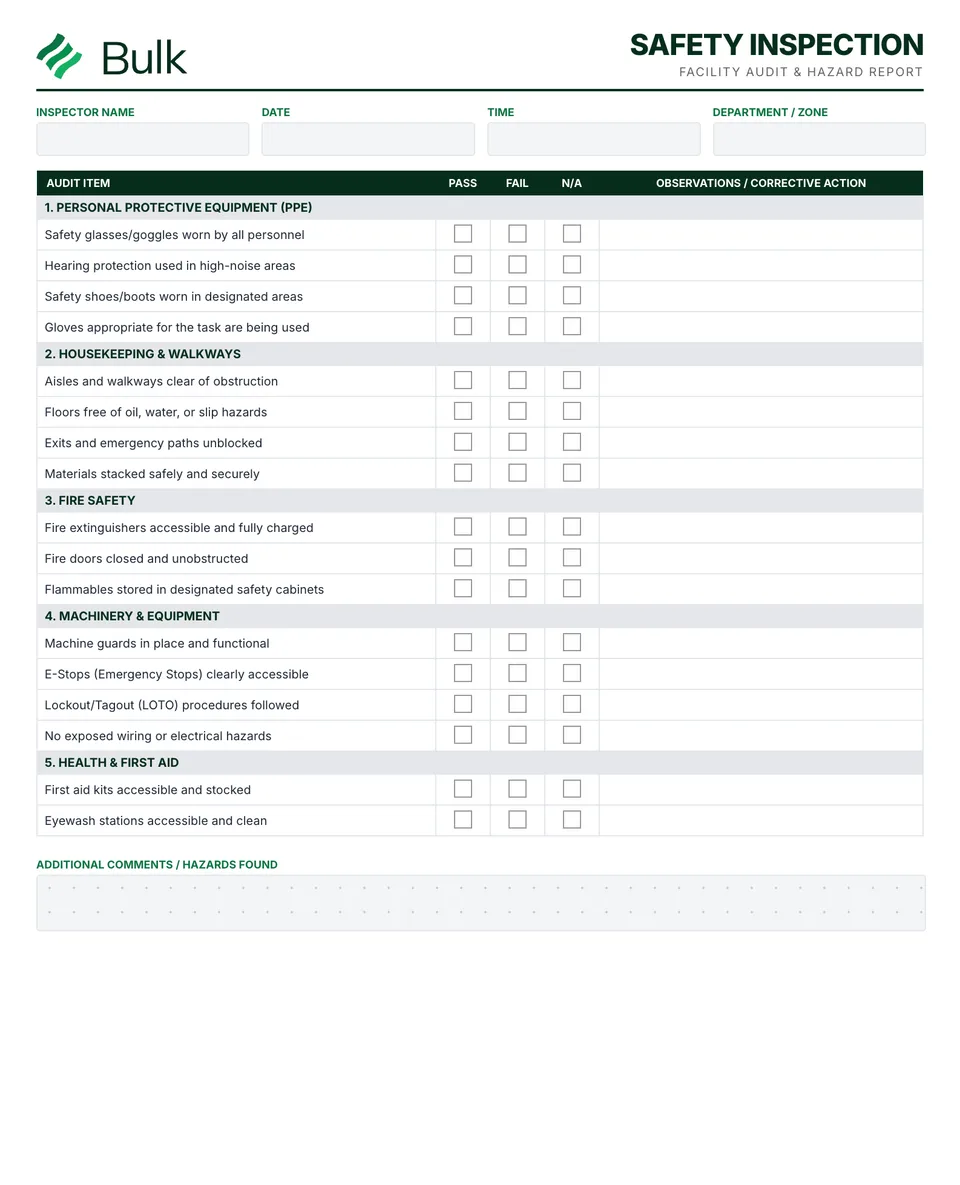
 Safety Inspection FormDefine the area, scope and applicable checks with the responsible people.
Fire extinguisher inspection checklist
Check every portable extinguisher on the route each month, record defects and keep the annual service dates in one place.
What it's for
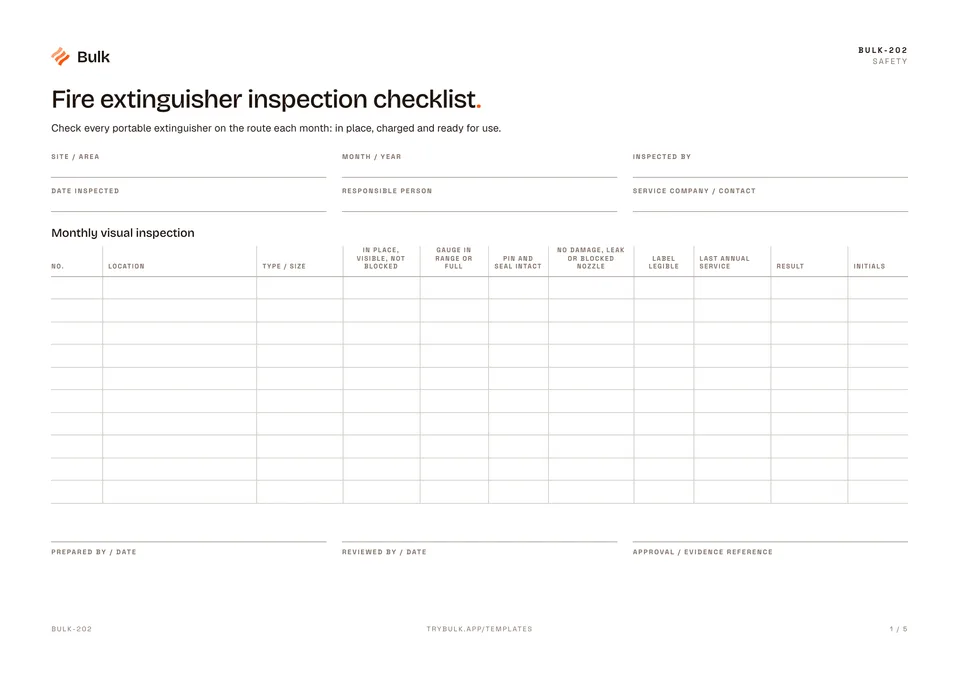
Check every portable extinguisher on the route each month, record defects and keep the annual service dates in one place. This free fire extinguisher inspection checklist is a monthly register for one area: one row per extinguisher, the checks that show it is in place, charged and ready for use, and what happened to any that failed.
What you can download
Available files: PDF. Each PDF includes the blank form first, a fictional completed example and instructions. The download is free; enter your email to receive a secure link valid for seven days. Product-news consent is optional.
The blank checklist is two A4 landscape pages. The header records the site or area, the month, who inspected and when, the responsible person and the service company. Page one is the monthly visual inspection register: for each extinguisher its number, location and type, five Y / N checks (in place, visible and not blocked; gauge in range or full; pin and seal intact; no damage, leak or blocked nozzle; label legible), the last annual service, the result and the inspector’s initials. Page two holds the defects and actions, including the equivalent cover put in place, and the annual maintenance, six-year maintenance and hydrostatic test dates for each extinguisher.
What OSHA requires
In general industry, OSHA’s portable fire extinguisher standard makes the employer responsible for inspection, maintenance and testing of every portable extinguisher in the workplace (29 CFR 1910.157(e)(1)). The rule sets three intervals:
- Monthly: a visual inspection of every portable extinguisher (1910.157(e)(2)). OSHA defines an inspection as a visual check that equipment is in place, charged and ready for use.
- Annually: a maintenance check, with the date recorded and the record kept for one year after the last entry or the life of the shell, whichever is less (1910.157(e)(3)).
- Every six years and at hydrostatic test intervals: stored-pressure dry chemical extinguishers that need a 12-year hydrostatic test are emptied and maintained every six years, counted from the last recharge or test (1910.157(e)(4)); hydrostatic test intervals are listed in Table L-1 of 1910.157(f), for example five years for carbon dioxide.
While an extinguisher is away for maintenance or recharge, equivalent protection must be provided (1910.157(e)(5)). Many sites also follow NFPA 10, Standard for Portable Fire Extinguishers, through their fire code or insurer; OSHA has noted that NFPA 10’s inspection at about 30-day intervals is consistent with its monthly rule. Use the edition your fire authority adopts and add its items to the checks.
How to complete the checklist
- Walk the route in the same order every month and list every extinguisher, including spares and any that are missing.
- For each one, mark the five checks Y or N.
- Read the date of the last annual service from the tag or the service record.
- Give any N a defect number and write the result: pass, fixed on the spot, or fail.
- On page two, record what was done about each defect, the equivalent cover provided and when it was closed.
- Keep the annual maintenance, six-year maintenance and hydrostatic test dates up to date after each service visit.
Completed manufacturing example
In the fictional example, eight extinguishers in a fabrication hall are inspected on 5 October. Five pass. One in the saw bay is blocked by a pallet of sheet; the pallet is moved on the spot and the floor marking repainted, so it is recorded as fixed. One in a weld bay has its gauge needle in the recharge zone, and one in the paint store has a broken tamper seal. Both are removed for service, a spare is hung in each place the same day, and the service company returns them on 9 October.
The annual record on page two shows how the dates connect. The extinguisher recharged on 9 October has its six-year maintenance date reset to October 2032, because the six-year clock starts again from a recharge. The carbon dioxide unit has no six-year maintenance and a five-year hydrostatic test interval.
Common fire extinguisher inspection mistakes
- Initialling a tag without looking. A tick on the tag is not a check that the gauge, seal and access are right.
- Missing units. A register in route order shows an empty bracket; a pile of tags does not.
- Leaving a gap in cover. An extinguisher taken away for recharge needs an equivalent one in its place.
- Mixing up monthly and annual. The monthly check is visual; the annual check is maintenance, usually by a service company.
When to use this template
Use it for the monthly inspection of portable extinguishers in a plant, warehouse or workshop, and to keep their service dates together. It is a record of inspections and service dates. It does not certify compliance with OSHA 29 CFR 1910.157, NFPA 10 or any fire code, and it does not replace the annual maintenance and hydrostatic testing done by trained persons.
Continue with the safety inspection form for a wider area walk, the hot work permit where welding or cutting needs a fire watch, or the incident report form if an extinguisher was used.
In Bulk, a Safety audit can be scheduled monthly against an area, so the due check appears in the Audits inbox of everyone who covers that area and moves to Overdue if it is not done. A failed item can require a photo or comment and raise a follow-up task. Explore Bulk audits and start a free trial to run it live, no card needed.
How to use it
- Inspect every portable extinguisher on the route once a month, and when one is first placed in service. Use one row per extinguisher, in route order, so a missing unit shows as a gap.
- A monthly inspection is a visual check that each extinguisher is in place, charged and ready for use. Mark each check Y or N; any N is a defect with its own number.
- Fix what you can on the spot and record it. Remove an extinguisher that is discharged, damaged or has a broken seal, and provide equivalent cover while it is away for service.
- Record each annual maintenance date and keep the record for one year after the last entry or the life of the shell, whichever is less. Keep six-year maintenance and hydrostatic test dates with it.
Key features
- Monthly visual inspection register, one row per extinguisher
- In place, charged and ready-for-use checks
- Defects and actions, with equivalent cover recorded
- Annual maintenance, six-year maintenance and hydrostatic test dates
Ideal for
- Facilities, maintenance and safety staff who walk the extinguisher route each month
- Plants that keep extinguisher records ready for an inspector or insurer
Common uses
- Recording the monthly visual inspection of every portable extinguisher in an area
- Tracking defects through to recharge, service or replacement
- Keeping annual maintenance and test due dates beside the monthly checks
Questions, answered.
01
How often should fire extinguishers be inspected?
OSHA requires portable extinguishers in general industry workplaces to be visually inspected monthly and to have an annual maintenance check (29 CFR 1910.157(e)(2) and (e)(3)). NFPA 10 also calls for inspection when an extinguisher is first placed in service and at about 30-day intervals, and more often when circumstances require.
02
What do you check in a monthly fire extinguisher inspection?
OSHA defines an inspection as a visual check that equipment is in place, charged and ready for use. In practice that means it is in its designated place, visible and not blocked; the gauge is in the operable range or it is full by weight; the pin and tamper seal are intact; there is no damage, corrosion, leakage or blocked nozzle; and the label is legible.
03
How long do you keep fire extinguisher inspection records?
OSHA requires the annual maintenance date to be recorded and the record kept for one year after the last entry or the life of the shell, whichever is less. Hydrostatic test records are kept until the next test or until the extinguisher leaves service. Your insurer or fire authority may ask for more.
04
Who can do the monthly fire extinguisher inspection?
A monthly visual inspection is usually done by a trained member of staff. Annual maintenance is normally done by a fire-protection service company, and hydrostatic testing must be done by trained persons with suitable equipment (1910.157(f)(1)).
05
Does this checklist make us OSHA or NFPA 10 compliant?
No. It is a record of inspections and service dates. Compliance depends on how your extinguishers are selected, placed, maintained and tested, and on the rules your fire authority applies. Adapt the checks to your site and the codes you follow.
Related templates.
Safety Inspection FormDefine the area, scope and applicable checks with the responsible people.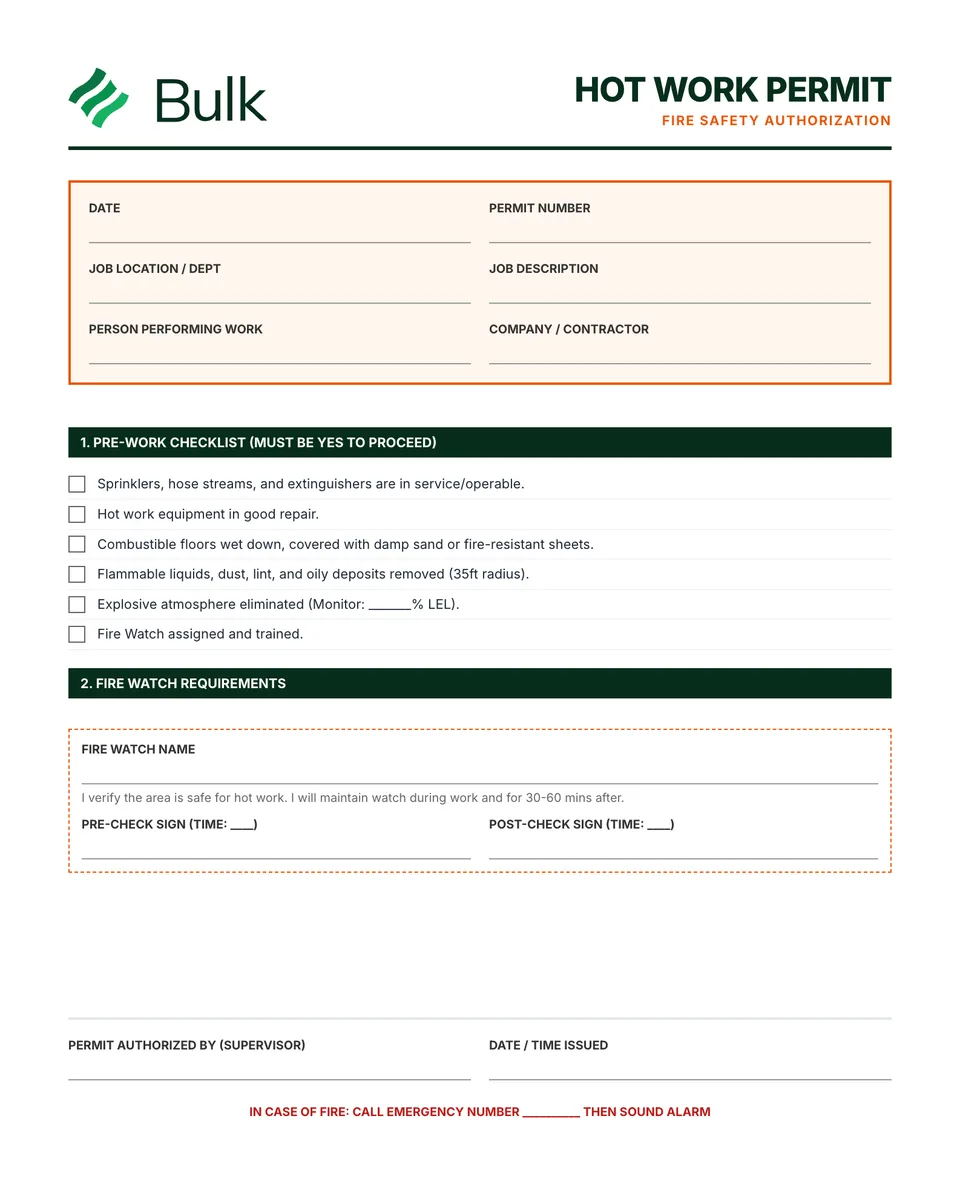 Hot Work PermitIdentify the job, location and proposed method, and consider whether the work can be moved or completed without hot work.
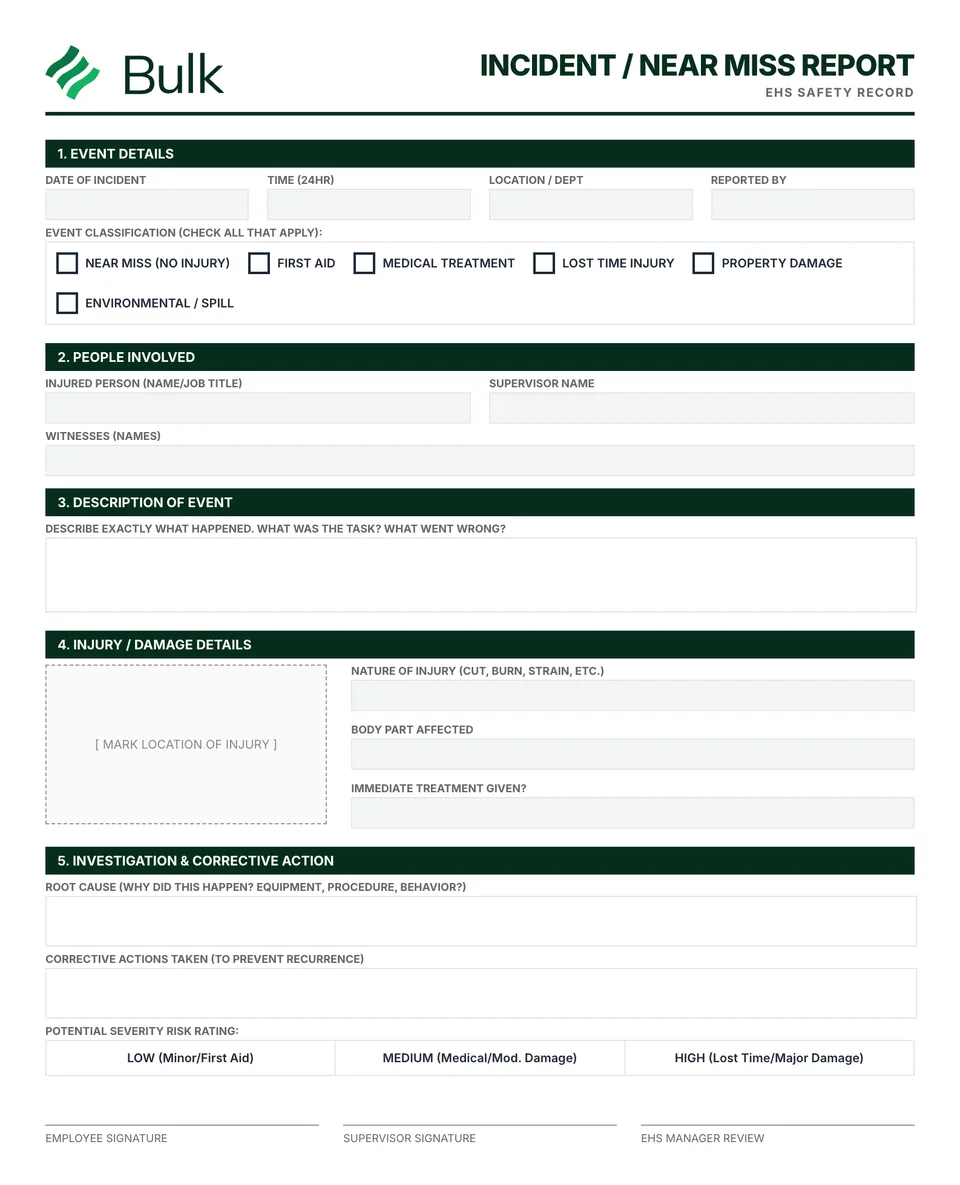 Incident Report FormFollow the emergency response process first.
Turn the form into a live workflow.
Bulk connects the same checks, evidence, owners and approvals to the work happening on your floor.