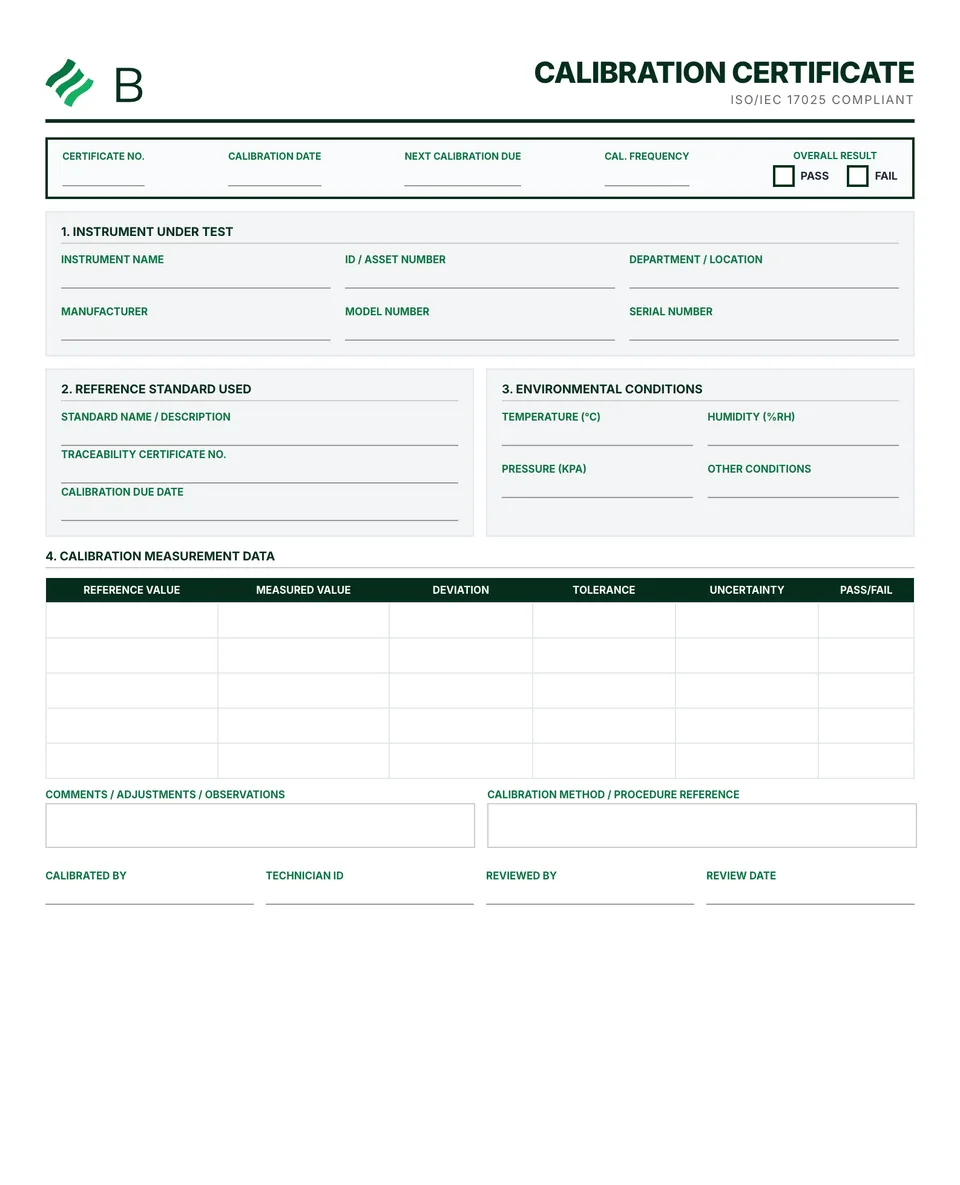
 Equipment Calibration RecordIdentify the instrument, range, method, reference standard and current traceability evidence.
Gage R&R study
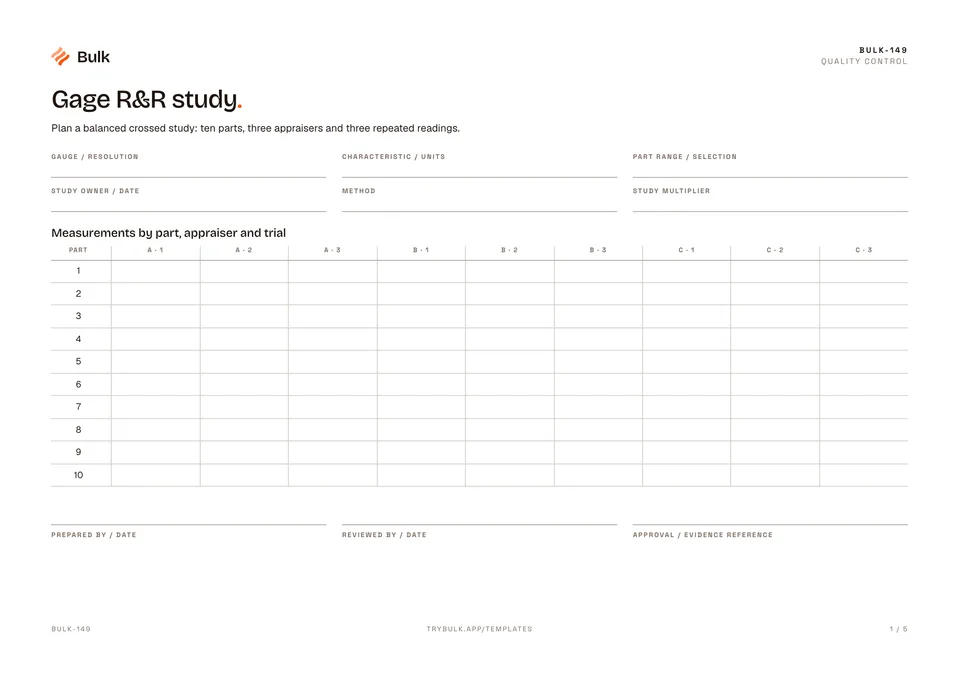
Plan a balanced crossed study: ten parts, three appraisers and three repeated readings.
What it's for
Plan a balanced crossed study: ten parts, three appraisers and three repeated readings.
What you can download
Available files: PDF, Excel. Each PDF includes the blank form first, a fictional completed example and instructions. The Excel workbook includes an unused template and a separate completed example, with labelled inputs, calculation cells and print settings. The download is free; enter your email to receive a secure link valid for seven days. Product-news consent is optional.
Completed manufacturing example
Ten stable parts, three appraisers and three repeats produce 90 readings. The balanced crossed ANOVA example gives Gage R&R variance 0.00013422 mm², Gage R&R standard deviation 0.01158543 mm and 9.5248% of study variation, with ndc 14.
The model retains part-by-appraiser interaction and displays raw estimates while truncating negative variance components at zero. All 90 numeric readings are required. These results describe the example study; acceptance depends on its purpose and the applicable requirements.
When to use this template
Requires metrology/statistical review of the study design and decision. Unsuitable for destructive tests, nested designs or unbalanced data. Method reference: NIST/SEMATECH e-Handbook, measurement-process characterisation.
The analysis is a balanced crossed two-way random-effects ANOVA. It does not support missing readings, destructive measurement, a nested study or an unbalanced design.
Continue with Equipment Calibration Record, Individuals control chart, Process control plan.
For shared records, evidence and follow-up, explore Bulk quality. Start a free trial to run it live, no card needed.
How to use it
- Use ten stable parts representing the process range, three appraisers and three repeats per combination. This workbook supports only that balanced crossed design.
- The workbook requires all 90 numeric readings. Missing, text or incomplete cells stop the analysis. Review randomisation, resolution and measurement drift before interpreting results.
- The two-way random-effects ANOVA retains part-by-appraiser interaction. Negative variance estimates are truncated at zero and raw estimates remain visible. No universal acceptance cutoff is supplied.
Key features
- Measurements by part, appraiser and trial
- Study controls
- Variance-component summary
- Interpretation and limitations
Ideal for
- Metrology and quality teams working with an appropriate statistical reviewer
Common uses
- Analysing a complete balanced, non-destructive crossed measurement study
Related templates.
Equipment Calibration RecordIdentify the instrument, range, method, reference standard and current traceability evidence.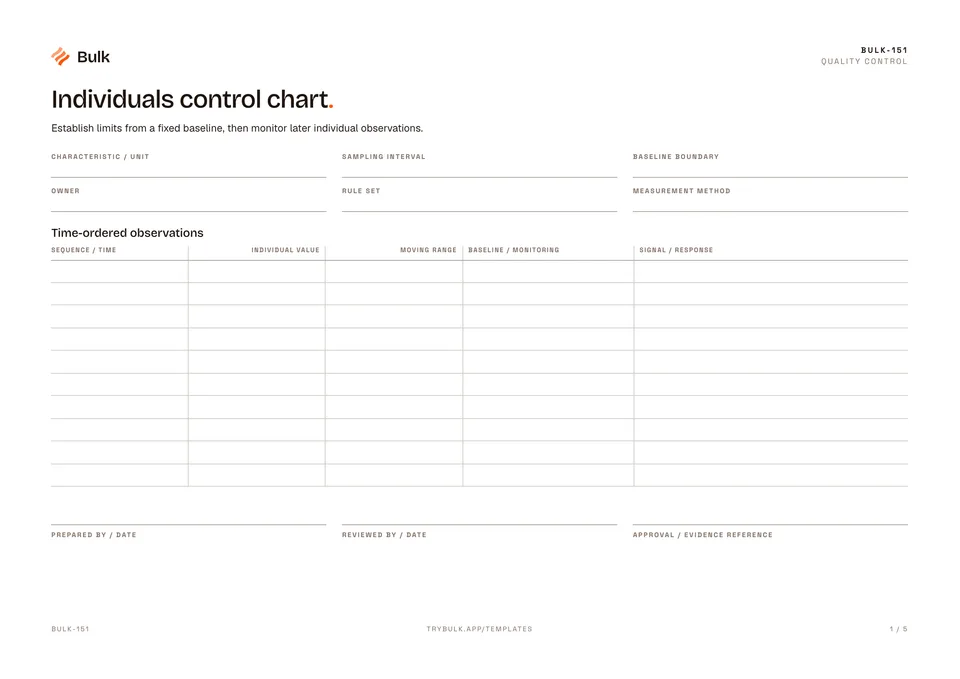 Individuals control chartEstablish limits from a fixed baseline, then monitor later individual observations.
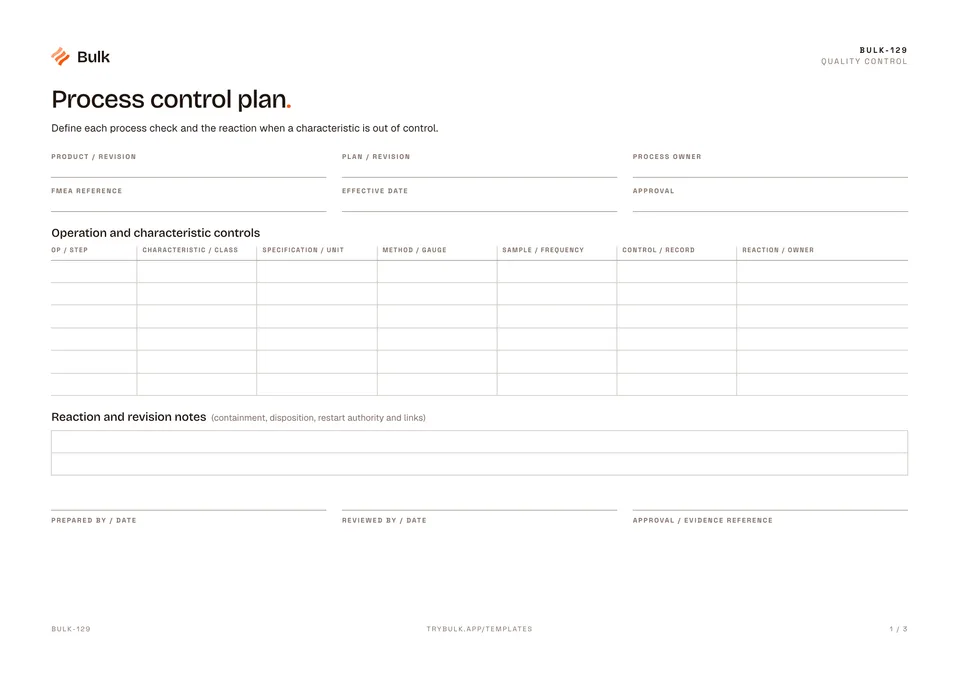 Process control planDefine each process check and the reaction when a characteristic is out of control.
Turn the form into a live workflow.
Bulk connects the same checks, evidence, owners and approvals to the work happening on your floor.