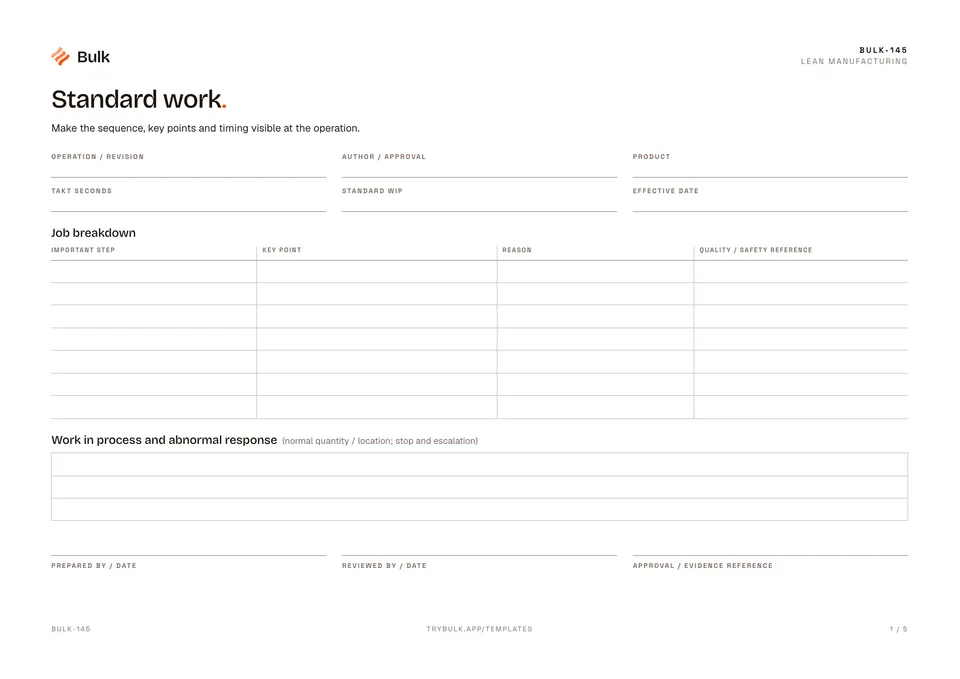
 Standard workMake the sequence, key points and timing visible at the operation.
Leader Standard Work Template
Plan a team leader's daily and weekly routine, mark each slot done or missed, and follow up what it finds.
What it's for
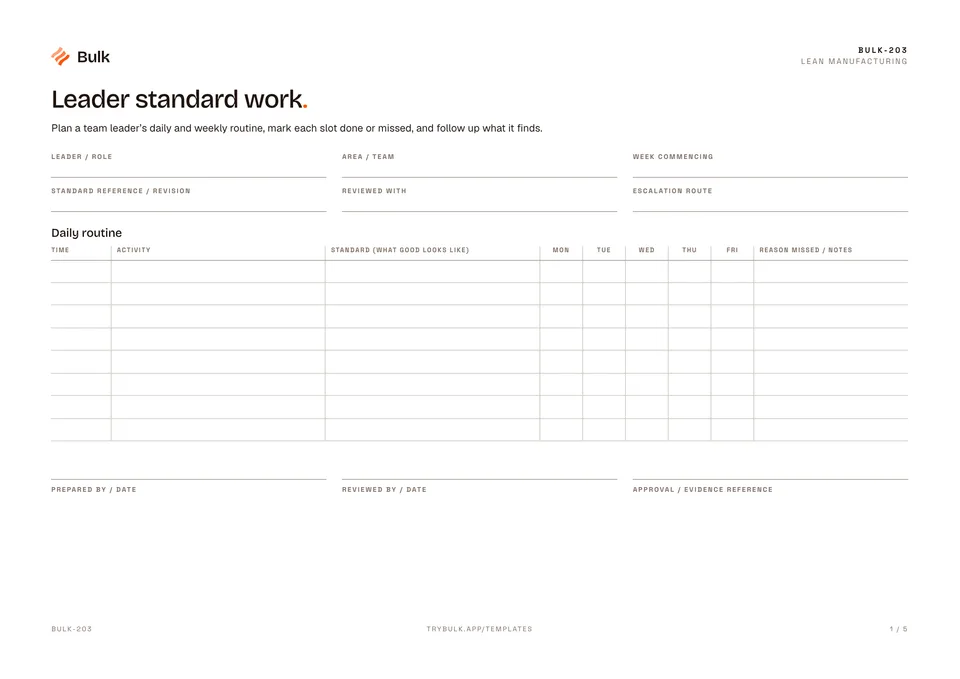
Plan a team leader’s daily and weekly routine, mark each slot done or missed, and follow up what it finds. This free leader standard work template puts one leader’s week on one sheet: the timed daily routine and its standards, the weekly and monthly tasks, the actions that come out of them and the weekly review with their manager.
What you can download
Available files: PDF. Each PDF includes the blank form first, a fictional completed example and instructions. The download is free; enter your email to receive a secure link valid for seven days. Product-news consent is optional.
The blank template is two A4 landscape pages. The header records the leader and role, the area or team, the week, the standard’s reference and revision, who it is reviewed with and the escalation route. Page one is the daily routine: one row per activity with its time, what it involves and the standard that says what good looks like, a Y / N mark for each weekday and a column for why a slot was missed. Page two holds the weekly and monthly tasks, the actions and escalations raised during the week, and the weekly review with the leader’s manager.
What leader standard work is
Operator standard work describes how one operation is done. Leader standard work describes what the leader does every day and week to keep those standards in place: checking that people and stations are ready, running the stand-up, going to see the work, checking a standard with the operator who follows it, reviewing output against plan and handing over. A Lean Enterprise Institute article on getting started advises starting simple and improving the sheet through plan, do, check and adjust, so it changes as the area does.
It is written down for the same reason operator work is. A routine on paper can be followed by a new leader, covered when someone is away, and improved when it does not work. The done / missed marks show which parts slip and why, which is where the routine or the area needs attention.
What a good leader standard work sheet includes
- Times, not just tasks. A slot at 07:30 gets done; “hold a stand-up” floats.
- A standard for each activity. What good looks like, so the check means something.
- Room for a reason. Every N has a short reason, which is what the weekly review discusses.
- Daily, weekly and monthly layers. Only the essentials are daily; audits and reviews sit on a weekly or monthly cadence.
- An action list. What the routine finds is only useful if it gets an owner and a date.
- An escalation route. What the team cannot fix goes somewhere named, at a named time.
How to complete the template
- Fill in the header, including the escalation route.
- List the daily activities in time order, each with its standard.
- Through the week, mark each slot Y or N and write the reason for each N.
- Add the weekly and monthly tasks and date them when done.
- Log every action or escalation with an owner and a due date, and close it when it is done.
- At the end of the week, review the sheet with your manager and record what to change.
Completed manufacturing example
The fictional example is a week for a machining cell team lead. The daily routine has seven slots, from a 06:00 staffing check against the skills matrix to the 14:00 handover. Thirty-three of the 35 slots are done. Thursday’s station check is missed because the leader was covering an absent setter, and Wednesday’s output review because of a customer visit. Monday’s stand-up overran to 18 minutes.
The weekly and monthly tasks show a layered process audit with one finding, the monthly skills matrix review and a 5S audit moved to the following week. Three actions came out of the routine: a coolant concentration check added to machine start-up, a missing gauge replaced on a shadow board, and late bar stock escalated to the tier 2 meeting, still open. In the weekly review the leader and manager agree to prepare the board on Friday afternoon so Monday’s stand-up stays short.
Common leader standard work mistakes
- A day with no slack. If the routine only works on a quiet day, it will be abandoned on a busy one.
- Treating N as failure. Missed slots are the information; a sheet that is always all Y is not being filled in honestly.
- Checks with no follow-up. Findings that never become actions teach the team that the walk does not matter.
- Never changing it. The routine should change when the area, the product or the problems change.
When to use this template
Use it to write and run a team leader’s or supervisor’s routine, or to coach a leader through their first months in the role. It describes a routine and its follow-up. It does not replace operator standard work, safety inspections or your site’s escalation procedure.
Continue with the standard work template for the operator side, the gemba walk checklist for each walk, and the SQDCP board for the daily stand-up.
In Bulk, a teamboard runs the stand-up: each column is coloured day by day from KPIs and daily audit schedules, so an audit not completed shows on the board, and actions raised at the board become tasks with a due date and assignees. Explore Bulk teamboards and start a free trial to run it live, no card needed.
How to use it
- Write the routine from what the area needs: the checks that keep standards in place, the meetings that bring problems to the surface and the time to go and see the work.
- Give every activity a time and a standard that says what good looks like. Keep the daily part short enough to finish on a normal day; move the rest to weekly or monthly tasks.
- Mark each slot Y (done) or N (missed) and write why it was missed. A missed slot is information about the system, not a score for the leader.
- Log what each check or meeting finds as an action with an owner and a due date, and escalate what the team cannot fix.
- Review the sheet with your manager each week and change the routine when the area changes.
Key features
- Daily routine with times, standards and done / missed marks
- Reasons for missed slots
- Weekly and monthly tasks
- Actions and escalations with owners and dates
- Weekly review with your manager
Ideal for
- Team leaders, supervisors and value-stream managers building a daily management routine
- Operations managers coaching leaders through a weekly review
Common uses
- Writing a team leader's daily and weekly routine
- Showing which parts of the routine slip, and why
- Keeping actions from stand-ups and station checks owned and dated
Questions, answered.
01
What is leader standard work?
Leader standard work is a leader's own routine, written down like operator standard work: the checks, meetings and walks they do each day and week to keep standards in place and bring problems to the surface. It is most often written for team leaders and supervisors, and can extend to managers.
02
What should a leader standard work template include?
Timed daily activities with a standard for each, a way to mark each slot done or missed with the reason, weekly and monthly tasks, the actions and escalations the routine turns up, and a weekly review with the leader's manager.
03
How is leader standard work different from standard work?
Standard work describes one operation for the operator who does it, with the sequence, key points and timing. Leader standard work describes the leader's routine around that work, including checking that operator standard work is being followed.
04
What goes into a team leader's daily routine?
Typically a start-of-shift check of staffing, a walk of the area, a short stand-up at the team board such as an SQDCP board, an escalation meeting, a check of one standard at one station, a review of output against plan and the handover. A gemba walk checklist records each walk in more depth.
Related templates.
Standard workMake the sequence, key points and timing visible at the operation.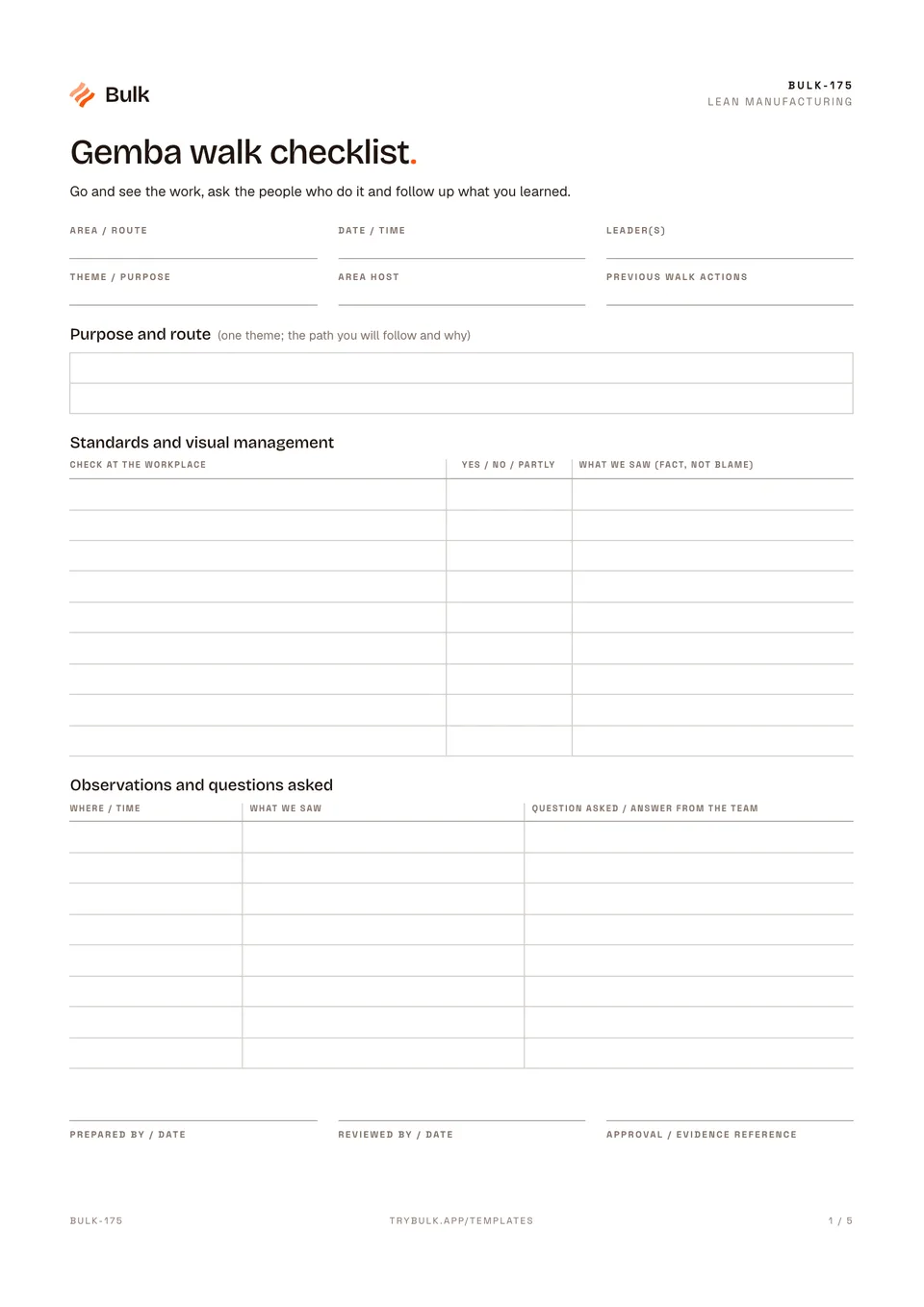 Gemba walk checklistGo and see the work, ask the people who do it and follow up what you learned.
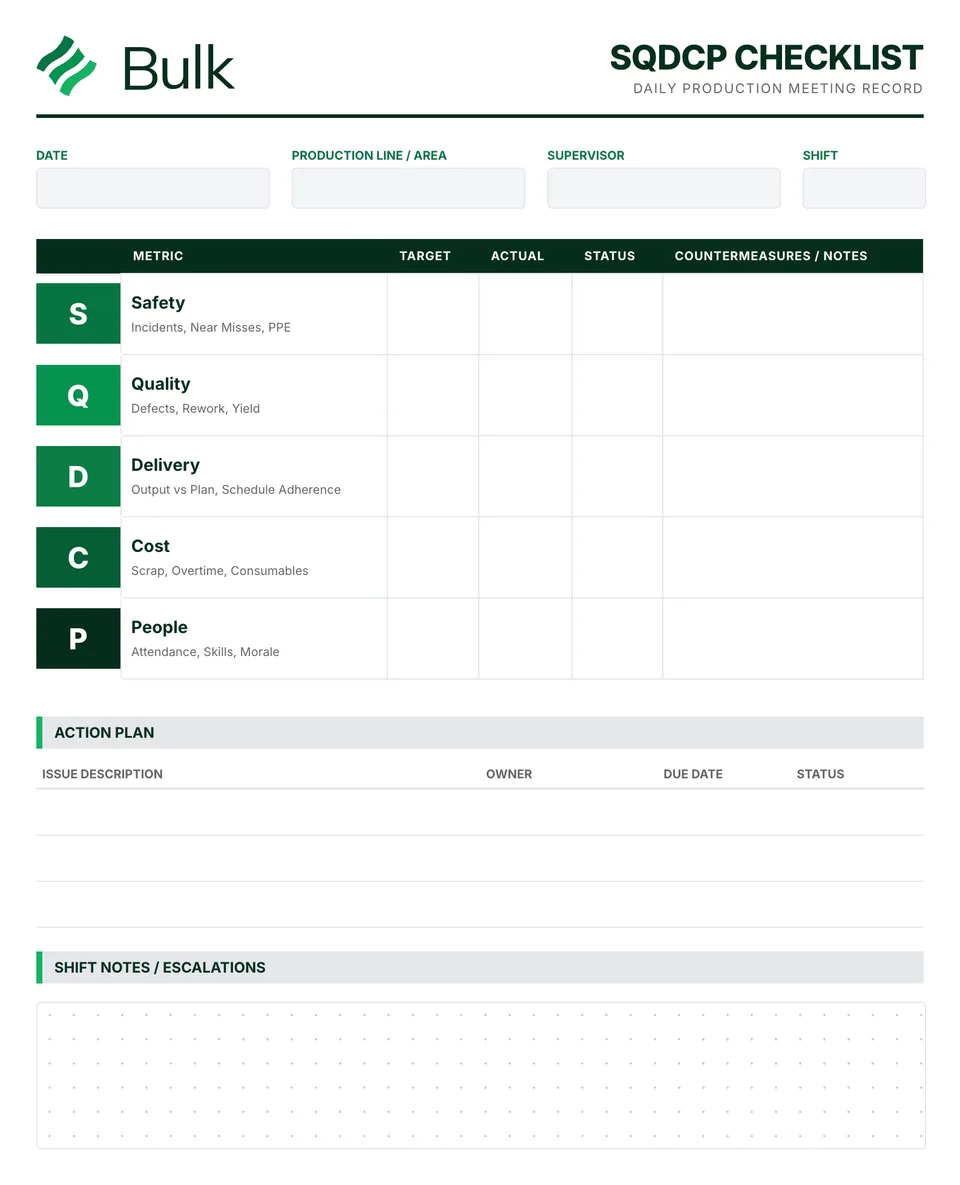 SQDCP Board TemplateDefine a target and an actual measure for Safety, Quality, Delivery, Cost and People.
Turn the form into a live workflow.
Bulk connects the same checks, evidence, owners and approvals to the work happening on your floor.