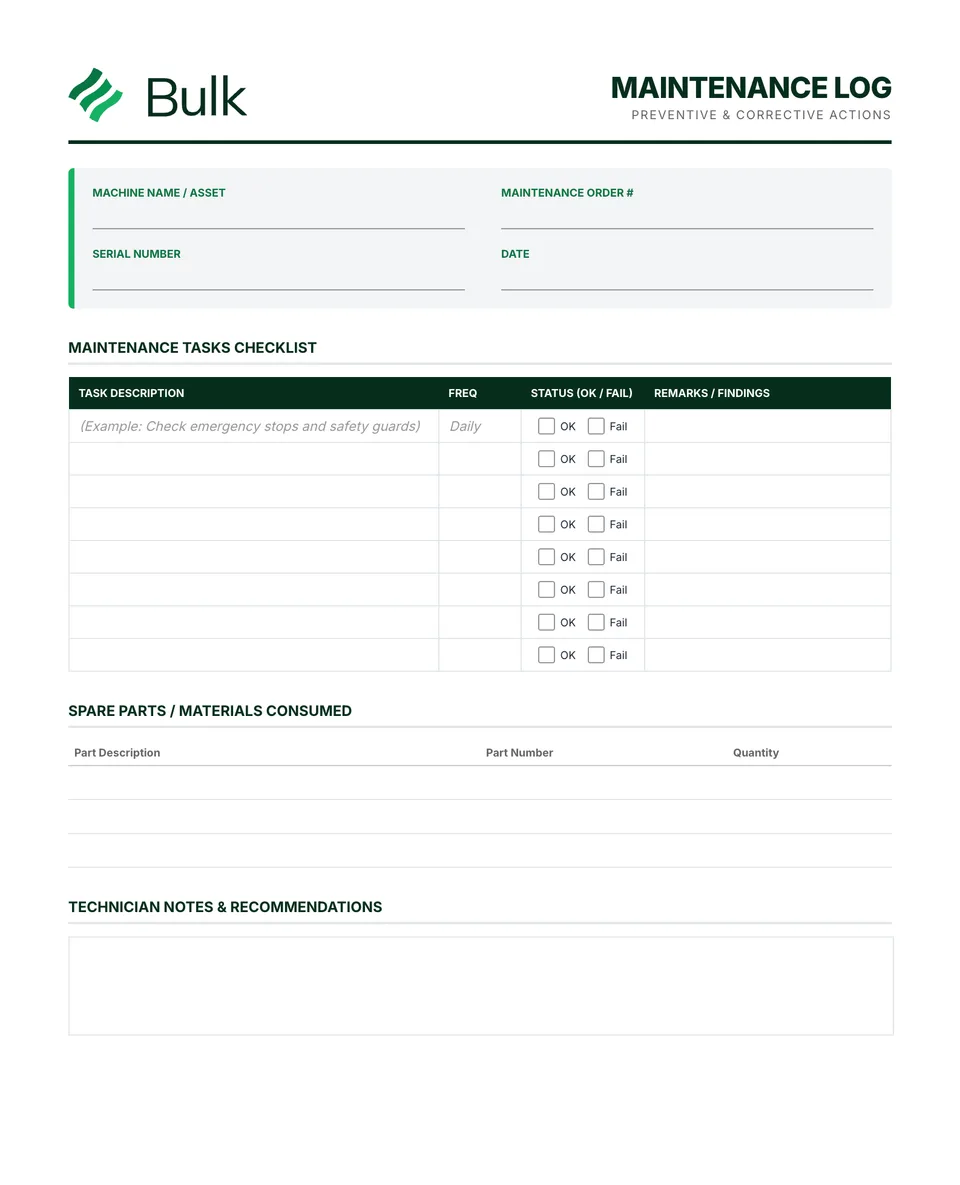
 Equipment Maintenance LogIdentify the asset and work order.
Preventive-maintenance schedule
Plan calendar and runtime maintenance without treating hours as dates.
What it's for
Plan calendar and runtime maintenance without treating hours as dates. This free preventive maintenance schedule template lists every planned task with its interval and next due point, so the due list doubles as a preventive maintenance checklist for the planning window.
What you can download
Available files: PDF, Excel. Each PDF includes the blank form first, a fictional completed example and instructions. The Excel workbook includes an unused template and a separate completed example, with labelled inputs, calculation cells and print settings. The download is free; enter your email to receive a secure link valid for seven days. Product-news consent is optional.
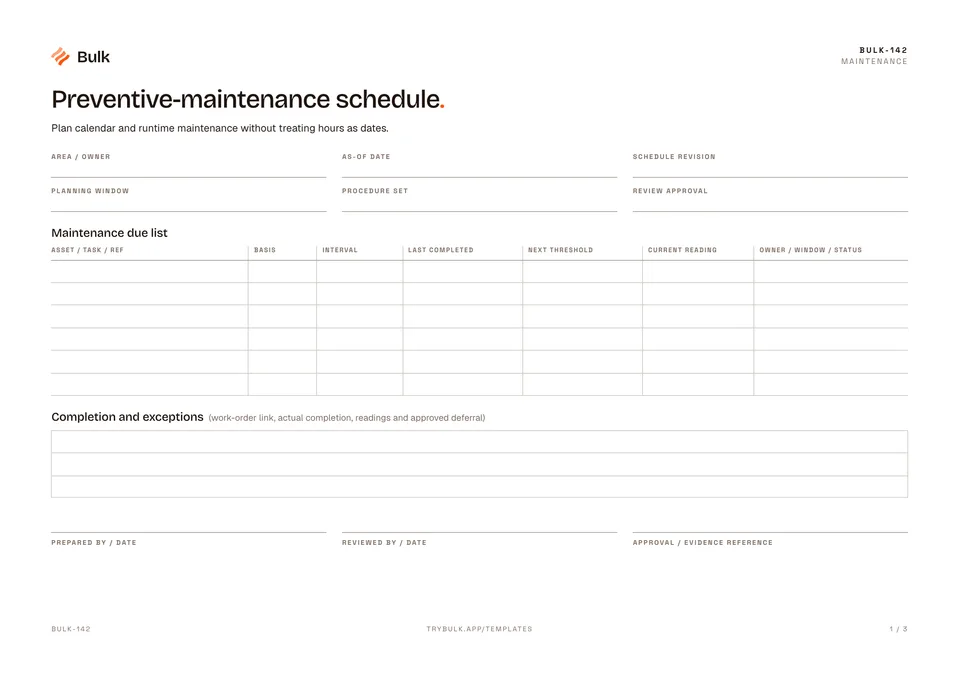
The blank schedule is one A4 landscape page. The header records the area and owner, as-of date, schedule revision, planning window, procedure set and review approval. The maintenance due list has one row per task with columns for asset, task and procedure reference, basis (days or runtime), interval, last completed, next threshold, current reading, and owner, window and status. A completion and exceptions box below links work orders, actual completions, readings and any approved deferral.
Preventive maintenance schedule vs checklist
A preventive maintenance schedule answers “what is due, on which asset, and when?” across a whole area. A preventive maintenance checklist is often used for the same thing (a list of due PM tasks to tick off), and sometimes for the step-by-step list a technician follows during one task. This template is the schedule and the due-work checklist. The steps for each task come from its procedure reference (PM-12 and PM-14 in the example), the completed work is recorded in an equipment maintenance log, and daily operator care checks sit on a TPM checklist.
What a good preventive maintenance schedule includes
- Every asset and task with a procedure reference, so the schedule points to how the work is done.
- A basis for each task. Calendar days or runtime hours, never mixed in one comparison.
- An approved interval from the manufacturer’s procedure and your operating conditions.
- Last completed and next threshold in the same unit as the interval.
- A current reading for runtime tasks. A blank reading means unknown, not fine.
- An owner and status (upcoming, due, overdue) for the planning window.
- Exceptions with authority. Any deferral has an owner, a reason and an approval.
How to build a preventive maintenance schedule
- List the assets in the area and, for each, the PM tasks from the manufacturer’s manual and your own procedures.
- Decide whether each task runs on calendar days or runtime hours, and set the approved interval.
- Enter the last completion date or reading, then calculate the next threshold as last completion plus interval.
- Record the current date and each runtime reading, and compare dates with dates and hours with hours.
- Mark each task upcoming, due or overdue, give it an owner and a window, and plan access with production.
- When a task is done, record it in the maintenance log first, then update the last completed value. Record any approved deferral in the exceptions box.
Calendar-based vs runtime-based PM
Calendar-based tasks fall due after a fixed number of days, whether or not the machine ran: belt inspections, filter checks, safety device tests. Runtime-based (usage-based) tasks fall due after a number of operating hours or cycles: lubrication, wear parts, oil changes. The schedule keeps them in separate comparisons because converting hours into a date requires a forecast of utilisation, which this template deliberately does not make.
Completed manufacturing example
A calendar task completed on 20 August with a 30-day interval is due on 19 September. A runtime task last completed at 1,000 hours with a 250-hour interval is already overdue at a current reading of 1,260 hours.
Dates and runtime readings use separate comparisons. A missing reading stays unknown. The maintenance log records the completed work; this schedule identifies due work and retains approved exceptions.
The example covers cell B, owned by Jon, as of 14 September 2026 with a 30-day planning window and procedures drawn from the manufacturer’s manuals and PM work instructions. Drill D-1’s belt inspection (PM-12) is upcoming, planned for 18 September. Press P-2’s lubrication (PM-14) was due at 1,250 hours and is overdue at 1,260, so its status is “hold and plan” with Lee as owner.
Common preventive maintenance mistakes
- Treating hours as dates. A 250-hour interval does not mean “about every month” unless utilisation is measured.
- Updating last completed before the work is done. The schedule then shows a task as current when it is not.
- Leaving readings blank and assuming all is well. Unknown is its own status.
- Intervals nobody can trace. Every interval should come from a procedure or an approved decision.
- Silent deferrals. Skipping a task without an owner and approval turns preventive maintenance into breakdown maintenance.
When to use this template
No runtime-to-date forecast is made. Safety-related inspection requirements need the site’s competent review.
Continue with Equipment Maintenance Log, TPM Checklist (Total Productive Maintenance), Calibration schedule.
For shared records, evidence and follow-up, explore Bulk tasks and projects. Start a free trial to run it live, no card needed.
How to use it
- Use days for calendar tasks and hours for runtime tasks. Set intervals from the approved procedure and operating conditions.
- Next threshold = last completion + interval. Compare dates only with dates and hours only with runtime readings.
- Blank readings remain unknown. Plan overdue tasks and document any approved exception; use the existing maintenance log for execution evidence.
Key features
- Maintenance due list
- Completion and exceptions
Ideal for
- Maintenance planners coordinating equipment access and task ownership
Common uses
- Planning approved calendar and runtime maintenance tasks
Questions, answered.
01
What is the difference between a preventive maintenance schedule and a PM checklist?
The schedule tells you which tasks are due, on which assets and when. The checklist is the list of steps a technician works through while doing one task at the machine. This template is the schedule, and its due list works as the checklist of what needs doing in the planning window.
02
What should a preventive maintenance checklist include?
For each task, the asset and task reference, whether it runs on calendar days or runtime hours, the interval, when it was last done, when it is next due, the current reading, the owner and a status such as upcoming, due or overdue, plus a record of completions and approved deferrals.
03
How do you calculate when preventive maintenance is due?
Next due equals last completion plus the interval, in the same unit. A 30-day task done on 20 August is due on 19 September; a 250-hour task last done at 1,000 hours is due at 1,250 hours.
04
Should preventive maintenance be based on calendar time or runtime hours?
Use runtime or usage for wear that depends on how much a machine runs, such as lubrication, and calendar time for things that age or drift regardless of use, such as inspections. Follow the manufacturer's procedure and your operating conditions; many assets need both.
05
Is there an Excel preventive maintenance schedule template?
Yes. The download includes an Excel workbook with an unused template and a separate completed example, with labelled inputs, calculation cells and print settings, as well as the PDF.
Related templates.
Equipment Maintenance LogIdentify the asset and work order.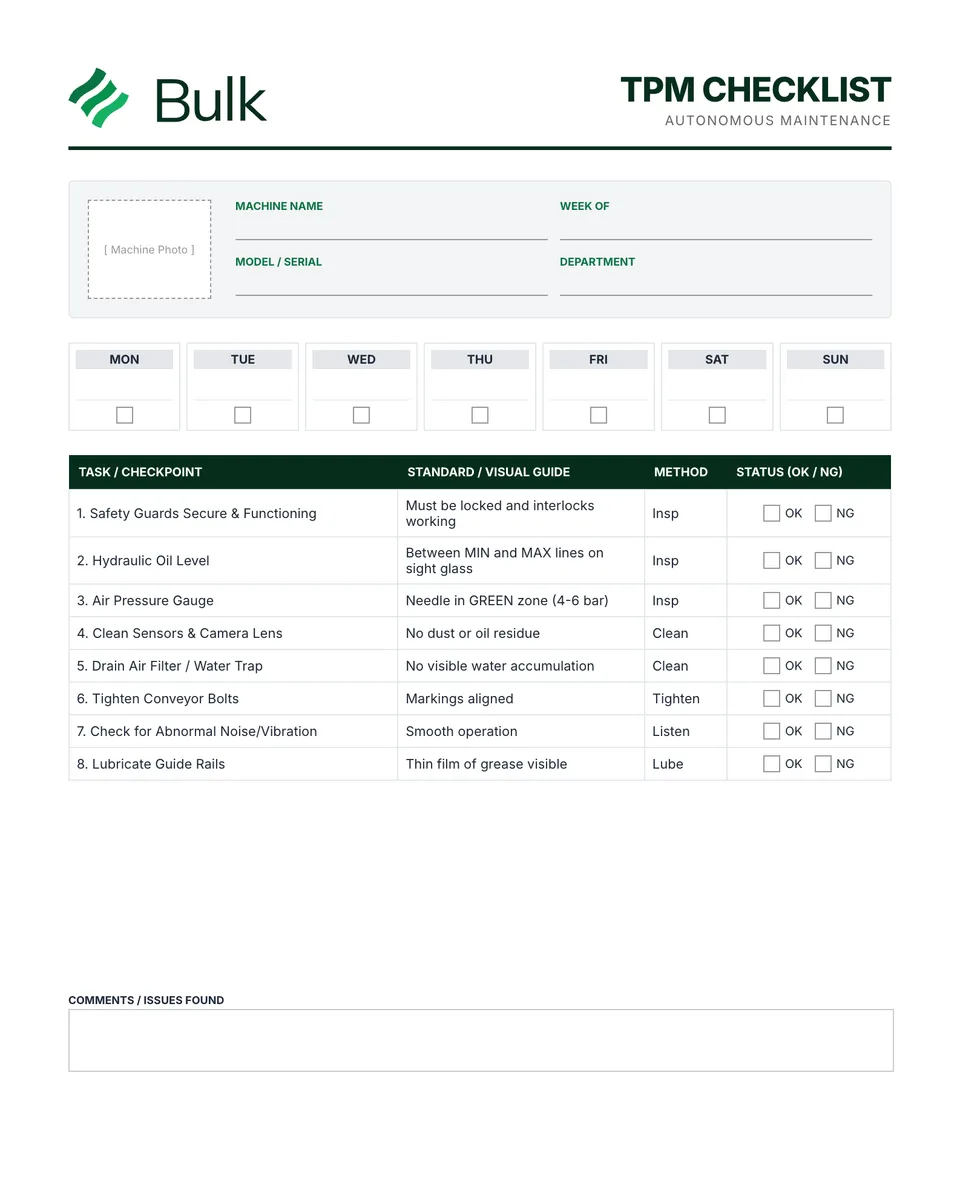 TPM Checklist (Total Productive Maintenance)Match each task and standard to the actual asset and manufacturer's instructions.
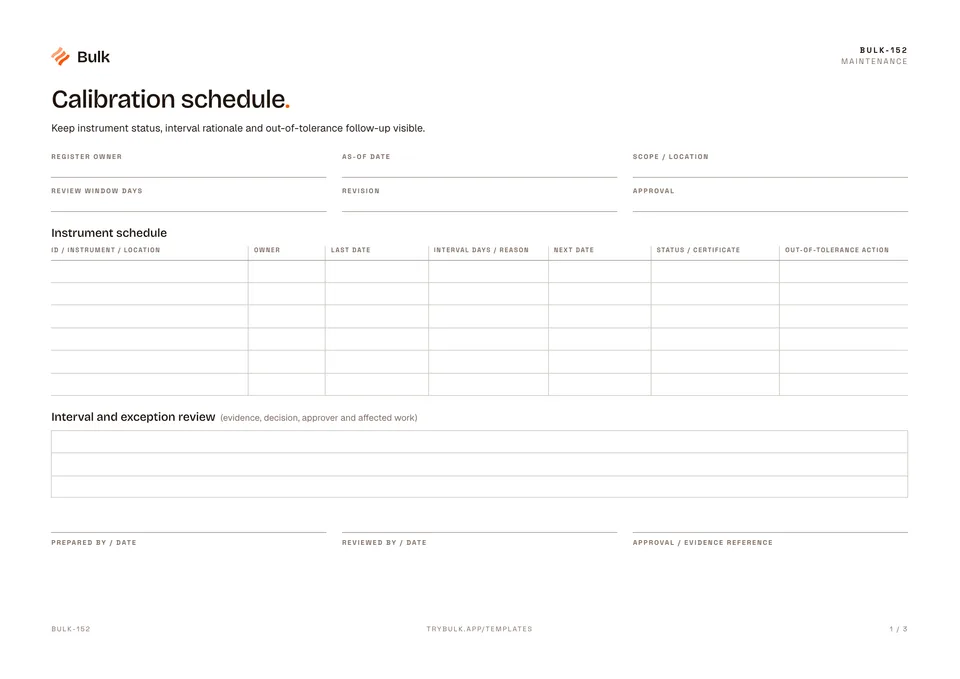 Calibration scheduleKeep instrument status, interval rationale and out-of-tolerance follow-up visible.
Turn the form into a live workflow.
Bulk connects the same checks, evidence, owners and approvals to the work happening on your floor.