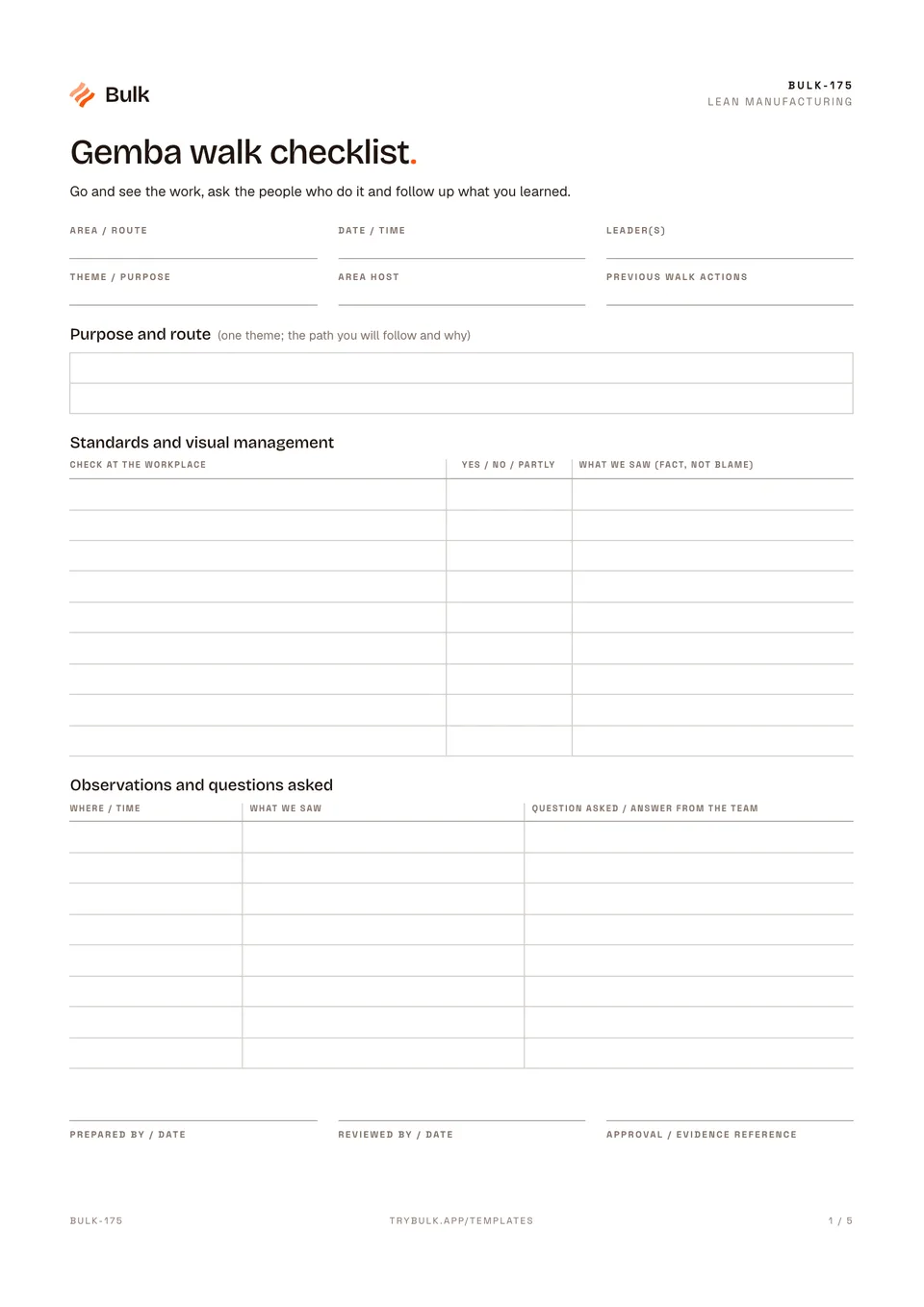
 Gemba walk checklistGo and see the work, ask the people who do it and follow up what you learned.
5S audit checklist
Observe the work area, score only applicable checks and follow each finding to closure.
What it's for
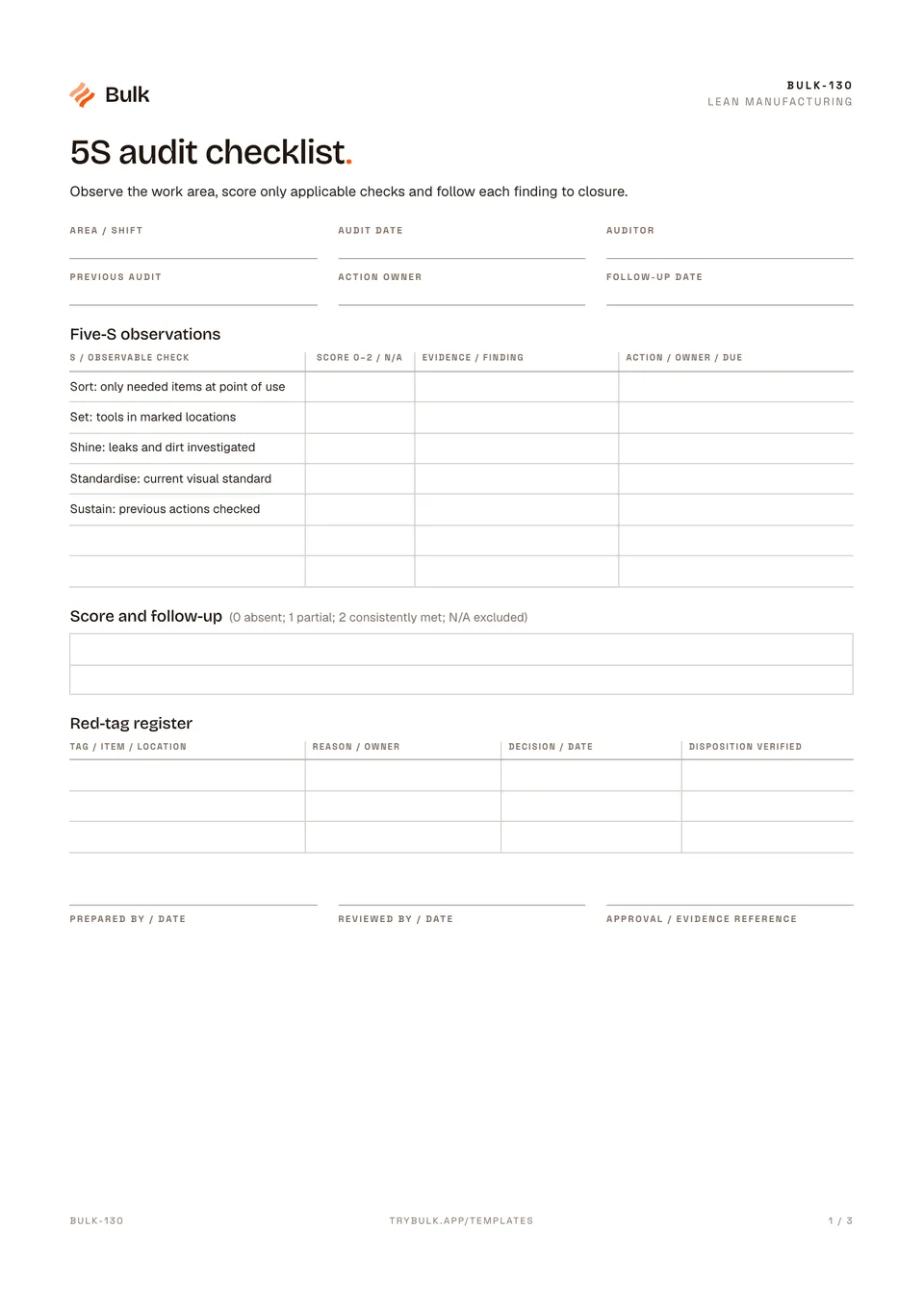
Observe the work area, score only applicable checks and follow each finding to closure. This free 5S audit checklist is a one-page 5S checklist with a simple 0–2 score for each S, evidence and actions beside every score, and a red-tag register for Sort.
What you can download
Available files: PDF. Each PDF includes the blank form first, a fictional completed example and instructions. The download is free; enter your email to receive a secure link valid for seven days. Product-news consent is optional.
The blank 5S audit form is one A4 page. The header records the area and shift, audit date, auditor, previous audit date, action owner and follow-up date. The five-S observations table has one observable check per S (Sort: only needed items at point of use; Set: tools in marked locations; Shine: leaks and dirt investigated; Standardise: current visual standard; Sustain: previous actions checked), each with a score of 0–2 or N/A, the evidence or finding, and an action with owner and due date. A score and follow-up box sits beneath it, then the red-tag register with tag, item and location, reason and owner, decision and date, and verified disposition.
What the 5S mean
- Sort (seiri). Keep only what the work needs at the point of use; red-tag the rest.
- Set in order (seiton). A marked place for everything, close to where it is used.
- Shine (seiso). Clean, and investigate the cause of dirt, leaks and debris rather than just wiping them.
- Standardise (seiketsu). A current visual standard that shows what good looks like.
- Sustain (shitsuke). The habit of keeping the standard, checked by following up previous actions.
What a good 5S checklist includes
- Observable criteria for this area. “Gauges in labelled positions” can be checked; “tidy” cannot.
- A simple, consistent score. Three levels are enough to separate absent, partial and consistently met.
- Evidence for every score. What the auditor actually saw, so the score can be challenged.
- An action, owner and date for anything below 2.
- A red-tag register so questioned items are decided, not just moved.
- A follow-up. Sustain is scored partly on whether last time’s actions were done.
How to run a 5S audit
- Agree the checks for the area with the team who work in it, and write them as observable statements.
- Walk the area at a normal time, not straight after a clean-up.
- Score each check 0, 1 or 2 and note what you saw. Mark a check N/A only when it genuinely does not apply.
- Red-tag items whose need is in question and record each one with a reason and owner.
- Work out the score: points earned divided by twice the number of applicable checks.
- Agree actions with owners and dates, report any hazard immediately through the safety procedure, and check the actions at the next audit.
Completed manufacturing example
Five applicable checks earn 1, 2, 0, 1 and 2 points. The total is 6 out of 10, or 60%. An obsolete jig receives a red tag with an owner and verified removal; an oil leak is escalated immediately.
Exclude N/A checks from the denominator. If no checks apply, report no score. A high total cannot cancel a serious finding, and a 5S improvement audit is different from a workplace safety inspection.
Lee Morris audits cell B on the day shift on 14 September 2026, following up the audit of 31 August. Sort scores 1 for an obsolete jig on the bench, which gets red tag RT-07 and is removed to stores, with the disposition verified, on 16 September. Set scores 2 with every gauge position labelled. Shine scores 0 for oil beneath the press, reported before further use. Standardise scores 1 because the visual standard photo predates a rack move, and Sustain scores 2 with four prior actions verified.
Common 5S audit mistakes
- Scoring an impression. Without evidence, two auditors will give the same area different scores.
- Counting N/A as zero. It drags the score down for checks that do not apply.
- Auditing only before visits. An area cleaned for the audit tells you nothing about Sustain.
- Red tags with no owner. Tagged items end up in a corner rather than being decided.
- Letting a good score hide a hazard. A leak or damaged guard is escalated regardless of the total.
5S audit, gemba walk or layered audit?
A 5S audit looks at the organisation of one area. A gemba walk is a broader visit to where the work happens to observe and ask questions, a waste walk looks specifically for the eight wastes, and a layered process audit checks that key process steps are being followed. Use a one-point lesson to teach a new standard once an audit has set it.
When to use this template
A workplace improvement audit; use the site safety procedure for hazards and urgent defects.
Continue with Gemba walk checklist, Waste Walk Checklist, One-point lesson.
For shared records, evidence and follow-up, explore Bulk audits. Start a free trial to run it live, no card needed.
How to use it
- Agree observable criteria for the area. Record what you saw, not a general impression.
- Divide earned points by two times the number of applicable checks. With no applicable checks, report “not scored”.
- Red tags require an owner and a disposition decision. Verify actions at the next audit.
Key features
- Five-S observations
- Score and follow-up
- Red-tag register
Ideal for
- Team leaders and operators improving a defined work area
Common uses
- Reviewing workplace organisation and following red tags to closure
Questions, answered.
01
What is a 5S audit checklist?
A 5S audit checklist is a short, repeatable review of one work area against observable criteria for Sort, Set in order, Shine, Standardise and Sustain, with a score, evidence and actions for anything that falls short.
02
How do you score a 5S audit?
Score each applicable check 0 (absent), 1 (partial) or 2 (consistently met), exclude N/A checks, and divide the points earned by twice the number of applicable checks. Five applicable checks earning 6 points give 6 out of 10, or 60%.
03
How often should you do a 5S audit?
Often enough to check that the previous actions were completed and to keep the standard alive, commonly weekly or monthly per area. The worked example follows up two weeks after the previous audit.
04
What is a red tag in 5S?
A red tag marks an item whose need or location is in question during Sort. Each tag gets a reason, an owner and a decision (keep, move, return to stores or dispose), and the disposition is verified.
05
Is a 5S audit the same as a safety inspection?
No. A 5S audit reviews workplace organisation. Hazards and urgent defects go through the site safety procedure straight away, and a safety inspection form covers safety conditions properly.
Related templates.
Gemba walk checklistGo and see the work, ask the people who do it and follow up what you learned.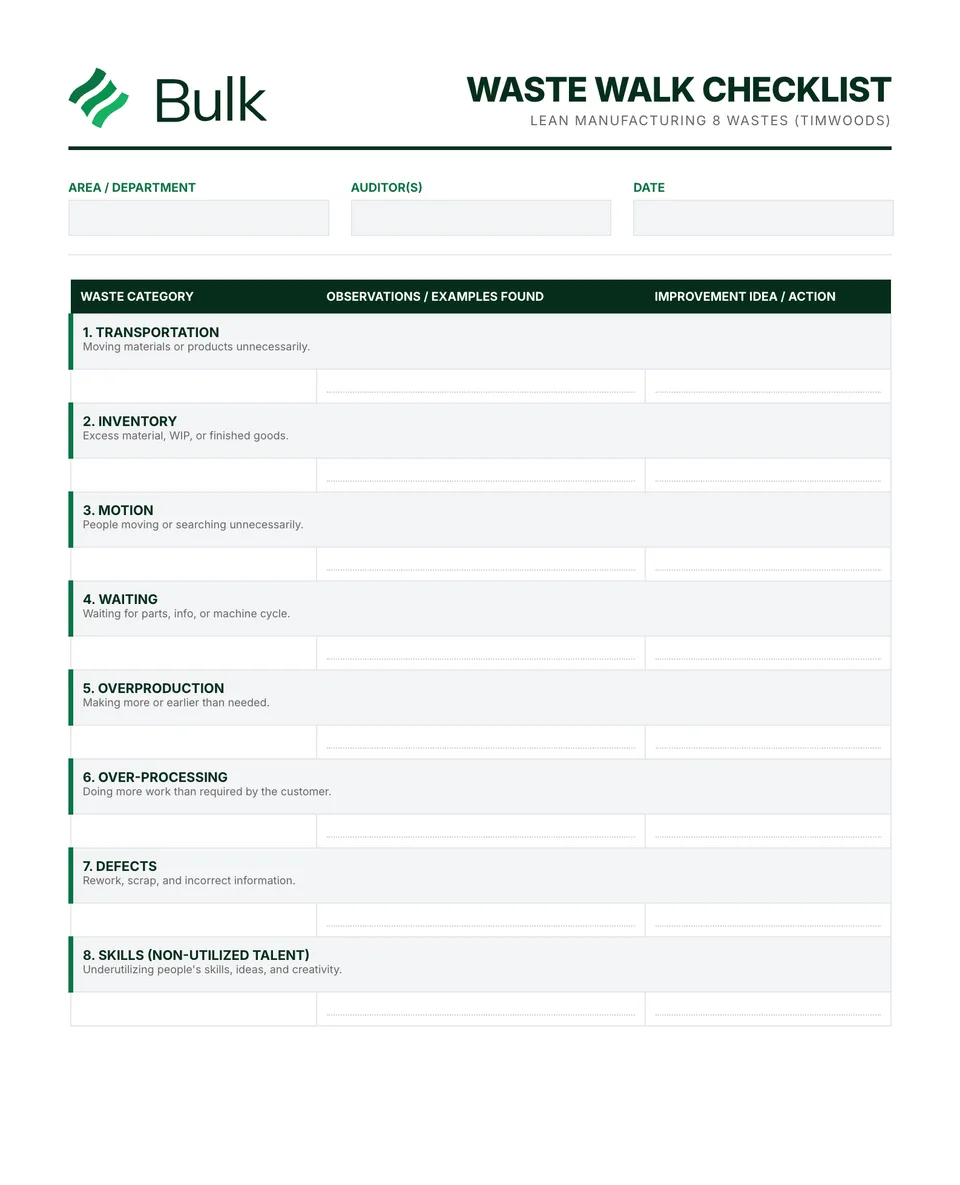 Waste Walk ChecklistAgree the area and observe normal work with the people doing it.
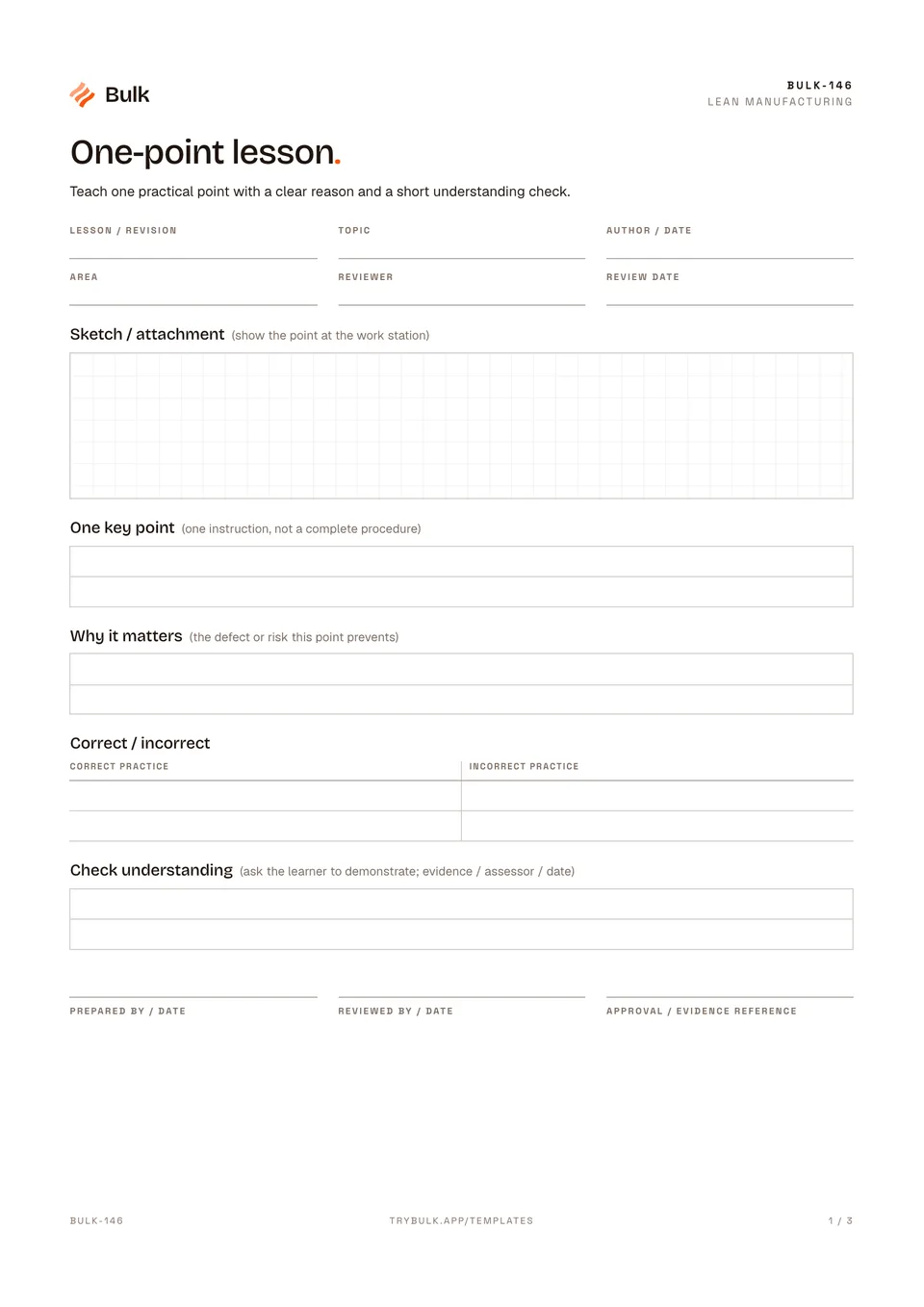 One-point lessonTeach one practical point with a clear reason and a short understanding check.
Turn the form into a live workflow.
Bulk connects the same checks, evidence, owners and approvals to the work happening on your floor.