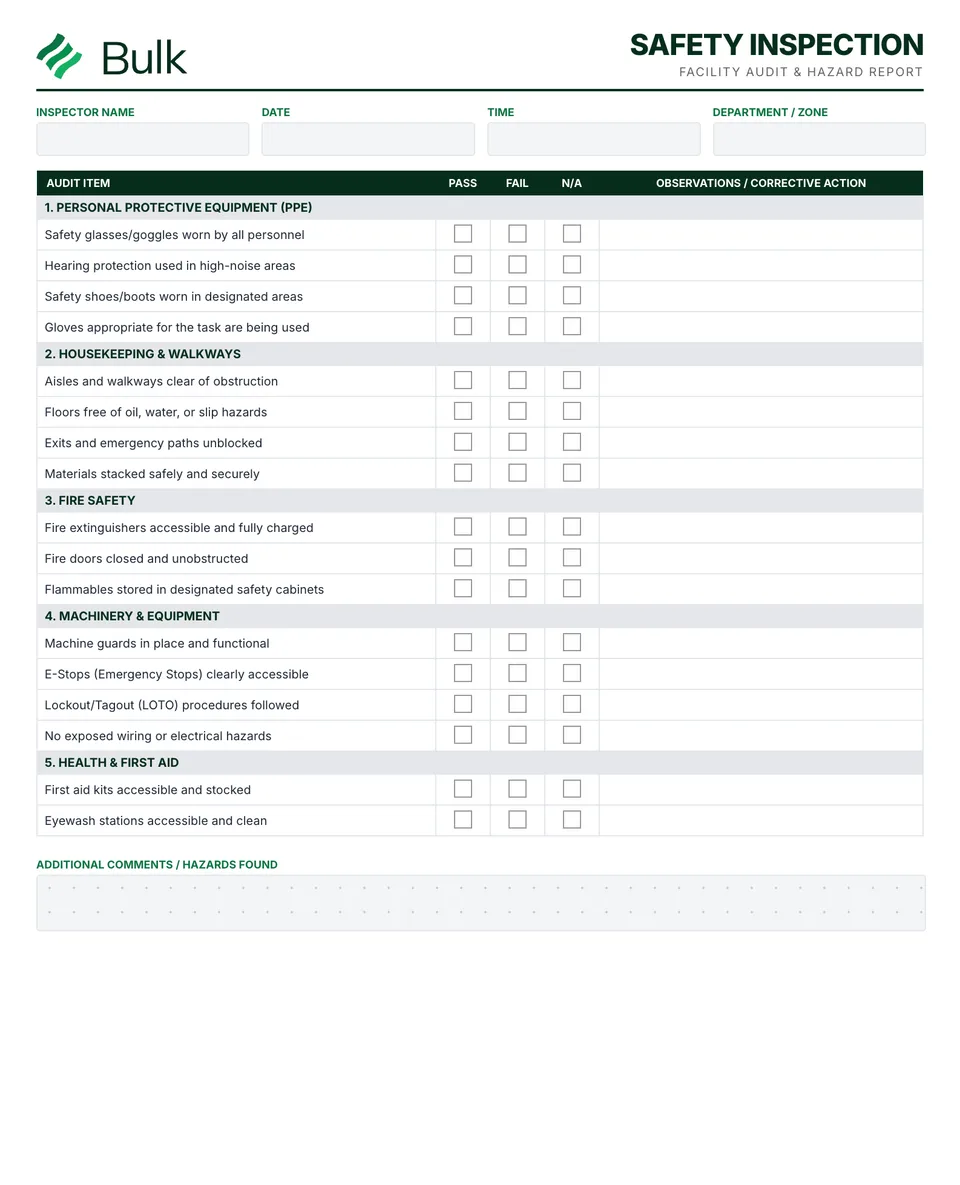
 Safety Inspection FormDefine the area, scope and applicable checks with the responsible people.
Forklift inspection checklist
Check the named truck before use. Report defects and prevent use until authorised release.
What it's for
Check the named truck before use. Report defects and prevent use until authorised release. This free daily forklift inspection checklist records one truck’s pre-use check on one shift, and what happened if it failed.
What you can download
Available files: PDF. Each PDF includes the blank form first, a fictional completed example and instructions. The download is free; enter your email to receive a secure link valid for seven days. Product-news consent is optional.
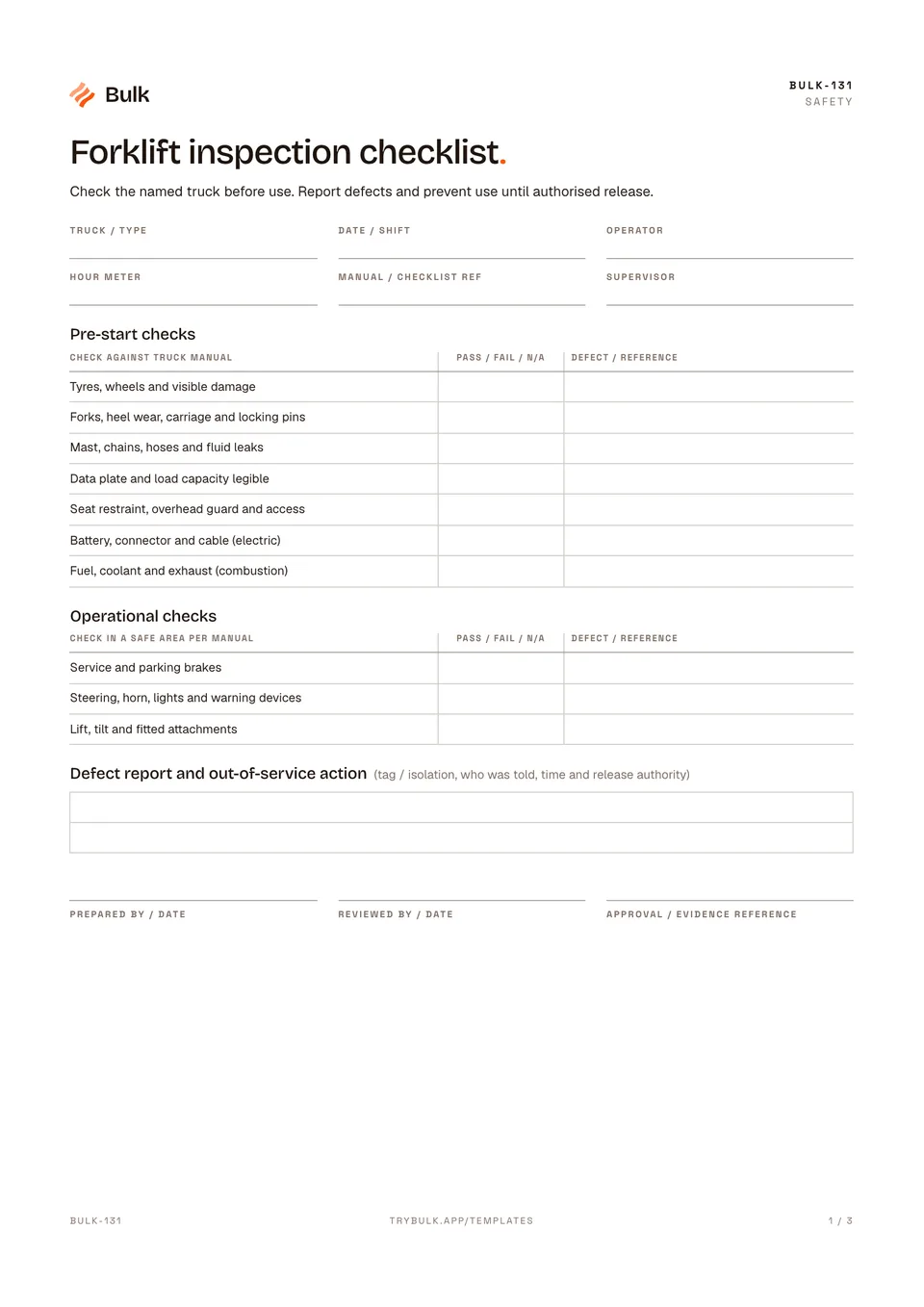
The blank forklift inspection checklist is one A4 page. The header records the truck and type, date and shift, operator, hour meter reading, the manual or checklist reference and the supervisor. Pre-start checks, each marked pass, fail or N/A against the truck manual with a defect reference, cover tyres, wheels and visible damage; forks, heel wear, carriage and locking pins; mast, chains, hoses and fluid leaks; data plate and load capacity; seat restraint, overhead guard and access; battery, connector and cable for electric trucks; and fuel, coolant and exhaust for combustion trucks. Operational checks in a safe area cover service and parking brakes; steering, horn, lights and warning devices; and lift, tilt and fitted attachments. A defect report box records the tag or isolation, who was told, when, and the release authority.
The daily pre-use check
The pre-use check is a short inspection by the operator before the truck goes into service: first with the truck parked and the power off, then with it running in a safe area. OSHA’s powered industrial truck standard requires trucks to be examined before being placed in service, at least daily, and after each shift where they are used around the clock, and not to be used if the examination finds a condition that affects safety. Other jurisdictions have their own rules. The daily check does not replace planned servicing or the periodic thorough examinations carried out by a competent person.
What a good forklift inspection checklist includes
- The specific truck. Truck number, type and hour meter, so the record belongs to one machine.
- The manufacturer’s checks. Items and limits from that truck’s manual, including any attachments.
- Visual before operational. Nothing is driven until the parked checks are done.
- Three honest results. Pass, fail, and N/A with a reason; untested is recorded as untested.
- A defect route. Who was told, the tag or isolation used, and who can release the truck.
How to complete the checklist
- Record the truck, date, shift, operator and hour meter reading.
- With the truck parked and the power off, work through the pre-start checks and mark each item.
- If every pre-start check passes, carry out the operational checks in a safe area.
- Record any defect with a reference and describe it plainly.
- If a defect affects safe use, stop, secure the key, tag the truck out of service and tell the supervisor.
- Keep the completed sheet with the truck’s records so repeat defects are visible.
What to do when a forklift fails
A failed check means the truck does not go into service. Stop the inspection at the point of failure, secure the key or isolate the battery, attach an out-of-service tag with the defect reference and tell the supervisor. Mark any checks you did not reach as not tested, not as passed. The truck returns to service only after a qualified repair and a release by the authorised person named in your site procedure; the operator who found the fault does not release it. If a defect was involved in a collision or near miss, record that on an incident report form.
Completed manufacturing example
A fictional electric truck has hydraulic fluid beneath its mast. The inspector stops after the visual check, records defect D-14 and secures an out-of-service tag. Brakes, steering and lifting checks remain marked not tested.
Not tested is different from pass or N/A. The combustion-engine check is N/A because the example is electric; the operating checks are untested because the truck is held. Only the authorised repair and release process can return it to service.
The truck is FLT-04, an electric counterbalance truck at 2,180 hours, checked on the day shift against its manufacturer’s manual and site checklist FL-04. The other applicable pre-start items pass. The key is secured and tag D-14 attached at 07:05, the supervisor is informed, and qualified maintenance is asked to inspect, with no operator release.
Common forklift inspection mistakes
- One generic checklist for every truck. Electric, combustion and reach trucks, and their attachments, need different checks.
- Ticking pass on anything not tested. An untested brake is not a working brake.
- Driving it “just to move it”. A truck with a safety defect stays where it is until it is released.
- Self-release. The person who found the defect should not be the one who decides it is fixed.
- No hour meter reading. Without it, the check cannot be linked to the service history.
When to use this template
Based on pre-use inspection principles in OSHA powered industrial truck guidance. This is not a universal compliance checklist; a competent site reviewer must approve the truck-specific version.
A template does not replace the manufacturer’s checklist, the operator’s training or authorisation to drive the truck.
Continue with Safety Inspection Form, Incident Report Form, Risk Assessment Form.
For shared records, evidence and follow-up, explore Bulk safety. Start a free trial to run it live, no card needed.
How to use it
- Adapt the checks to the specific truck, attachments and manufacturer instructions. Only a trained authorised operator should inspect or operate it.
- Do visual checks before operational checks. Do not operate a truck with a defect affecting safe use.
- Record and report failures, prevent use under the site procedure and obtain authorised repair verification before return to service.
Key features
- Pre-start checks
- Operational checks
- Defect report and out-of-service action
Ideal for
- Trained operators and maintenance reviewers using an approved truck checklist
Common uses
- Recording a truck-specific pre-use examination and defect escalation
Questions, answered.
01
How often should a forklift be inspected?
Before it is used, at least once a day, and after each shift where trucks run around the clock; that is the pre-use examination described in OSHA's powered industrial truck standard. Planned servicing and periodic thorough examinations by a competent person are separate and follow the manufacturer and your local rules.
02
What is on a daily forklift inspection checklist?
Visual checks with the truck parked (tyres, forks, mast, chains, hoses, leaks, data plate, seat restraint, overhead guard, and battery or fuel system), then operational checks in a safe area (brakes, steering, horn, lights, warning devices, lift, tilt and attachments), and a place to record defects.
03
What should I do if a forklift fails its pre-use inspection?
Stop the inspection, do not use the truck, secure the key, attach an out-of-service tag and report it to your supervisor. Only an authorised person can release it after a qualified repair has been verified.
04
Does this checklist replace the manufacturer's checklist or operator training?
No. Adapt the checks to the truck's manual and attachments, and have a competent site reviewer approve the truck-specific version. Only trained and authorised operators should inspect or drive the truck.
05
Who should do the forklift pre-use inspection?
A trained and authorised operator, normally the person who will use the truck on that shift, with defects escalated to the supervisor and maintenance.
Related templates.
Safety Inspection FormDefine the area, scope and applicable checks with the responsible people.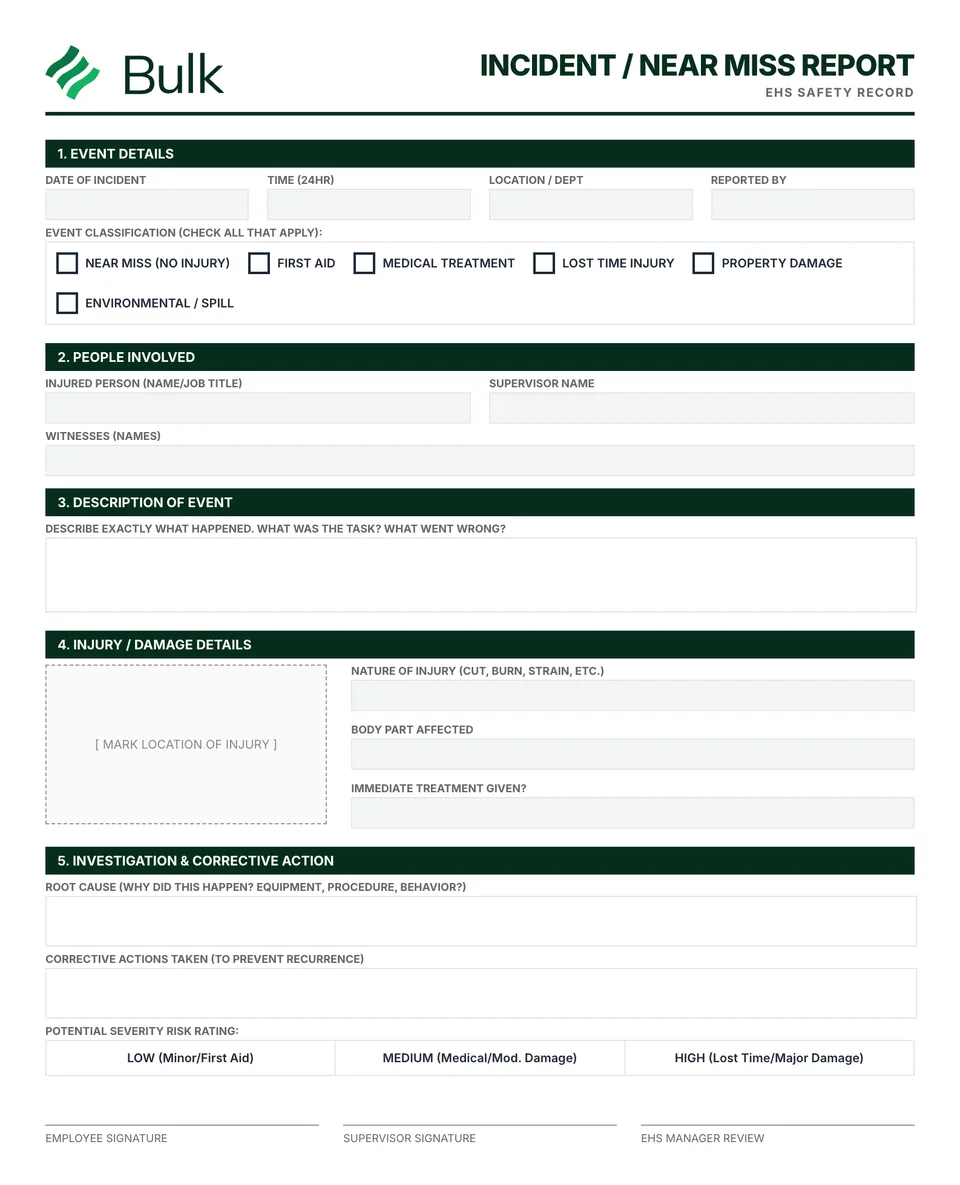 Incident Report FormFollow the emergency response process first.
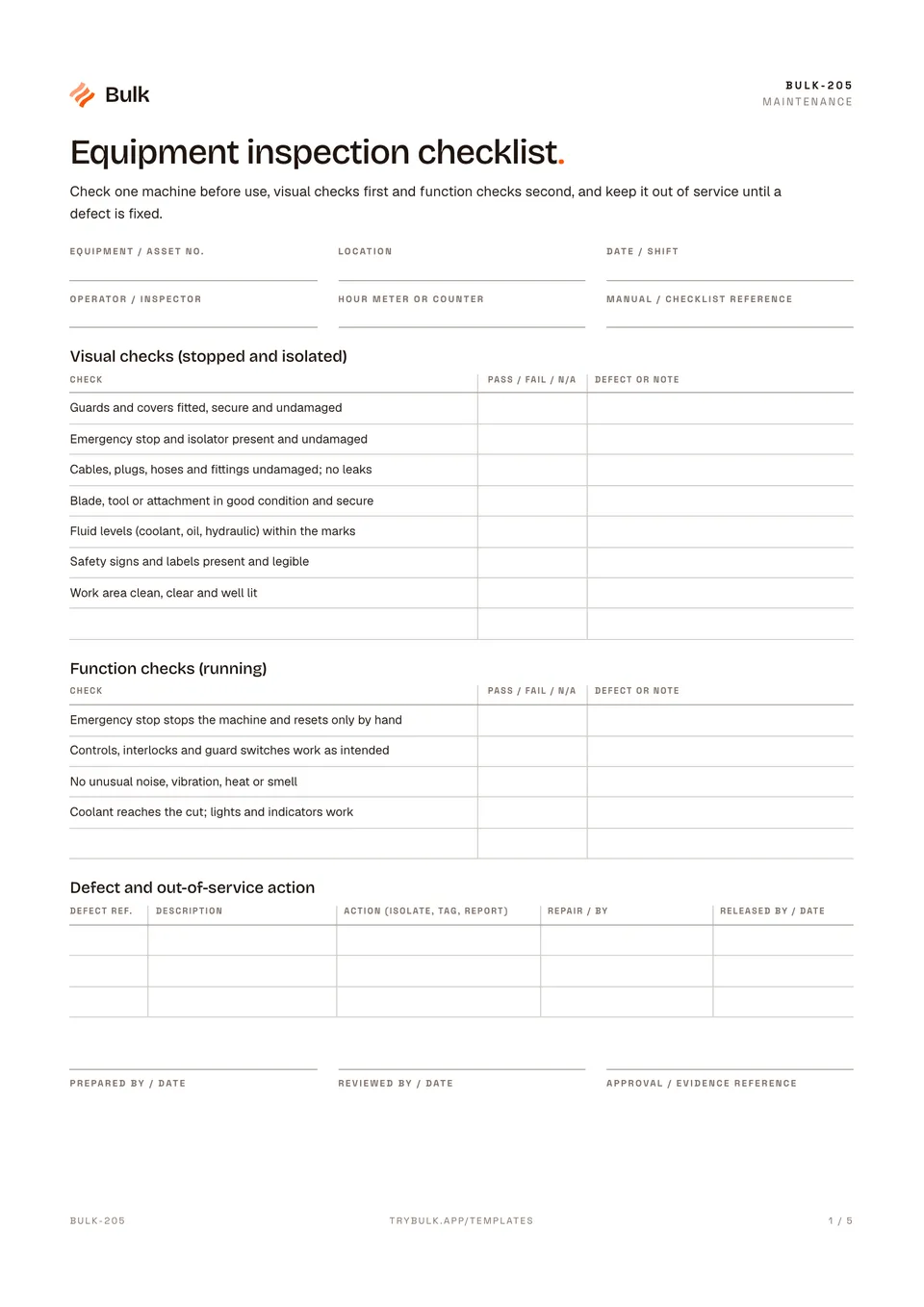 Equipment inspection checklistCheck one machine before use, visual checks first and function checks second, and keep it out of service until a defect is fixed.
Turn the form into a live workflow.
Bulk connects the same checks, evidence, owners and approvals to the work happening on your floor.