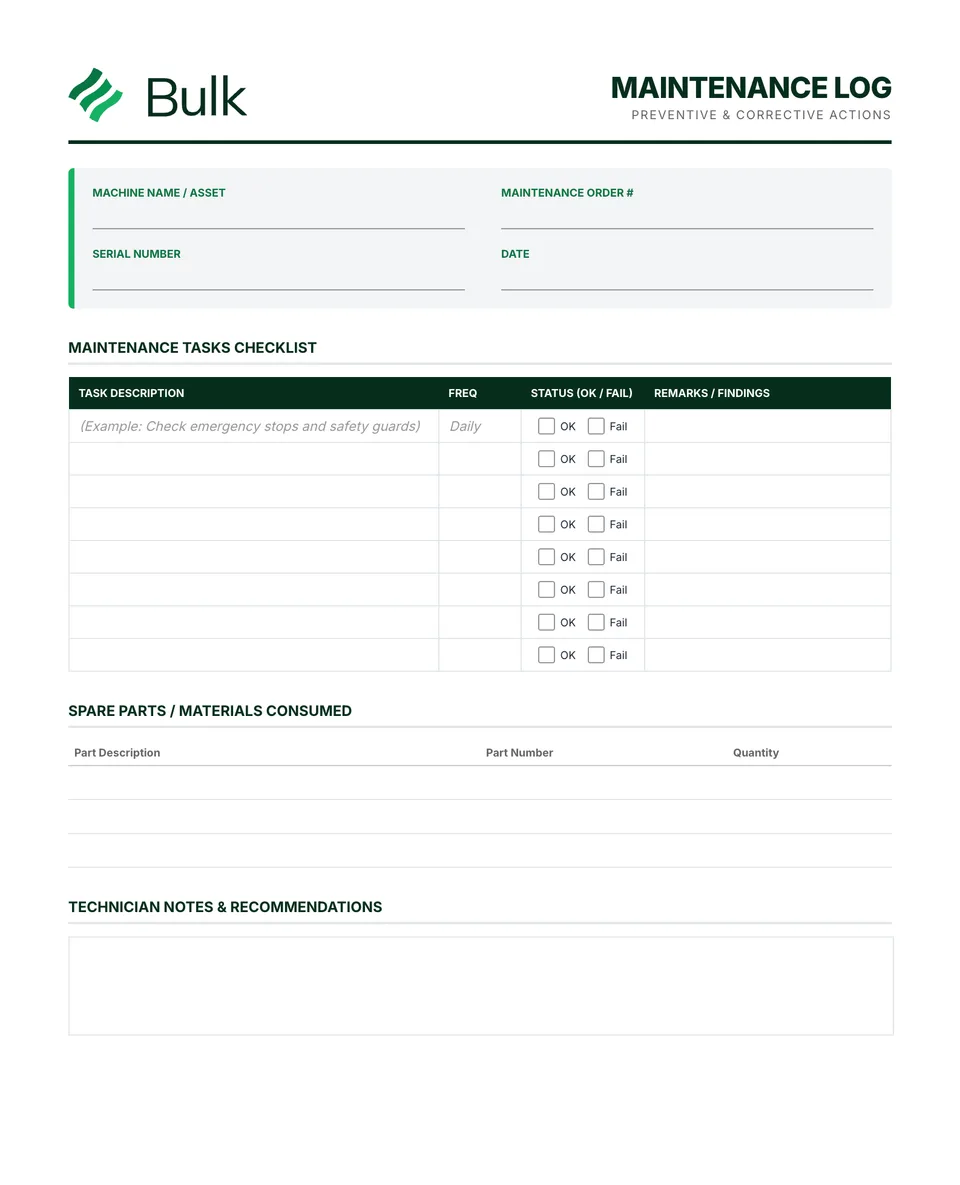
 Equipment Maintenance LogIdentify the asset and work order.
Equipment inspection checklist
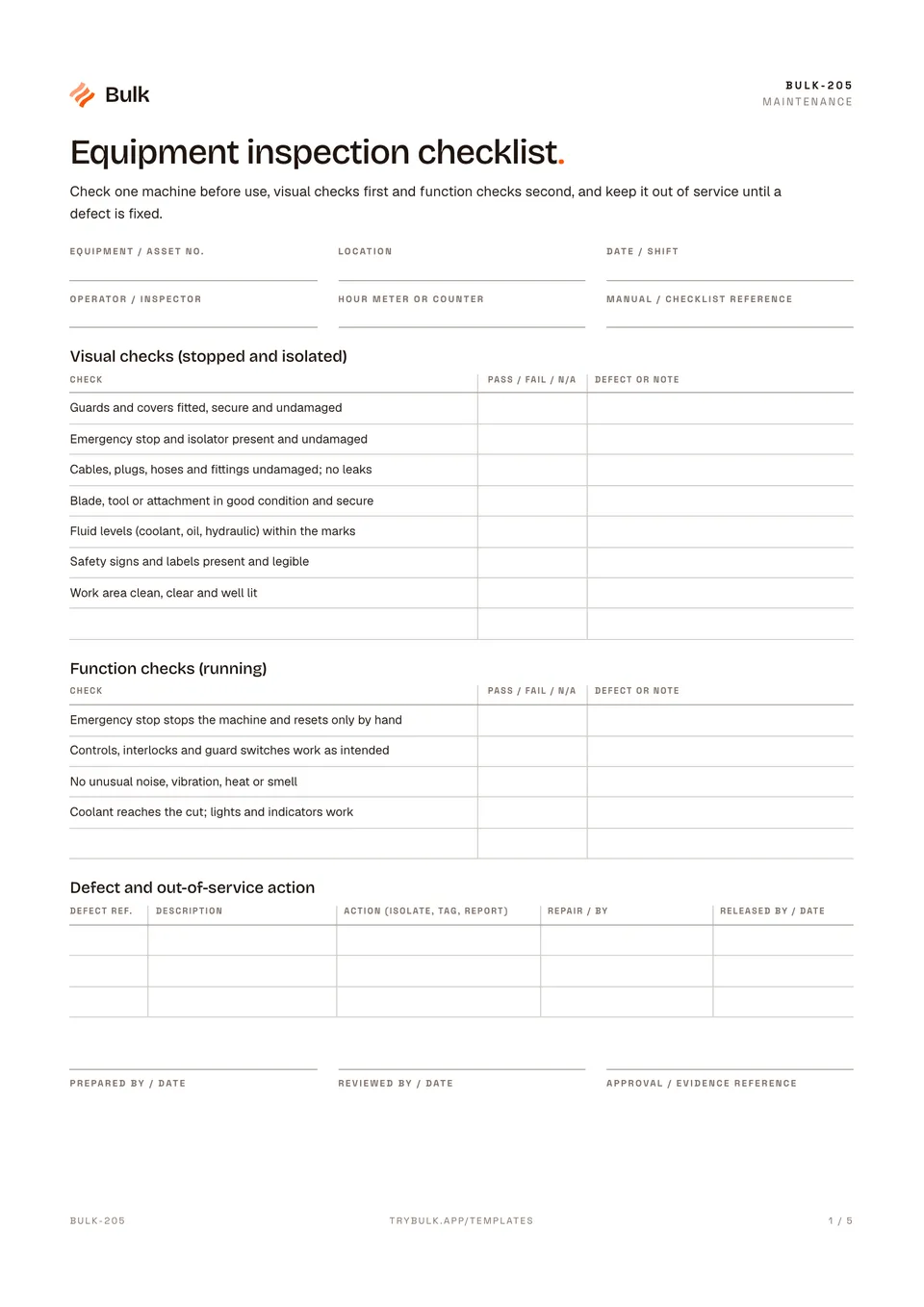
Check one machine before use, visual checks first and function checks second, and keep it out of service until a defect is fixed.
What it's for
Check one machine before use, visual checks first and function checks second, and keep it out of service until a defect is fixed. This free equipment inspection checklist is a generic pre-use form you tailor to any production machine: a saw, press, drill, grinder, compressor or other equipment that has no checklist of its own.
What you can download
Available files: PDF. Each PDF includes the blank form first, a fictional completed example and instructions. The download is free; enter your email to receive a secure link valid for seven days. Product-news consent is optional.
The blank equipment inspection checklist is two A4 pages. The header records the equipment and asset number, location, date and shift, operator or inspector, the hour meter or counter reading and the manual or checklist reference. Page one lists seven visual checks made with the machine stopped and isolated (guards and covers; emergency stop and isolator; cables, plugs, hoses and fittings; blade, tool or attachment; fluid levels; signs and labels; the work area) and four function checks made with it running (emergency stop; controls, interlocks and guard switches; unusual noise, vibration, heat or smell; coolant, lights and indicators). Each has pass, fail or N/A and a note, with blank rows for your own items. A defect table records how the machine was isolated and tagged, the repair, and who released it. Page two is a weekly record of shift checks for the same machine and a box for the checks you have added for it.
What a good equipment inspection checklist does
A pre-use check catches damage and wear that has happened since the last planned maintenance: a guard that no longer locks, a split hose, a stop button that does not latch. The UK Health and Safety Executive’s guidance on inspecting work equipment says inspection should concentrate on the safety-related parts needed for safe operation, that a quick check before use is enough for much equipment, and that checklists should be tailored to the equipment so they do not turn into a tick-box exercise. In the US, OSHA’s general machine guarding rule (29 CFR 1910.212) requires guarding that protects the operator and others near the machine from hazards such as the point of operation, ingoing nip points, rotating parts, and flying chips and sparks, which is why guards come first on this form.
- Tailored to one machine. Generic items to start, plus the checks from the manual and your risk assessment.
- Visual before function. Nothing is run until the stopped checks are done.
- Honest results. Pass, fail, N/A with a reason, and “not tested” for anything not reached.
- A defect route. Isolate, tag, tell the supervisor, repair, and release by an authorised person.
- A history. A week of checks on one sheet shows repeat defects and missed checks.
How to complete the checklist
- Record the machine, location, date and shift, your name and the hour meter or counter reading.
- Stop and isolate the machine, then work through the visual checks.
- If every visual check passes, run the machine and work through the function checks.
- Record any defect with a reference and describe it plainly.
- If a defect affects safe use, keep the machine isolated, fit an out-of-service tag and tell the supervisor.
- After the repair, the authorised person checks it and records the release.
- Add the shift’s result to the weekly record on page two.
Completed manufacturing example
In the fictional example, an operator checks a horizontal bandsaw at the start of the day shift. Six visual checks pass, with a note that the blade was changed four days earlier. One fails: the upper blade guard will not lock in position. The operator stops there, so the four function checks are recorded as not tested rather than passed.
The saw is isolated, out-of-service tag OOS-58 is fitted and the supervisor is told at 06:20. A maintenance technician replaces the guard’s locking knob, and the supervisor releases the saw at 10:15. The weekly record shows four clean checks earlier in the week, the failed check and the passing check after the repair. The box on page two lists the checks added for this saw: the blade tension indicator and chip brush from the manual, and the vice jaw bolts after an earlier defect.
Common equipment inspection mistakes
- One generic list for every machine. Start from this form, then add what the manual and past defects say matters.
- Running the machine to “see if it’s fine”. A failed visual check means it stays stopped.
- Ticking what was not tested. Untested is not passed.
- Self-release. The person who found the fault should not be the one who decides it is fixed.
When to use this template
Use it for pre-use checks on production machines and plant that have no equipment-specific form. Use the forklift inspection checklist for powered industrial trucks, the ladder inspection checklist for ladders and the safety inspection form for an area walk. This is a generic pre-use record to adapt to one machine. It does not replace the manufacturer’s instructions, statutory thorough examinations or the inspection regime your risk assessment sets.
Continue with the maintenance log to record repairs and the preventive maintenance schedule for planned work.
In Bulk, a pre-use check is an audit template assigned to a machine’s asset type. Set it as Compulsory with production blocking on, and the workstation shows Production blocked until the check is completed and passed; a supervisor can override with a reason, a time limit and a signature. Explore Bulk audits and start a free trial to run it live, no card needed.
How to use it
- Tailor the checks to the machine. Take them from the manufacturer's manual and your risk assessment, and add items that past defects show matter.
- Do the visual checks with the machine stopped and isolated, then the function checks with it running. If a visual check fails, stop; the function checks are not done.
- Mark each check pass, fail or N/A. Write "not tested" for anything you did not reach; never tick it as passed.
- If a defect affects safe use, stop, isolate the machine, tag it out of service and tell the supervisor. Only an authorised person releases it after the repair has been checked.
Key features
- Visual checks with the machine stopped and isolated
- Function checks with the machine running
- Defect and out-of-service action
- Weekly check record for one machine
- Checks added for this machine
Ideal for
- Operators and maintenance technicians checking production machines before use
- Supervisors who decide when a tagged machine goes back into service
Common uses
- Recording a pre-use check on a saw, press, drill, compressor or other machine
- Holding a machine out of service from defect to verified repair
- Keeping a week of shift checks for one machine on one sheet
Questions, answered.
01
What is an equipment inspection checklist?
A list of the checks someone makes on a machine before using it, with the result of each, what was done about any defect and who released the machine. It catches damage and wear between planned maintenance visits.
02
What should be on a pre-use equipment inspection checklist?
Visual checks with the machine stopped and isolated (guards, emergency stop and isolator, cables and hoses, the tool or attachment, fluid levels, signs, the work area), then function checks with it running (emergency stop, controls and interlocks, unusual noise or heat). Add the checks from the manufacturer's manual and your risk assessment.
03
How often should equipment be inspected?
It depends on the equipment and the risk. The UK HSE describes quick checks before use, weekly checks of guards and safety devices, and more extensive examinations every few months or longer, with the frequency set by risk assessment and the manufacturer's recommendations. Some equipment, such as forklifts, has its own rules.
04
Who should carry out the equipment inspection?
Someone with enough knowledge of the equipment to know what to look at, what to look for and what to do if they find a problem. For a pre-use check that is usually the trained operator, with defects escalated to the supervisor and maintenance.
Related templates.
Equipment Maintenance LogIdentify the asset and work order.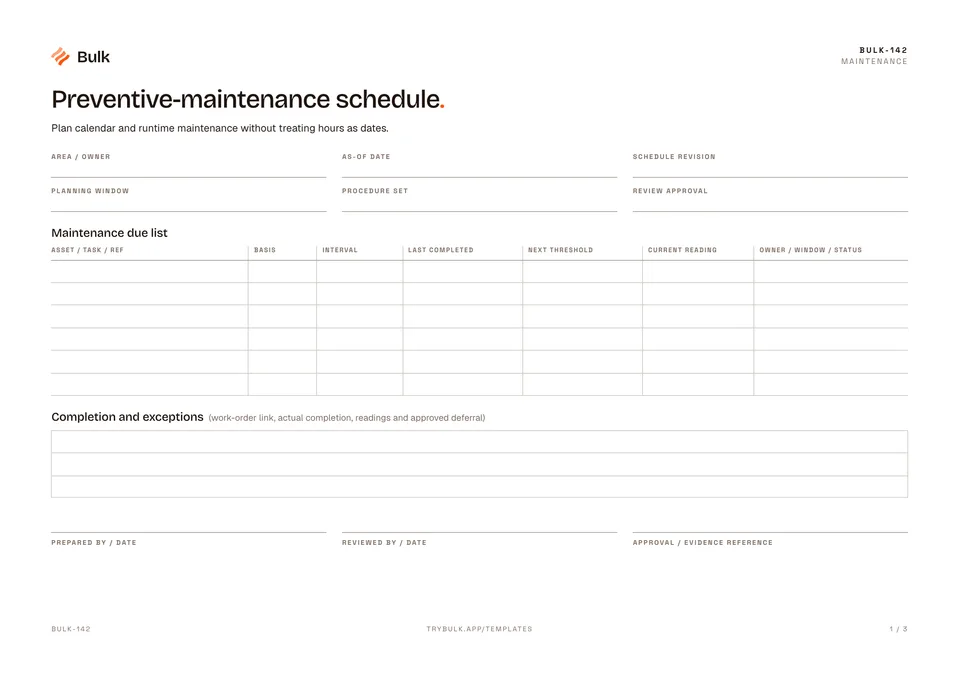 Preventive-maintenance schedulePlan calendar and runtime maintenance without treating hours as dates.
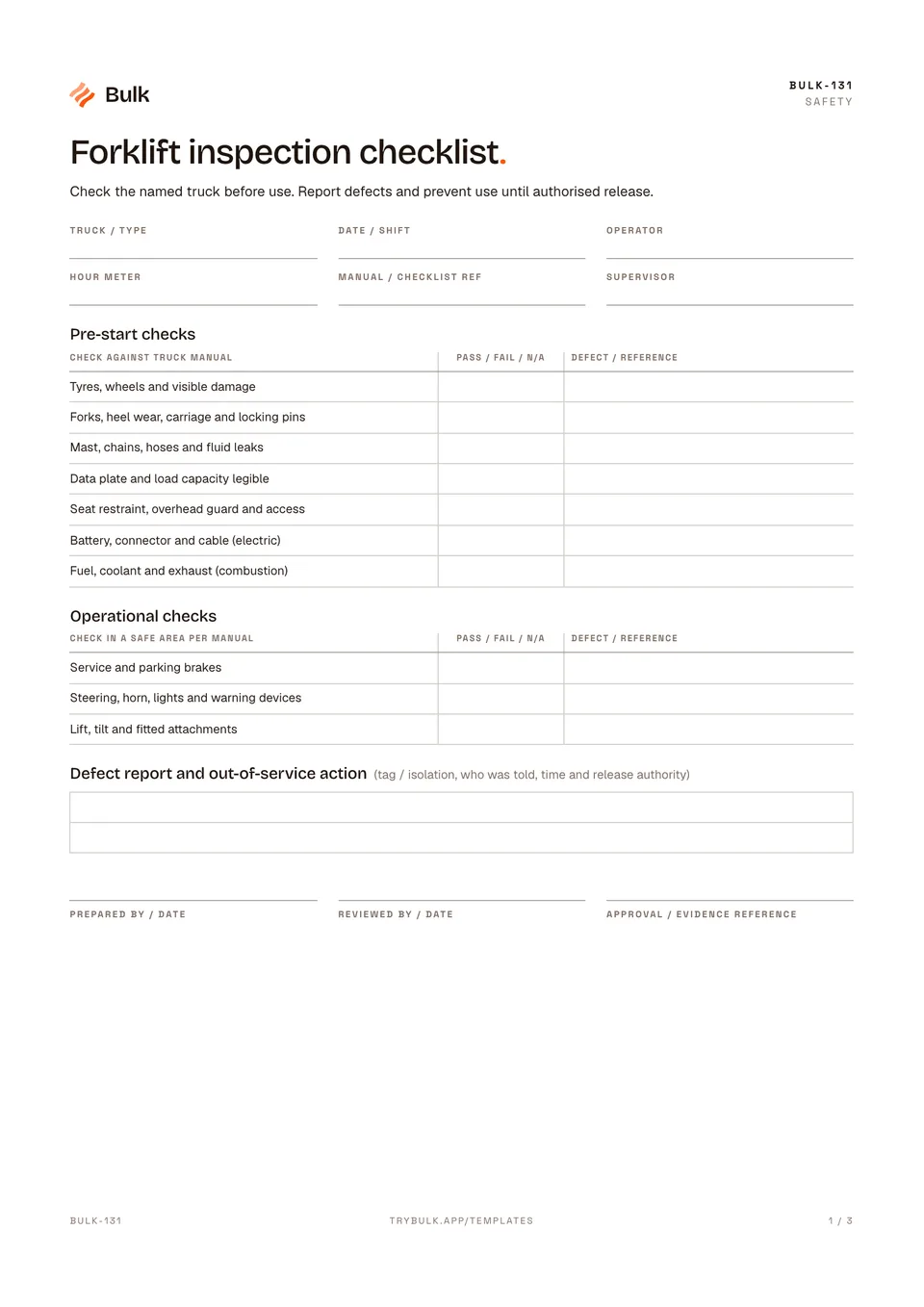 Forklift inspection checklistCheck the named truck before use. Report defects and prevent use until authorised release.
Turn the form into a live workflow.
Bulk connects the same checks, evidence, owners and approvals to the work happening on your floor.