Lockout Tagout Procedures: 6 Steps and What to Write Down
Lockout tagout procedures in six steps: prepare, shut down, isolate, apply locks, control stored energy and verify, plus what each machine procedure records.

Illustration of procedure planning, not an example of an isolated machine.
Lockout tagout procedures tell an authorised employee exactly how to control hazardous energy on the equipment they are about to service. They follow six steps: prepare, shut down, isolate, apply lockout or tagout devices, control stored energy and verify. A written procedure for each machine needs more than a row of tick boxes: which energy sources, which isolation points, which controls and which checks establish that work can begin.
Start with Bulk’s printable LOTO procedure template. The template page offers an email download request. The one-page form provides an equipment header, an energy-source table, photo spaces and short shutdown and restart checklists. Treat it as a starting sheet. Add the machine-specific instructions and programme references described below before issuing it for use.
This guide is for US manufacturing teams preparing documentation under the federal general-industry framework. Have the person responsible for your energy-control programme validate the procedure against the actual equipment, manufacturer information and applicable rules. A blank form or this article cannot authorise servicing work.
What lockout tagout procedures control
Lockout/tagout, often shortened to LOTO, addresses hazardous energy during servicing and maintenance. Electricity is only one source. Pressure, moving parts, heat and stored energy can also injure someone after a machine has stopped. OSHA’s hazardous-energy overview explains the scope and examples.
A stop button tells a machine to stop. An energy-isolating device physically prevents energy transmission or release. Do not list a touchscreen command, emergency stop or selector switch as the isolating device. A tag communicates a warning; it does not provide a lock’s physical restraint. Where the isolating device can be locked, lockout is required unless the employer demonstrates equivalent protection under the standard’s tagout provisions. See 29 CFR 1910.147, definitions and paragraphs (c)(2) and (c)(3).
Keep three documents distinct:
- The energy-control programme sets responsibilities, training, inspection and other site rules.
- The equipment procedure specifies how those rules apply to a particular machine or defined system.
- A job checklist or execution record records what was checked during a particular use.
One document can reference another, but a technician should not need to invent missing isolation instructions at the machine.
An authorised employee performs the servicing and applies energy controls. An affected employee operates the equipment or works in the area affected by its servicing. Their training and responsibilities differ. A job title alone does not establish authorisation.
The 6 lockout tagout steps
OSHA’s lockout/tagout guide describes preparation, shutdown, isolation, device application, stored-energy control and verification. Use that sequence to organise machine-specific instructions:
- Prepare and notify. Identify the energy, hazards and control methods. Notify affected employees before applying energy controls.
- Shut down. Specify the equipment’s orderly stopping procedure.
- Isolate. Identify and operate every required energy-isolating device.
- Apply devices. State how authorised employees secure the isolating devices under the site’s lockout or permitted tagout arrangements.
- Control stored energy. Specify how residual energy is relieved, disconnected, restrained or otherwise made safe. If hazardous energy can reaccumulate, continue verifying isolation until servicing is complete or that possibility no longer exists.
- Verify. Define how the authorised employee confirms isolation and de-energisation before servicing begins.
These headings need actual equipment instructions beneath them. “Isolate all energy” is a reminder, not a description of where to go or what to do.
Identify the actual lockout hardware needed at each point. A padlock alone may not fit a valve or breaker. The employer must provide suitable devices that meet the standard’s durability, standardisation, strength and identification requirements. Keep energy-control locks dedicated to that purpose.
Make verification specific to the hazard
Do not turn “try the start button” into a universal test. A motor that does not start tells you nothing by itself about a suspended load or pressure trapped elsewhere in the system.
The procedure should identify the required verification method, where it is performed, the expected result and any continuing checks. A failed or uncertain result means the equipment is not ready for the planned servicing. Resolve the discrepancy through the site’s authorised process.
For work involving exposed electrical parts, electrical safe-work requirements also apply. OSHA’s 1910.333(b)(2)(iv) requires a qualified person to use test equipment to verify de-energisation and check for induced voltage or backfeed. A start attempt is not a replacement for that electrical verification.
What to write in each machine’s LOTO procedure
Start with the equipment identity and the work covered. “Press maintenance” is too broad if different tasks expose different hazards. Name the asset, location and task boundary, including connected equipment that may affect the work.
Use the following as a document-development checklist. It is not a procedure for operating any machine.
| Part of the procedure | Detail to capture |
|---|---|
| Identity and scope | Equipment ID, location, work covered and excluded tasks |
| Document control | Procedure number, revision, approval and links to applicable site rules |
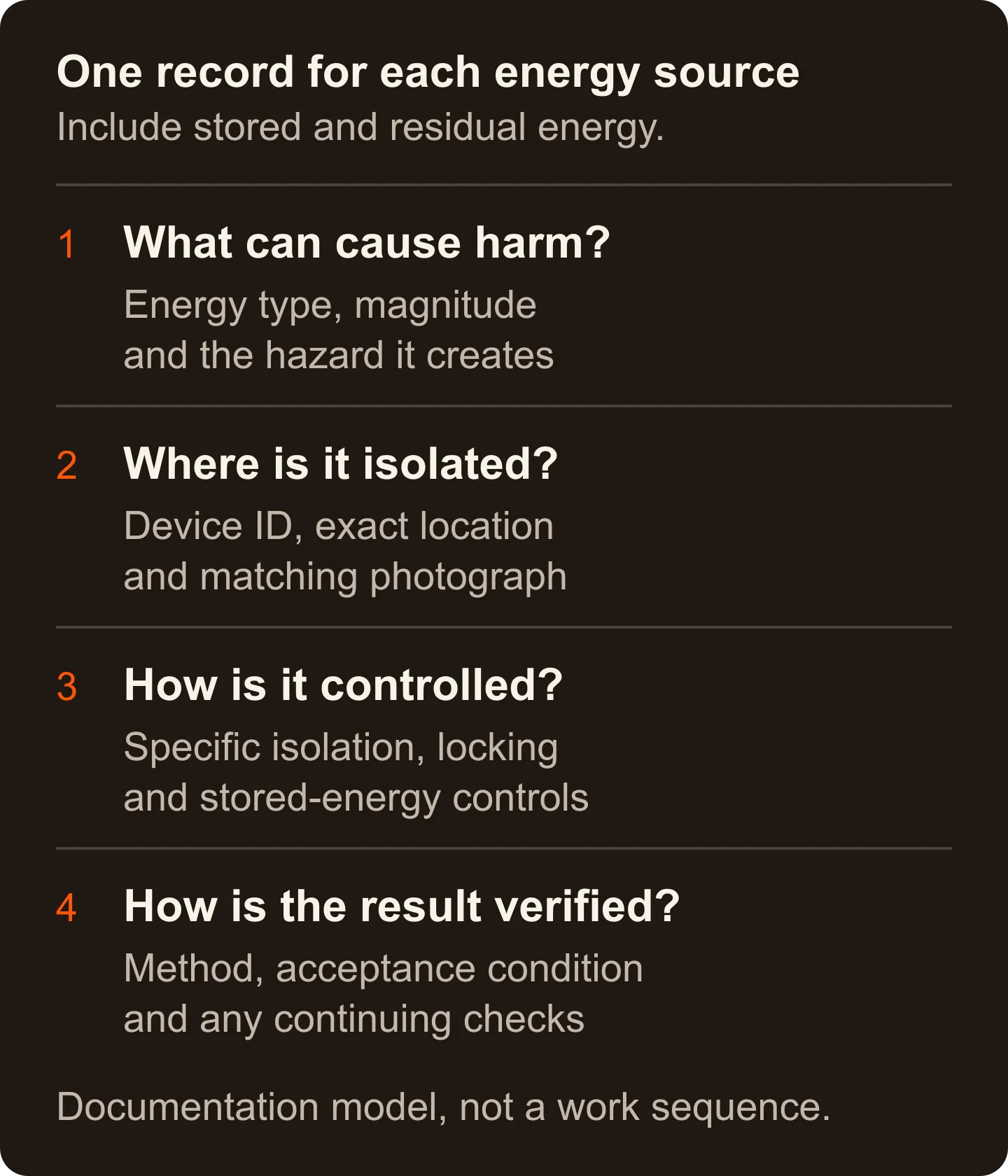
| Energy inventory | Each source, its type and magnitude, and stored or residual energy |
| Isolation points | Unique device identifiers, physical locations and clear supporting photographs |
| Control instructions | The ordered shutdown, isolation, locking and stored-energy controls for that equipment |
| Verification | A method and acceptance condition for each relevant hazard, including reaccumulation where possible |
| People and handovers | Responsibilities, notifications and references for group work, contractors and shift changes |
| Return to service | Equipment and personnel checks, device-removal responsibilities and restart notification |
OSHA’s energy-control procedure requirements call for specific scope, responsibilities, control steps and testing requirements. Revision numbers and photographs are practical ways to make those instructions easier to identify and follow; they are not substitutes for the instructions themselves.
Match the photos to the written instructions
Use the same device identifier in the table, photograph and equipment label. Show enough of the surroundings to locate the device. A close-up of an unlabelled handle gives the reader little help when three similar handles stand together.
Keep the text readable without colour. Print a test copy at the size people will use, then ask an authorised employee who did not write it to locate each referenced point. Resolve ambiguous names and outdated photographs before approval.
A worked example: the row that “power off” misses
Consider a hypothetical hydraulic press with an electrical supply, stored hydraulic pressure and an elevated moving assembly. This is an example of planning questions, not a complete hazard inventory or a servicing instruction.
An entry that says “main power off, lock fitted” leaves unanswered questions:
- Where is pressure stored after the electrical supply is isolated?
- What prevents the raised assembly moving under gravity?
- Which method verifies each control before someone enters the danger area?
Record those as separate hazards to resolve with the equipment documentation and competent technical input. Do not copy a bleed-down method, blocking arrangement or test point from another press because the machines look alike.
For each row, the author should be able to point to the specific device or control and explain what evidence confirms its effectiveness. If that explanation depends on “the fitter will know”, the procedure still needs work.
Cover the work that crosses people and shifts
The simple one-person sequence does not cover every maintenance job. The Texas Department of Insurance sample written programme includes broader programme arrangements. Use such examples to identify what your site must address, then check the applicable standard.
Group work: define who coordinates the isolation and how each authorised worker receives personal protection. Group arrangements must provide equivalent protection; under the standard, each authorised employee applies and removes a personal device on the group device, lockbox or comparable mechanism when starting and stopping work.
Shift changes: define an orderly transfer that maintains protection throughout. A handover note alone does not establish continuity of isolation.
Contractors: the on-site and outside employers must exchange their respective energy-control procedures. Resolve differences before the work begins.
Testing that needs power: provide a separate controlled process for clearing equipment and people, removing devices, testing, then de-energising and reapplying controls before servicing continues. Do not hide this inside a general “test machine” checkbox. These situations are addressed in 1910.147(f).
Other permits on the same job: where the work also needs a hot work permit or a confined space entry permit, cross-reference the documents so the permit shows which isolation procedure applies. The permit does not replace the machine’s energy-control steps.
Write the return-to-service instructions too
The procedure should cover checks that the equipment is intact, nonessential items are removed and people are safely positioned. Notify affected employees after devices are removed and before startup. OSHA’s sample procedure includes a restoring-to-service section to help structure this part.
Normally, each employee removes the device they applied. An absent employee’s lock is not something a supervisor can simply remove to meet a schedule. Any exception needs the employer’s documented procedure, training and equivalent protection, including confirmation the employee is absent, reasonable contact efforts and ensuring they know about removal before resuming work. See 1910.147(e)(3).
Keep the approved copy and the training current
Maintain an editable master, issue a clearly identified PDF and replace obsolete copies when instructions change. Check photographs and references after equipment alterations. A QR link can help people find a document, but the link must open the right approved revision where the work takes place.
OSHA requires periodic inspection of the energy-control procedure at least annually by an authorised employee other than those using the procedure being inspected. This includes reviewing responsibilities and correcting deficiencies, not just changing the date on a PDF. The employer must certify the inspection. Training must also be kept current, with retraining for relevant changes or identified deficiencies. OSHA’s lockout/tagout guide explains these programme duties.
Keep training records alongside the procedure register. Bulk’s Training & Competency page describes programme assignments and completion records. Those records support administration; a completion status does not prove that a particular machine is isolated or that a person is authorised for the task.
Questions about lockout tagout procedures
Is there one OSHA-approved LOTO template?
OSHA specifies requirements, rather than requiring Bulk’s form or a particular PDF layout. Its sample procedure appendix is non-mandatory guidance. The narrow exception from documenting a particular machine’s procedure requires all eight conditions in 1910.147(c)(4)(i); it is not an exemption from energy control.
Can I use a lockout tagout procedure template in Excel?
An editable spreadsheet can be the master for the energy-source table. Check that printed pages keep the equipment ID, revision, instructions and photographs together. Bulk’s linked download is a PDF, not an Excel workbook or an interactive fillable form. Use an editor or your own document layout if you need more space or different fields.
Does a pre-task plan replace the LOTO procedure?
Use a pre-task plan or a job hazard analysis to discuss the wider job and its hazards. Link it to the applicable equipment procedure. It still needs that procedure’s specific energy controls and verification requirements. OSHA’s Job Hazard Analysis guide explains task analysis and includes examples.
Does this guide apply in every US workplace?
Its starting point is federal general industry. Other sectors, electrical work and OSHA-approved State Plans can involve different or additional requirements. Check the applicable State Plan and standards before adopting a procedure.
Start with one machine
Open the LOTO procedure template, identify the equipment and list the energy sources. Then have the responsible people check every control and verification instruction against the machine. Add pages where needed. The useful result is a procedure an authorised employee can follow without guessing.