Gemba Walk: Meaning, Steps and Questions to Ask
A gemba walk means going where the work happens to see, ask and learn. How to plan the route, what to look for, questions to ask and how to follow up.
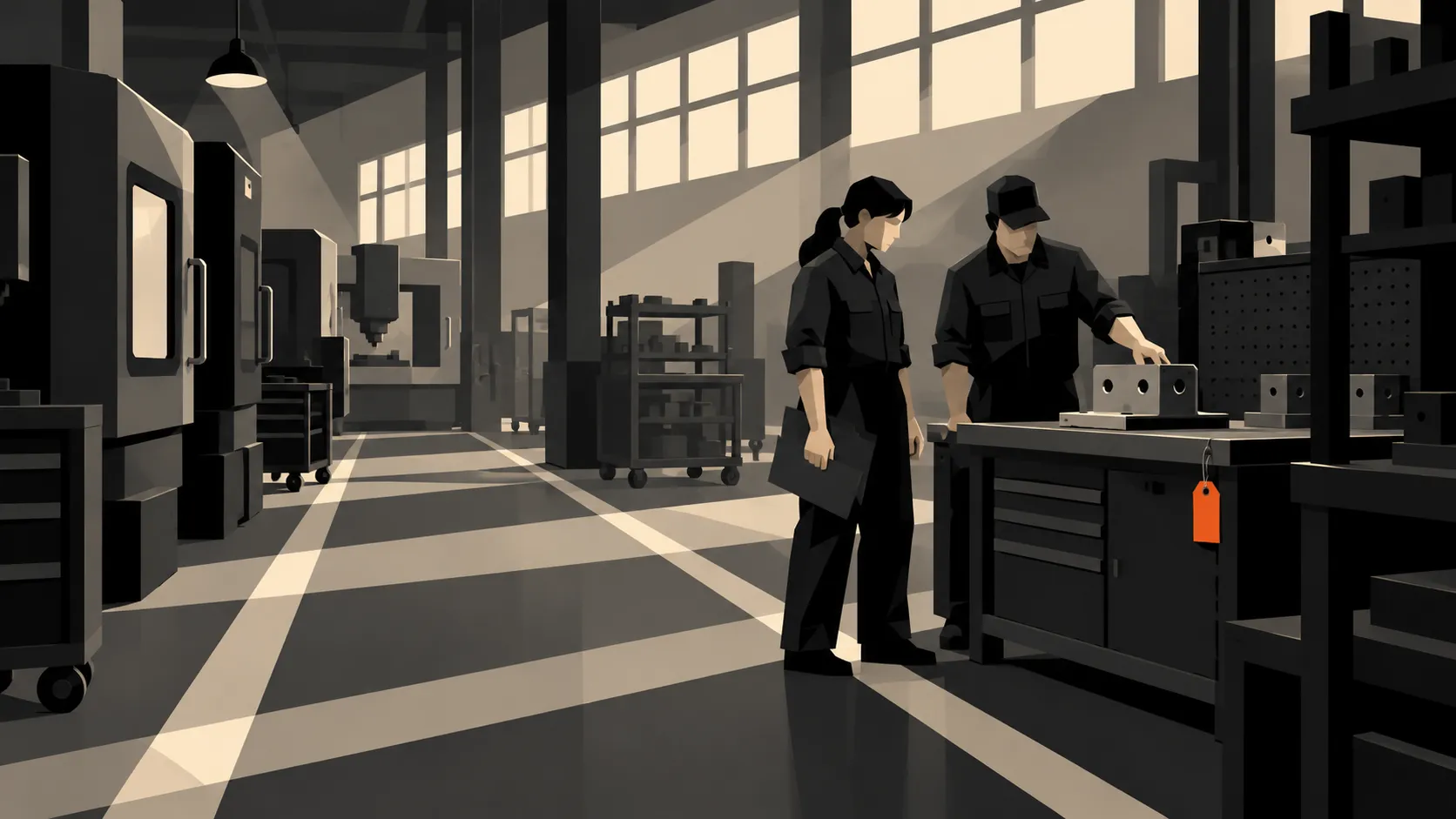
A gemba walk is a leader going to the place where the work is done to see it, ask the people doing it, and learn before deciding anything. Gemba is Japanese for “the actual place”. The Lean Enterprise Institute’s lexicon defines the gemba walk as a management practice for grasping the current situation “through direct observation and inquiry before taking action”.
That last part is what separates a gemba walk from a tour. You go to understand a problem or a process, you write down what you saw and heard, and you follow up. This guide covers the practical side: who walks, how to plan the route, what to look for, the questions to ask and how to make sure the walk changes something. To take a structure with you, print the free gemba walk checklist, which has space for the route, observations, questions, actions and feedback.
What a gemba walk is, and what it is not
The meaning of a gemba walk is easiest to see next to the things it is often confused with.
| Activity | What it is for |
|---|---|
| Gemba walk | Understand how the work really runs, with the people doing it, then follow up |
| Plant tour | Show the operation to a visitor; nothing is meant to change |
| Waste walk | Count and categorise the eight wastes in one area |
| 5S audit | Score workplace organisation against a standard |
| Safety inspection | Find and control hazards under the site’s safety procedure |
A gemba walk can include some of these, but it is not a scored audit or an inspection of people. If you want to tally waste, use a waste walk checklist. If you want to score an area, use the 5S audit checklist. Keep the gemba walk for questions about how the work flows and what gets in the way.
The Lean Enterprise Institute has written about the difference between going to see and going to be seen: a senior visit that no one learns from is a tour, whatever it is called.
Who should walk, and how often
Gemba walks are for anyone who makes decisions about the work without doing it every day: team leaders, supervisors, area and plant managers, and the support functions whose decisions land on the floor, such as planning, quality, maintenance and engineering.
Frequency depends on the level. A common pattern is team leaders walking their own area daily, managers walking weekly and senior leaders walking a value stream less often but on a fixed rhythm. Treat that as a starting point, not a rule. The useful test is whether the walks are frequent enough to keep the follow-up moving. A monthly walk whose actions are forgotten by the next one teaches the team that walks change nothing.
Walk with the area’s own leader where you can. They know the history, they will own most of the actions, and the walk is less likely to feel like an inspection.
How to do a gemba walk in seven steps
1. Choose one purpose
Pick a theme before you go: a late order, a quality complaint, a new process, safety at a changeover, or simply how work flows through one cell. One purpose keeps the walk focused and gives the area a reason for your visit. Write it at the top of the gemba walk checklist.
2. Plan a route that follows the work
Follow the flow of value rather than the layout of the building. Choose an order, a part or a customer request and follow it from where it enters to where it leaves, or walk it backwards from dispatch. Each handoff on the route is a place where work can wait, get lost or be reworked.
3. Tell the area you are coming
Say when you will be there and why. Surprise walks put people on the defensive and show you a performance rather than the normal work. The point is to learn from the people closest to the process.
4. Watch before you ask
Stand where you can see the work and watch several full cycles before saying anything. Notice where people wait, walk, search, or check and recheck. An LEI article on starting gemba walks puts it bluntly: observe and listen first, and ask less rather than more.
5. Ask open questions
Ask the people doing the work what the standard is, how they know whether they are ahead or behind, and what stopped them today. Ask “why” to understand, not to find fault. The questions section below has a list to start from.
6. Record facts, not judgements
Write what you saw and heard in a form someone else could check: times, quantities, places and the words people used. “Two kits waited 40 minutes at the line-side rack for fasteners” is a fact. “Stores are slow” is a conclusion, and it may be wrong.
7. Agree actions and feed back before you leave
Resist fixing problems on the spot unless there is a safety risk. Agree a small number of follow-up actions, each with an owner and a date, and tell the team what you saw and what happens next. Close the previous walk’s actions at the start of the next one.
What to look for on the floor
The purpose sets the focus, but these are the things most walks check along the way.
| Area | What to look at |
|---|---|
| Flow | Work in progress piling up, parts waiting between steps, people waiting for material |
| Standard work | Whether a current standard is posted and whether the work matches it |
| Visual management | Whether boards are up to date and whether anyone uses them to make decisions |
| Quality | Rejects and rework, where checks happen, how a defect is contained |
| Safety | Guarding, walkways, PPE in use, near misses people mention |
| Workplace | Tools and materials in their place, searching and walking to find things |
Compare what you see against the posted standard work for the station. A gap between the standard and the work is not automatically the operator’s fault; often the standard is out of date or cannot be followed with the material and tools available.
Gemba walk questions to ask
Good questions are open, specific to the work in front of you and asked of the people doing it. The LEI’s guidance on how to go to the gemba frames the walk around purpose, process and people, which gives a useful way to group them.
Purpose
- What is this process for, and who receives its output?
- What does a good day look like here?
- How do you know what the customer needs today?
Process
- What is the standard for this job, and where is it written down?
- How do you know whether you are ahead or behind right now?
- What stopped or slowed you today?
- What happens when a part, tool or instruction is missing?
- Where does work wait, and for what?
- How do you find out about a defect, and what do you do next?
People
- What would make this job easier or safer?
- What problem have you raised that has not been solved yet?
- What do you need from me, or from the teams upstream?
Write down the answers in the person’s words. Avoid leading questions (“Isn’t it the stores team that’s slow?”) and avoid questions that test people (“Why aren’t you following the standard?”). The aim is to understand the system that produced the problem.
What to record on a gemba walk
A gemba walk record does not need to be long, but it should let someone who was not there understand what was seen and what was agreed.
- Purpose and route: the theme, the area, and the order or part you followed.
- Observations: facts with times, quantities and places.
- Questions and answers: what you asked and what the team said.
- Actions: what will be done, by whom and by when.
- Feedback: what you told the team before leaving.
- Reflection: what you would look at next time.
The gemba walk checklist has a section for each, with a fictional completed example of a walk that follows a kitted order from stores to the assembly line.
A short example
An area manager wants to understand why a machining cell keeps missing its daily plan. She picks one late order and follows it backwards from dispatch.
At the cell she watches for twenty minutes. The operator stops twice to look for a gauge, and a pallet of finished parts sits beside the last machine waiting for a forklift. She asks how the operator knows the plan for the day; the answer is a printed list from the previous evening, already out of date. She records the three observations as facts, agrees two actions with the cell leader (a fixed home for the gauge, and a check of when the forklift route passes the cell) and books a return walk for the following week to look at the plan itself.
Nothing in that walk required a meeting room, and the actions are small enough to finish before the next one.
Following up: where gemba walks usually fail
Most gemba walks fail after the walk, not during it. The common reasons:
- Too many actions. A walk that ends with fifteen actions finishes none of them. Agree two or three.
- No owner or date. “Look into the forklift route” is not an action until someone owns it and a date is set.
- No return. If the next walk does not start by checking the last walk’s actions, the team learns that nothing changes.
- Fixing instead of learning. Solving a problem on the spot feels productive but skips the cause. Larger problems belong in a planned improvement, such as a kaizen event with the people who do the work.
Visible follow-up matters as much as the walk itself. Bring the actions to the team’s daily meeting, where the people who own them can report progress.
Running gemba walks in Bulk
Paper works for a first walk, and the gemba walk checklist is free. When the walks become a routine across areas, the follow-up is usually what gets lost.
In Bulk audits, a gemba walk can run as a Custom audit: a versioned checklist scheduled daily, weekly or monthly against an area, which appears in the Audits inbox of the people who cover that area. Walkers can add comments, photos and signatures as they go, and a failed item can raise a follow-up task.
At the daily stand-up, Bulk Teamboards keep those follow-ups in front of the team. Actions added from a Task Table on a board column become tasks with a due date, priority and assignees, and the table can show the overdue ones, so the next walk can start by checking what was closed.
Start with one area, one purpose and the checklist, and keep the walks going long enough to see the actions come back closed.